

When Venus Met Jupiter: A Morning Sky to Remember
At sunrise on 12th August 2025, millions of people across the globe witnessed something unusual and awe-inspiring. The two brightest objects in the evening sky, Jupiter and Venus, were near enough...

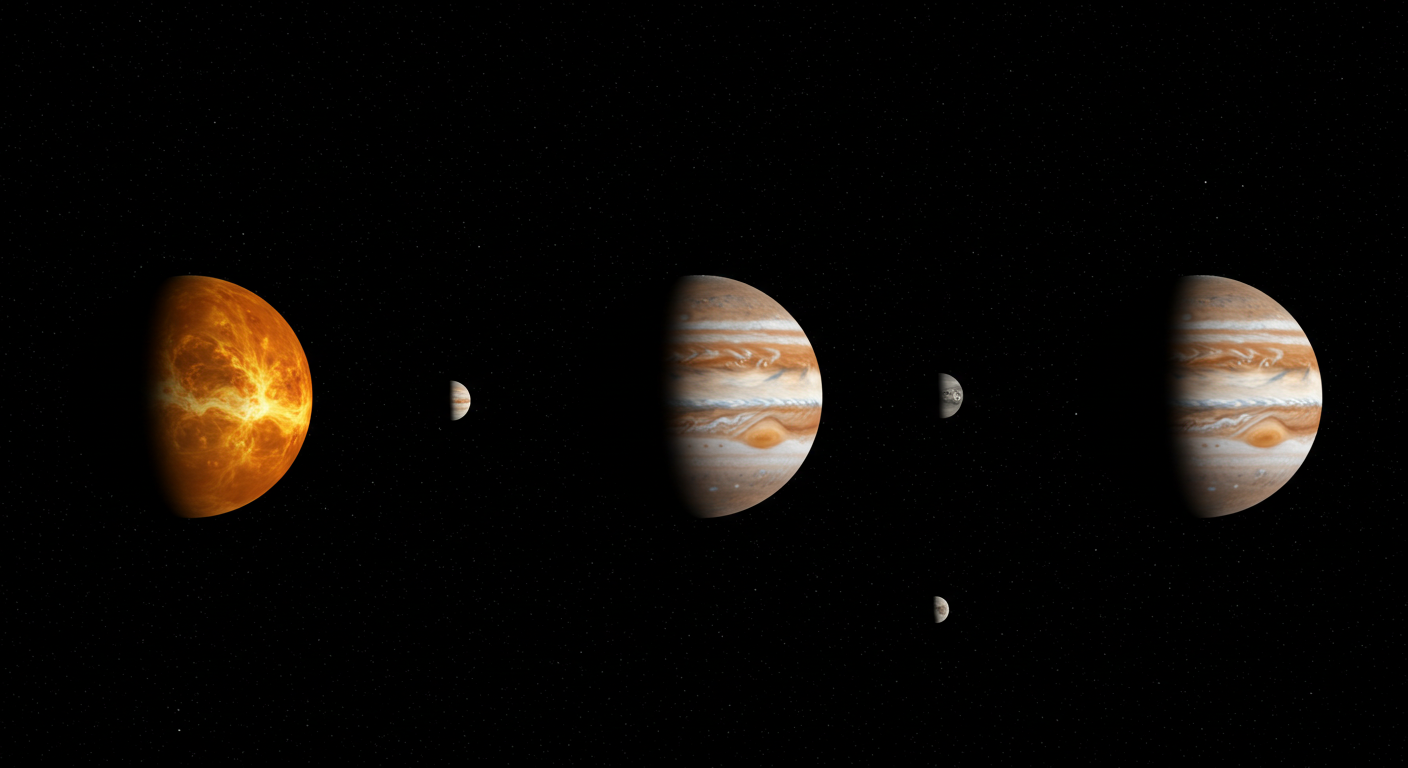
At sunrise on 12th August 2025, millions of people across the globe witnessed something unusual and awe-inspiring. The two brightest objects in the evening sky, Jupiter and Venus, were near enough together that they resembled a couple of bright stars. They were less than one degree apart narrower than the full Moon is wide. Shortly before dawn, they shone brightly in the east and were even visible in bright cities with much light. “For a few minutes, the sky was a meeting place for beauty and science,” one person recalled. Venus was the brighter of the two, glowing with a white light so intense that it seemed almost knife-edged against the blackness of the sky. Next to it, Jupiter glowed with a softer golden light. Astronomers said Venus was magnitude –4.0 and Jupiter –1.9. Even without knowing the figures, then, you could distinguish them. With binoculars, you could see Jupiter’s four largest moons and the curved outline of Venus, its gibbous phase. It was a sight that caused even the most casual of sky-gazers to doff his hat.
This wasn’t chance, this was choreographed cosmic dance. A conjunction is when two planets appear to be close to each other in our sky, but are really much farther apart in space. Venus and Jupiter will always have conjunctions every year or two, but this time it’s a close run that isn’t true to form. Because this time, they were lined up exactly, so they appeared to be together – just before dawn. The best time to have seen them was 30 to 45 min before sunrise when the sky was dark, the planets were high in the sky, and you could see them both. And to top it all off, timing coincided with the height of the Perseid meteor shower. As the planets glowed low on the east, brilliant meteors blazed across the upper horizon, leaving streaks of light for a second or two. Some managed to catch both in the same photo. “It was like the universe decided to put on a show,” a photographer said in retrospect.
Astronomers had been predicting the conjunction months in advance. NASA and many observatories published guides to where to observe the planets safely before dawn. The predictions were down to the minute. That precision came from centuries of study and the laws of planetary motion, rules that do not change. Science informed them exactly where and when to look but did not take away from the wonder of seeing it for themselves. People have looked up at the sky for millennia and imbued rare planetary alignments with significance. Some have seen them as signs of peace, some as warnings or blessings. We do not see them as omens now, but they still possess a magic. Wherever you were that morning, you could look up and see the same two bright lights. “In a world divided, the sky reminded us we are all under one roof,” a star-gazer wrote.
The phenomenon generated enormous interest on the Web. Social networks hummed with photos, videos, and enthusiasm. Astronomy clubs experienced increased membership in their events, and sales of telescopes increased. Teachers even employed the phenomenon in the classroom, demonstrating to pupils the ability of science to foretell such loveliness. For a few, it was the first time they ever really paid attention to the midnight, and dawn sky. Now, it’s all too easy to let such moments pass. But to glimpse Venus and Jupiter in a line was to be reminded to stop and look up. Nothing on the television or phone screen could rival it. The planets have long since passed on, one following its own orbit around the Sun. But for those who did get the glimpse, that morning is one they will be in no hurry to forget. “Sometimes,” a viewer said, “the best things are right over your head you just have to look.”.
Author