

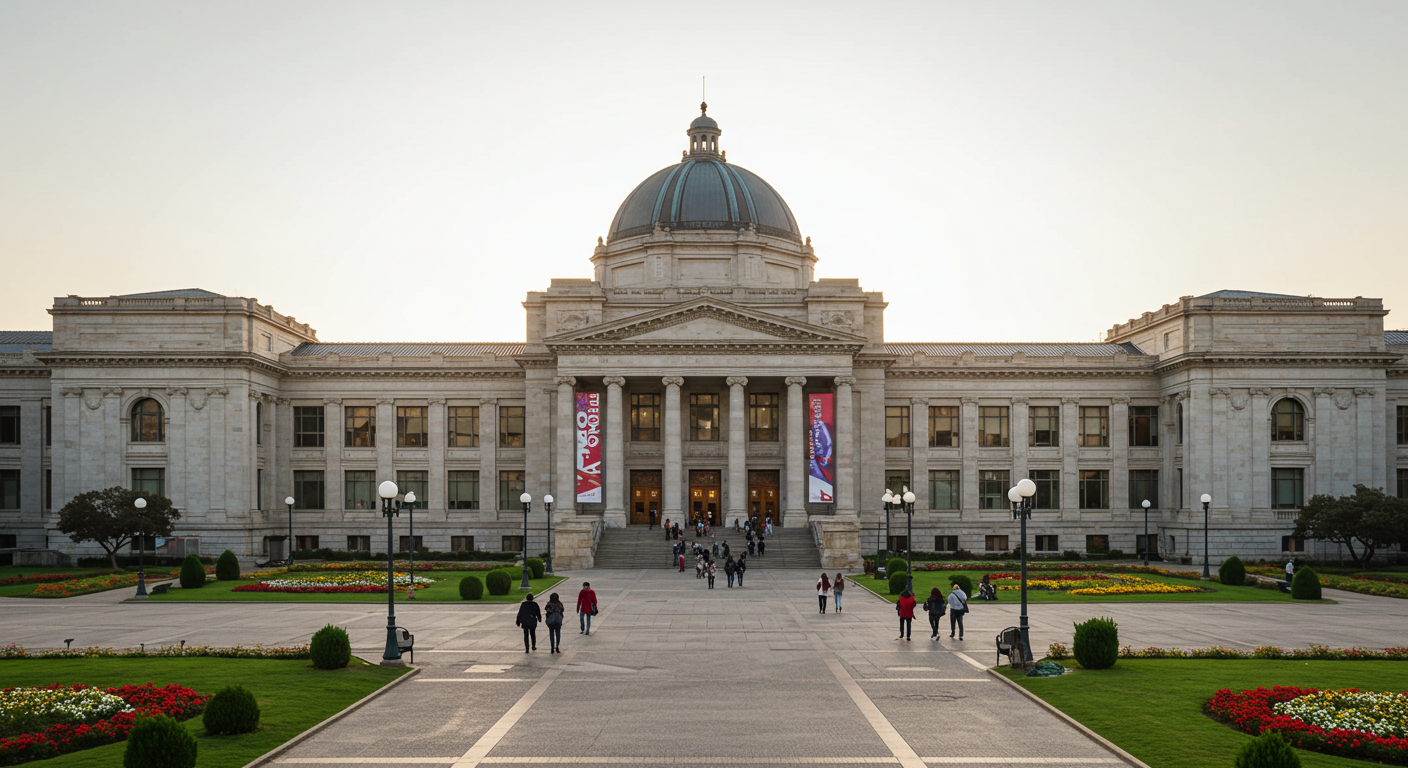
What is the National Museum of Bosnia and Herzegovina?
The National Museum of Bosnia and Herzegovina recently came to a choice that is a mix of courage and conscience. The museum said it would donate proceeds from ticket sales and from the sale of a...

The National Museum of Bosnia and Herzegovina recently came to a choice that is a mix of courage and conscience. The museum said it would donate proceeds from ticket sales and from the sale of a related book from the Sarajevo Haggadah exhibition to be used for the relief of the people of Gaza. The museum called them victims of systematic and intentional violence perpetrated by the state of Israel. This action is not charity. It is about solidarity. In an era where institutions prefer not to speak out, the museum preferred to clarify.
Museum director Mirsad Sijaric justified the decision honestly. “Did we take one of the sides? Yes, we took one of the sides,” he said. He continued to point out that pretending to be neutral usually assists perpetrators of injustice. His words remind us that neutrality in the face of injustice does not defend values; it destroys them.
The Sarajevo Haggadah itself holds centuries of history. It was written in medieval Spain in the year 1350, and it accompanied Jews who were leaving the country during the Inquisition. It endured both the Nazi rule and the Bosnian War. Now it lies securely within the museum vault room especially constructed for it. As a representation of the coexistence of various religions in Bosnia, it has stood as a symbol of the endurance of culture even in the worst of times.
That such a treasure is now used to aid Gaza indicates how heritage can be turned into a means of justice. By connecting the story of survival of the Haggadah to that of Palestinians, the museum illustrates that cultural memory need not get stuck in the past. It must speak to the present.
There were criticisms from some Jewish groups. The Anti-Defamation League charged the museum with politicizing a symbol of heritage and survival. Jakob Finci, leader of Bosnia’s Jewish community, labelled the decision offensive and said it tarnished Sarajevo’s reputation as a city of pluralism. These objections, however, overlook the museum’s evident distinction: the action is against state violence, not Jewish identity. To support Palestinians against oppression is not an attack on Jewish heritage. It is a protest for human dignity.
Bosnia’s own experience makes this act all the more potent. Having endured genocide and ethnic cleansing in the 1990s, Bosnia knows the silence that usually precedes suffering. The Sarajevo Haggadah is more than a manuscript; it is a survivor. By donating exhibition fees to Gaza, the museum links its own war memories to today’s calls for justice.
The ruling also defies the notion that cultural institutions must be neutral. Authentic heritage doesn’t stand outside of life. It reacts to it. The National Museum of Bosnia holds that culture is not without moral authority. Its riches can uphold values, not merely bedazzle history.
In an era when numerous governments are mute on Gaza, the museum has spoken louder than words. It tells us that even a manuscript in a glass case can be a voice for the voiceless when institutions do not hide behind political prudence.
This law makes it clear to the world that to stand with the oppressed should never be confused with hate against any people or faith. It is about standing up for life, dignity, and a belief that culture must serve mankind. The Sarajevo Haggadah survived centuries of conflict. It now carries an added connotation. It speaks for those whose homes have been bombarded, whose children live under siege, whose voices are frequently silenced.
The National Museum of Bosnia has demonstrated that history can lead the way. By turning heritage into solidarity, it has exemplified that culture and courage can go hand in hand.
Author