
What China’s First Foreign Astronaut Says About an Old Friendship
For five years China's Tiangong space station has been a strictly national home. When Shenzhou-24 lifts off, an officer from the Pakistan Air Force will become the first non-Chinese astronaut to...

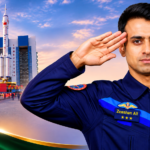
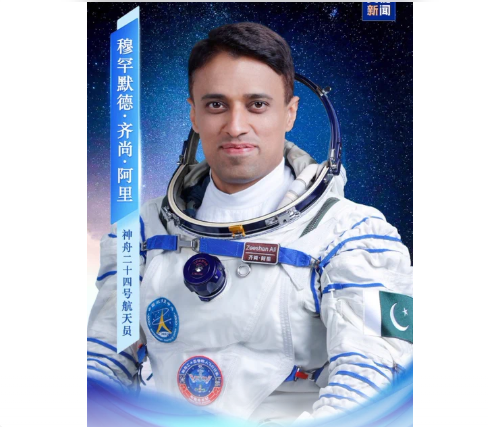
For five years China’s Tiangong space station has been a strictly national home. Every person who has floated through its modules has been Chinese. On Tuesday that changed. The China Manned Space Agency announced that Muhammad Zeeshan Ali, a 40-year-old Pakistani engineer, will fly as a payload specialist on Shenzhou-24, due to lift off from the Gobi Desert on Wednesday morning. He will be the first foreign astronaut to board the station.
“I carry the name of Pakistan on my shoulder, the hopes of 250 million Pakistanis,” Ali told reporters at the crew’s introduction, after speaking first in Mandarin and then in Urdu. It was a small detail that said a great deal. A Pakistani who had spent seven months learning Chinese alongside his crewmates was about to become the face of China’s openness in space.
Beijing could have chosen anyone for this honour. It has courted partners from the Gulf to Latin America and invited the whole UN membership to propose experiments for its station. It chose Pakistan. That choice is the real story. It shows how a friendship long described in the language of mountains and oceans, “higher than the Himalayas, deeper than the oceans,” is being rebuilt for a new century, one in which status is measured not only in roads and ports but in orbits.
The Road to Jiuquan
Ali’s journey began with a signature. In February 2025 Pakistan’s Space and Upper Atmosphere Research Commission (SUPARCO) and the China Manned Space Agency signed an agreement for China to train two Pakistani astronauts, one of whom would fly to the station as a scientific payload specialist. Prime Minister Shehbaz Sharif called it “another wonderful gesture” from Beijing.
What followed was a selection process that mirrored China’s own. Candidates were screened in Pakistan, then tested medically, psychologically and for aptitude at the Astronaut Centre of China. In February 2026 two were shortlisted, and in April they were named: Ali and Khurram Daud, who serves as his backup. Ali, born in 1986, comes from a background in mechanical engineering and mechatronics, with experience developing unmanned vehicles. He speaks English, Arabic and Chinese, and since April he has trained with the Shenzhou-24 crew. Halal meals have been prepared for his flight.
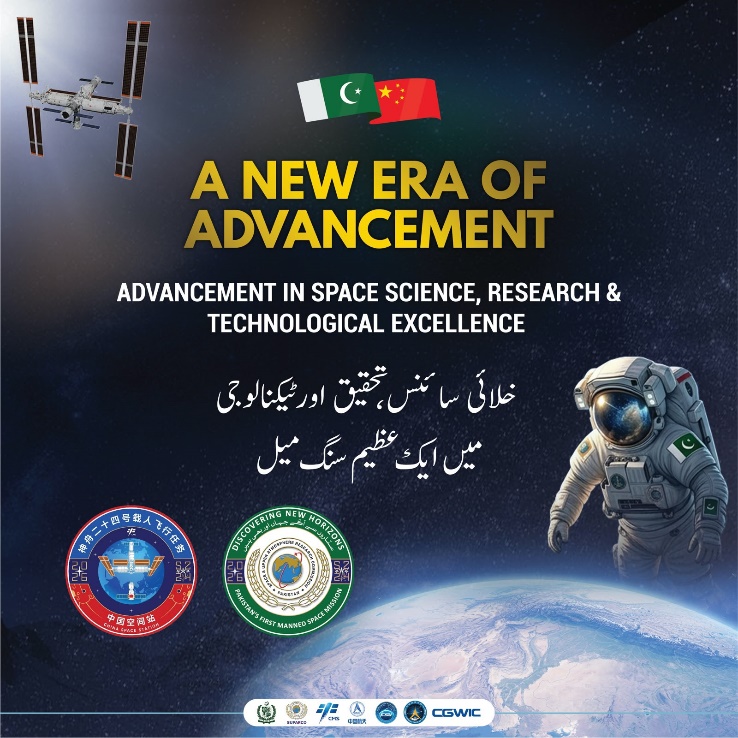
His mission will be short, about a week, before he returns to Earth on Shenzhou-23. He joins commander Tang Hongbo, a veteran of two earlier flights, and flight engineer Wu Yi. Around 90 experiments are planned across life sciences, materials science, fluid physics and space medicine.
Ali is not the first Pakistani to reach space. That honour belongs to Namira Salim, who flew on a Virgin Galactic suborbital flight in 2023 as a private passenger. But he is the first to go as Pakistan’s chosen astronaut, trained by a national programme and sent to live and work on a space station. The difference is the difference between a ticket and a partnership.
From Satellites to the Moon
The Shenzhou-24 seat did not appear from nowhere. It is the latest step in a space partnership that has been building quietly for decades.
In 2014 Pakistan’s armed forces moved onto China’s BeiDou satellite navigation system. A Stimson Center analysis cited by The Friday Times says Pakistan is the only foreign country granted access to BeiDou’s restricted, encrypted military service. In 2018 Chinese rockets carried Pakistan’s PRSS-1 and PakTES-1A remote-sensing satellites into orbit. In May 2024 a small Pakistani satellite, iCube-Qamar, rode to the Moon aboard China’s Chang’e-6, making Pakistan one of a handful of countries with a spacecraft in lunar orbit. Weeks later the PakSat-MM1 communications satellite launched from Xichang. Since then more Pakistani satellites, including the electro-optical PRSC-EO1 and the radar satellite PRSC-S1, have reached orbit on Chinese boosters. And in 2028 a Pakistani-built rover is due to land near the lunar south pole on Chang’e-8.
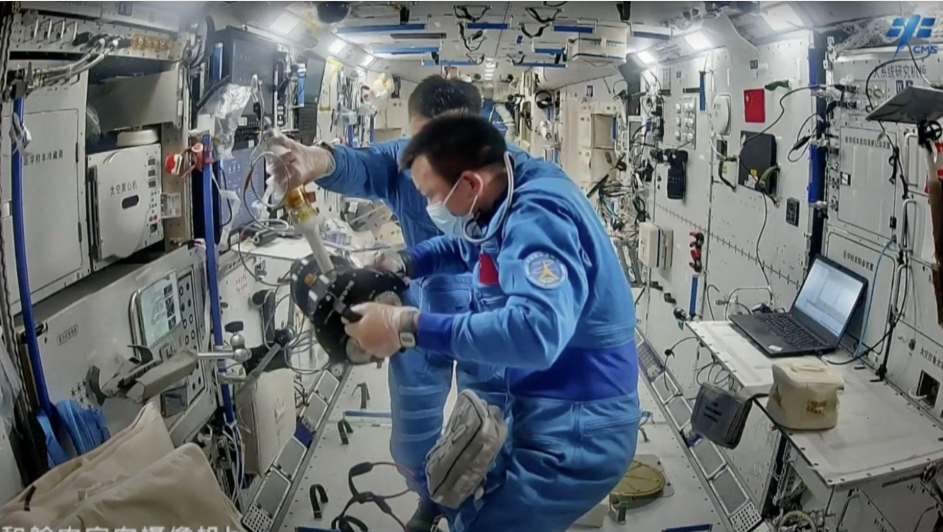
Trace that line and the shape of the relationship becomes clear. It began with access to data and navigation, moved to launches, then to deep space, and now to people. Each step has demanded more trust than the last. Sending a satellite on someone else’s rocket is a commercial transaction. Putting a foreign officer inside your national space station, among your astronauts and your experiments, is something else entirely.
Why Pakistan
For China the decision to open Tiangong to a foreigner was always going to be symbolic, and the first guest would define the message. Choosing Pakistan sends three.
The first is about trust. Space stations are not neutral ground. They carry sensitive technology, and the people aboard see how a country’s systems really work. China has kept Tiangong closed for years partly for that reason. Its first exception went to the partner it has trusted longest and most deeply, the same partner it trusts with BeiDou’s military signal and with CPEC. The friendship that once built the Karakoram Highway through some of the world’s hardest terrain is now being extended to the one place even harder to reach.
The second is about the Global South. The International Space Station, led by the United States and Russia, has long sold seats to private visitors and wealthy partners. China is presenting a different model: access offered to a developing partner as a mark of friendship rather than a purchase. Pakistan, with 250 million people and a modest space budget, is the ideal showcase for that pitch. If Pakistan can fly, so might others.
The third is about the region. In June 2025 India’s Shubhanshu Shukla became the first Indian to visit the International Space Station, flying on a commercial Axiom Space mission arranged with the United States. Seventeen months later Pakistan’s first astronaut is flying with China to a Chinese station. South Asia’s two rivals have each reached orbit, and each has done it through a different great power. The symbolism hardly needs spelling out.
For Pakistan, the meaning is simpler. For years the relationship with China has been described through loans, power plants and highways. Shenzhou-24 adds something different: prestige, science and an inspiring figure for a young population. A child in Quetta or Gilgit watching Ali’s launch sees a future that CPEC’s spreadsheets never quite captured.
Beyond the Launch
Sceptics will say Pakistan is a passenger in someone else’s programme. There is some truth in that. Every Pakistani satellite of the past decade has reached orbit on a Chinese rocket, and Pakistan has no launcher or crewed programme of its own. A single short visit to Tiangong will not change that.
But dependence is not the whole picture. Pakistani analysts describe the model as “launch with China, build at home“: Beijing supplies the lift while Pakistani engineers design and build the satellites, run the ground stations and analyse the data. PRSC-EO1 and PRSC-S1 are Pakistani-designed. So is the rover heading for the Moon. Ali’s week aboard Tiangong, and the experiments he carries for Pakistani scientists, extend that logic to human spaceflight.
Whether it becomes more than a moment depends on Islamabad. A one-off flight is a headline. A space capability needs a formal national space policy, steady funding that survives budget crises, university programmes that train engineers and scientists in numbers, and a plan to keep Ali and Daud’s hard-won expertise working for Pakistan after the cameras leave. The friendship opened the door. Pakistan now has to build the house.
Higher Than the Himalayas
For 75 years Pakistan and China have described their friendship in the language of geography: higher than the Himalayas, deeper than the oceans, sweeter than honey. The phrase has often been mocked as diplomatic poetry. On Wednesday, if the launch goes to plan, it will be literally true.
When Muhammad Zeeshan Ali floats through Tiangong’s hatch, he will be the first guest China has invited into the most personal symbol of its rise. That invitation says more than any communiqué. China has many partners. It has one it trusts with its navigation signals, its Moon missions and now its space station. For Pakistan the challenge is to turn a historic week into a lasting capability. For the region the message is already clear: in the new space age, South Asia’s rivalry has gone into orbit, and Pakistan has chosen its partner.