


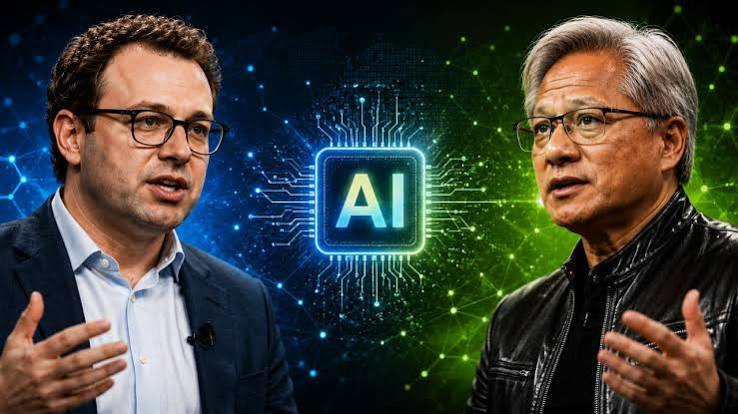
Jensen Huang and the Battle for AI Supremacy
Behind Nvidia's strategic importance lies a deeper disagreement within Silicon Valley over China, technological sovereignty and the future of artificial intelligence. Jensen Huang's return and his...

Behind Nvidia’s strategic importance lies a deeper disagreement within Silicon Valley over China, technological accessibility and the future of American global leadership.
The most enduring form of technological power may not lie in possessing an innovation, but in making the rest of the world build upon it. From the Industrial Revolution to the internet age, nations have expanded their influence not merely by inventing technologies but by establishing the standards through which others progress. As artificial intelligence emerges as the defining technology of the twenty-first century, Nvidia chief executive Jensen Huang stands at the centre of a debate that could reshape the future of American technological leadership.
While Washington seeks to preserve its technological advantage over Beijing, an equally significant disagreement has emerged within Silicon Valley itself. Huang and Anthropic chief executive Dario Amodei represent two distinct approaches to the same strategic objective: maintaining America’s leadership in artificial intelligence. Their disagreement extends beyond corporate competition, encompassing national security, economic interdependence and the future of global innovation.
Eleven Days That Revealed Huang’s Strategic Importance
On November 23, 2026, Nvidia officially announced Huang’s reinstatement as chief executive, president and board member, eleven days after his resignation. The unanimous decision followed consultations with senior US government officials, appeals from technology leaders and considerable investor pressure. According to Reuters, Nvidia’s shares surged approximately 31.5 per cent following the announcement, recovering nearly $1 trillion in market capitalisation.
President Donald Trump’s intervention further illustrated Nvidia’s significance to America’s economic and technological interests. However, the company confirmed that its independent investigation would continue, maintaining a distinction between corporate confidence and regulatory accountability. Beyond the immediate controversy, Huang’s comeback offers an opportunity to understand why his technological vision commands such considerable attention.
Two Visions of American Technological Supremacy
The disagreement between Nvidia and Anthropic became public in May 2025, when Anthropic endorsed stronger American semiconductor export restrictions aimed at limiting China’s access to advanced computing capabilities.
Nvidia responded by challenging the effectiveness of relying on regulation to secure technological supremacy. “America cannot manipulate regulators to capture victory in AI,” an Nvidia spokesperson stated.
The controversy intensified in January 2026 when Amodei, speaking at the World Economic Forum in Davos, compared selling advanced AI processors to China with selling nuclear weapons to North Korea.
Amodei’s concerns centre on the potential military, intelligence and surveillance applications of advanced artificial intelligence. Huang, however, emphasises the possibility that excessive restrictions could encourage competitors to establish independent technological ecosystems.
The distinction is fundamentally strategic: Anthropic prioritises preserving America’s immediate computing advantage, while Huang places considerable emphasis on sustaining its long-term technological influence.
The $4.5 Billion Question
Huang’s concerns are not merely theoretical. According to Nvidia’s regulatory filing with the US Securities and Exchange Commission, American export licensing requirements introduced in April 2025 resulted in a $4.5 billion charge associated with chip inventories and purchase commitments.
More significantly, Nvidia’s August 2026 financial filing acknowledged that its exclusion from China’s data-centre computing market had helped competitors expand their customer and developer networks.
However, Washington is not solely responsible for this fragmentation. Chinese government restrictions have also complicated Nvidia’s ability to sell processors authorised by American regulators.
China therefore represents both a major commercial opportunity and a formidable technological competitor. Managing this relationship requires balancing economic interests with legitimate national security considerations.
CUDA: America’s Invisible Technological Advantage
Understanding Huang’s strategy requires looking beyond semiconductor sales.
Introduced in 2006, Nvidia’s CUDA computing platform enables developers to build applications using its graphics processors. Over time, it has become deeply embedded in artificial intelligence, scientific research and high-performance computing. Every researcher, university or technology company adopting CUDA strengthens an ecosystem built around American innovation.
This mirrors America’s success during the internet revolution, when companies such as Microsoft, Google and Apple extended American technological influence through widespread international adoption.
Huang’s strategic concern is that if Chinese developers increasingly migrate towards domestic alternatives, American companies could lose not only customers but also influence over future technological standards.
The competition, therefore, is not simply about who manufactures the most powerful processor. It is also about whose technological infrastructure becomes the foundation of global innovation.
DeepSeek and the Economics of Accessibility
The emergence of DeepSeek in January 2025 challenged conventional assumptions about artificial intelligence. While investors feared that increasingly efficient AI models could reduce demand for expensive processors, Huang saw an opportunity for broader technological adoption.
His reasoning reflects the economic principle known as the Jevons paradox: when technological efficiency reduces costs, overall consumption can increase rather than decline.
Affordable artificial intelligence could enable millions of additional businesses, researchers and individuals to use advanced computing, potentially expanding the market for semiconductor manufacturers.
Nevertheless, access to AI applications such as ChatGPT and Claude differs considerably from access to the advanced processors required to develop frontier AI systems. Huang’s advocacy for broader technological adoption should not, therefore, be confused with unconditional support for transferring every sensitive American technology to China.
The Commercial Interests Behind the Debate
The contrasting business models of Nvidia and Anthropic provide another dimension to their disagreement. Nvidia benefits when artificial intelligence becomes more widely adopted, regardless of which company develops the most successful model. Anthropic, meanwhile, develops proprietary AI services that face competition from increasingly capable and affordable open-weight alternatives.
Consequently, wider technological accessibility can expand opportunities for semiconductor manufacturers while introducing competitive pressure for proprietary AI developers.
These commercial incentives deserve scrutiny, but they do not invalidate Anthropic’s security concerns. Nor is there established evidence linking Anthropic to Huang’s temporary departure.
The documented disagreement reflects competing approaches to innovation, commercial competitiveness and national security rather than a proven personal campaign against Nvidia’s leadership.
Beyond the American-Chinese Rivalry
For developing economies such as Pakistan, this debate carries considerable significance. Artificial intelligence offers opportunities to improve healthcare, education, agriculture and industrial productivity. However, access to affordable computing infrastructure remains essential to realising these benefits.
A fragmented technological landscape could impose additional costs on emerging economies, forcing them to navigate competing standards, supply chains and investment partnerships. Conversely, wider accessibility without appropriate safeguards could introduce serious cybersecurity and surveillance risks.
Huang’s emphasis on international technological participation offers an important perspective on how innovation can generate economic opportunities beyond established centres of power, while Anthropic’s concerns highlight the necessity of responsible technological development.
The Future of Power in the AI Age
Jensen Huang’s return represents more than the restoration of a prominent corporate leader. It brings renewed attention to a technological philosophy that views international adoption as an important component of American competitiveness.
His disagreement with Anthropic reflects a defining challenge of the AI era: how to preserve national security without unnecessarily sacrificing commercial opportunities, technological influence and international innovation.
Ultimately, America’s technological leadership will depend not only on its ability to produce sophisticated innovations but also on how effectively it balances security, competitiveness and global engagement.
As artificial intelligence reshapes the international order, will lasting technological supremacy belong to the nation that controls access to innovation, or the one whose innovations become indispensable to the rest of the world?