


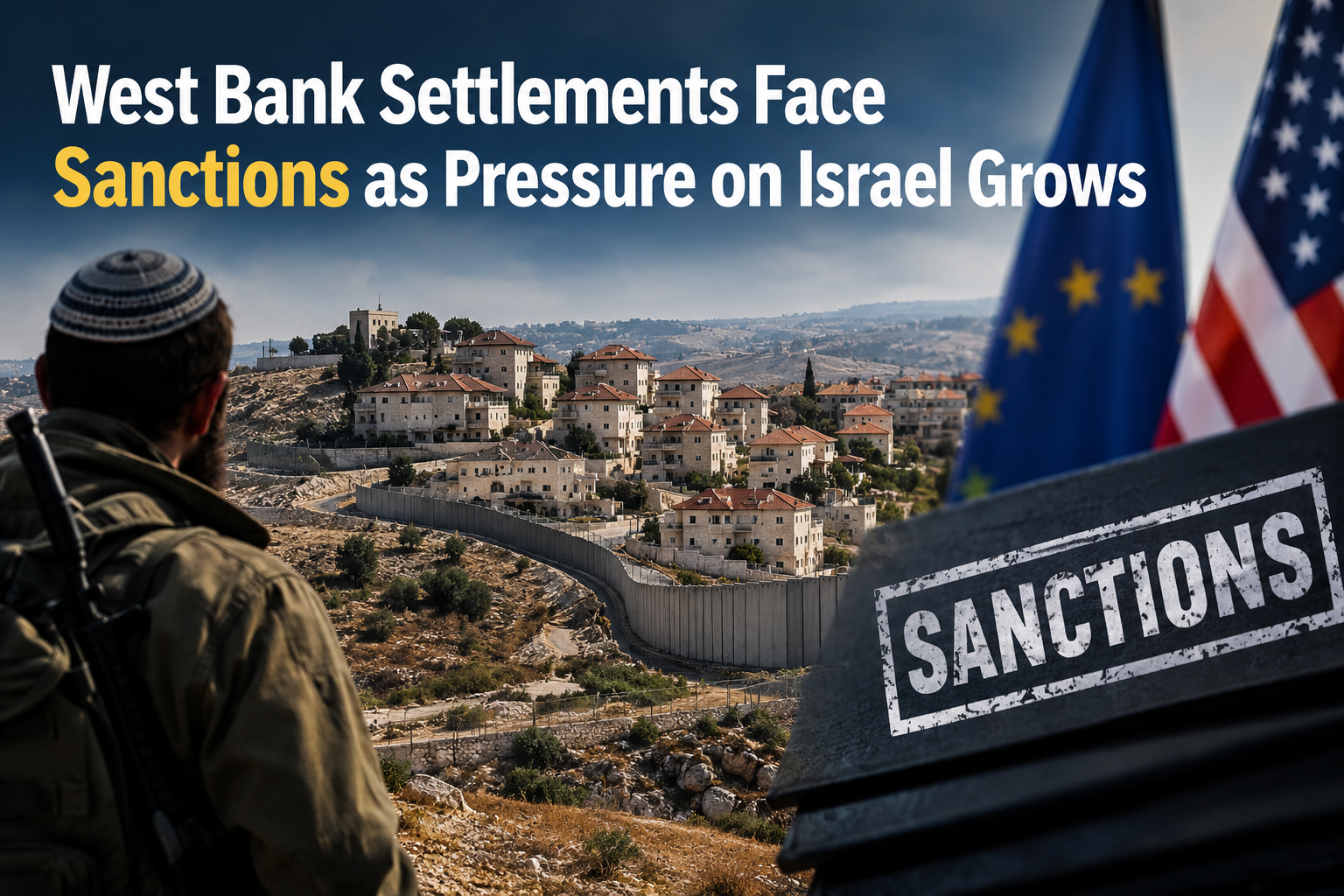
West Bank Settlements Face Sanctions as Pressure on Israel Grows
The words carried particular weight; Britain’s own foreign secretary told Parliament this week that the conduct amounted to “ethnic cleansing.” This was not the accusation of a Palestinian official...

The words carried particular weight; Britain’s own foreign secretary told Parliament this week that the conduct amounted to “ethnic cleansing.” This was not the accusation of a Palestinian official or rights group, but the assessment of a sitting British cabinet minister. A serving cabinet minister of one of Israel’s oldest allies, accusing the Israeli government of turning a blind eye to settler violence in the West Bank. Hours later, the United Kingdom, France, and Canada announced bans on imports from Israeli settlements in the occupied West Bank, joined by a coalition of twelve countries signaling support for similar measures. Pakistan, alongside Saudi Arabia, Turkey, Egypt, Indonesia, Jordan, Qatar, and the UAE, welcomed the move. What makes this moment significant is not simply the action itself, but the growing international coordination behind it.
A Crisis Israel Chose to Create
The scale of this response reflects the scale of what it addresses. The United Nations has described the displacement underway in the northern West Bank as the largest and longest since 1967, with as many as 40,000 Palestinians forced from the refugee camps of Jenin, Tulkarm, and Nur Shams, and tens of thousands still unable to return. This displacement was not an accident of war. It is the direct, foreseeable outcome of an Israeli settlement policy engineered to make Palestinian statehood physically impossible. At least 1,105 Palestinians have been killed by Israeli forces or settlers in the West Bank alone since the Gaza war began, a toll that unfolds gradually and draws far less attention than it deserves.
More than 500,000 Israelis now live on land the international community and the world’s highest court agree does not belong to Israel. Settler violence against Palestinian communities has grown severe enough that the United Kingdom’s own foreign secretary, addressing Parliament, used the term “ethnic cleansing” to describe the conduct of Israeli settlers, accusing the Israeli government of turning “a blind eye” to it. When language this direct comes from within the diplomatic establishment rather than from human rights organizations, it confirms what Palestinians have said for years; Israel’s settlement policy is not a contested territorial dispute but a documented campaign of dispossession.
The Law Israel Refuses to Follow
Israel’s conduct here is not a matter of interpretation. The International Court of Justice ruled in July 2024 that Israel’s occupation of Palestinian territory is unlawful in its entirety, and that Israel is obligated to end its presence “as rapidly as possible,” halt all settlement activity, and evacuate settlers. Israel has done none of these things. Instead, it has accelerated construction, deepened the occupation, and continued treating a binding ruling from the world’s highest court as an inconvenience to be ignored.
For decades, settlement goods such as dates, olive oil, avocados, and cosmetics moved through Western markets labeled as ordinary Israeli exports, quietly financing an enterprise the world’s courts have declared illegal. The United Nations’ own database, updated in 2025, lists 158 companies across 11 countries implicated in settlement activity, from banks to construction firms to real estate developers, all profiting from stolen Palestinian land. The bans announced this week finally sever that pipeline, and the United Kingdom’s decision to criminalize the financing and construction services that sustain settlement expansion goes further still, striking directly at the infrastructure Israel has relied on to entrench its occupation.
A Leadership Under International Indictment
Israel’s impunity now extends to its own leadership. In November 2024, the International Criminal Court issued arrest warrants for Prime Minister Benjamin Netanyahu and then-Defense Minister Yoav Gallant, finding reasonable grounds that both men bear criminal responsibility for war crimes and crimes against humanity, including starvation as a method of warfare and directing attacks against civilians. Israel’s challenge to the warrants was rejected by the ICC’s Appeals Chamber in late 2025, leaving them in force. A head of government now carries an active international arrest warrant while his country simultaneously expands the very settlements a UN-backed court has ruled unlawful, a staggering fact that Israel has met not with reflection, but with continued defiance.
Retaliation Instead of Reflection
Israel’s response to even these modest trade measures exposed exactly what its critics have long argued. Rather than examine why so many allies are turning away, Israel closed the British consulate in East Jerusalem, barred UK Members of Parliament from entering the country, and expelled British officials from Gaza coordination structures. Finance Minister Bezalel Smotrich went further still, publicly demanding the expulsion of Britain’s ambassador entirely. This is not the conduct of a government confident in the justice of its position. It is the conduct of a government that understands its settlement enterprise cannot survive honest scrutiny, and has chosen to punish those who name it rather than answer for it.
A Welcome Beginning
The scale of what Israel has built and the damage already done cannot be erased by trade restrictions alone. The breadth of this week’s response nonetheless deserves recognition. Twelve nations acting together, backed by explicit legal findings from the ICJ and the ICC, represents something Israel has rarely faced: a coordinated international consequence rather than isolated condemnation. For the first time in a generation, the machinery of Israel’s occupation carries really diplomatic and economic cost. Sustaining that pressure, and expanding it until Israel’s conduct in the West Bank finally changes, is the task that now falls to the nations willing to keep their word.
Author