


Vikki Goodwin Unveils Bipartisan Transition Team to Take Over GOP-Led Texas Senate
Lt. Gov.-elect Vikki Goodwin names a bipartisan transition team to prepare for her January takeover of the Republican-majority-controlled Texas Senate.

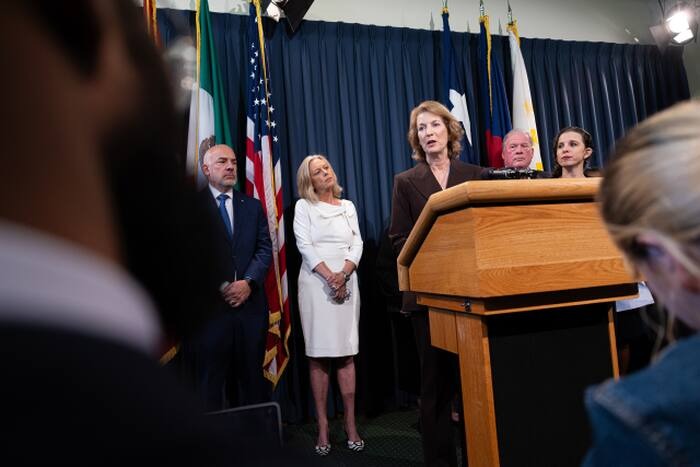
POLICY WIRE — Austin, Texas — Lieutenant Governor-elect Vikki Goodwin announced Tuesday a diverse group of former and current elected officials and staff to manage her leadership transition. This move comes as she readies to assume office in January following her election victory over long-term Republican incumbent Dan Patrick.
Angela Hale, a veteran figure in Texas political operations, has been appointed as the executive director for the Democrat-led transition. The team will be co-chaired by three prominent figures: outgoing Austin Democratic State Representative Chris Turner from Grand Prairie, former Democratic State Senator Leticia Van de Putte, who ran for lieutenant governor in 2014, and Austin Mayor Kirk Watson, who previously served as a Democratic state senator.
During her first press conference at the Capitol since her win, the four-term state representative emphasized that she recognizes the massive weight of her upcoming role. Goodwin noted that the Tuesday election results reflected a clear desire among Texans for new direction and effective leadership who can deliver results.
The leadership structure also includes former Republican State Senators Kel Seliger and Tommy Williams. Seliger, a frequent opponent of Patrick, left the Senate in 2023 after two years of service. Williams is a seasoned veteran of both legislative chambers and served as a fiscal advisor to Governor Greg Abbott. Along with Hale and Van de Putte, Williams is among eight registered lobbyists making up the majority of the 14-person team announced Tuesday.
The inclusion of Seliger and Williams is significant because Goodwin will lead a Senate that remains under Republican control. While Republicans lost hold of the lieutenant governor’s office for the first time since 1999, they maintain 19 of the 31 seats and possess the potential to alter Senate rules to limit Goodwin’s authority.
When addressing her strategy for working with the GOP majority, Goodwin pointed to her eight-year tenure in the Republican-controlled Texas House. She stated that she understands how legislation passed in the House still requires further effort to move through the Senate and noted that she has a proven track record of finding common ground with Republican senators.
The transition team also features Judd Messer, the former chief of staff for Republican State Senator Trent Ashby, who won a Senate seat last week. Other appointees include Denise Davis and Jesse Ancira Jr., both former chiefs of staff for the late Republican House Speaker Joe Straus, as well as Tom Phillips, the retired Chief Justice of the Texas Supreme Court.
Goodwin’s approach of hiring Republicans mirrors tactics used by previous GOP leaders when the lieutenant governor’s office shifted parties. In 2002, David Dewhurst hired Bruce Gibson, a former Democratic representative and staffer for former Lt. Gov. Bob Bullock. Similarly, Governor Rick Perry kept several staff members who had worked under Bullock when he took the office in 1998.
While there are no legal prohibitions against lobbyists serving on transition teams, such choices often face scrutiny regarding potential undue influence. In contrast, Dan Patrick revealed Monday that he is launching a consulting firm called Patrick Strategies to provide legislative and business advice, though he clarified he would not act as a lobbyist.
Randy Erben, a professor at the University of Texas at Austin School of Law, suggested that lobbyists could provide Goodwin with invaluable institutional knowledge of legislative mechanics. He noted this is legal under state ethics rules provided they act as advisors. If Goodwin hires them as state employees, they would be required to cancel their lobby registrations.
Erben, who lobbied for over twenty years, recalled that former House Speaker Tom Craddick hired prominent lobbyists Bill Miller and Bill Messer when he took leadership. He observed that lawmakers once viewed the lobby industry as a massive reference library filled with expertise.
Reporting by Policy-Wire (PW)