


Video Game Valor: Albuquerque Man’s Midnight Rampage Leaves Retailers and Reality Bruised
POLICY WIRE — Santa Fe, New Mexico — It was barely past 3 a.m. when the alarm blared, not signaling a nuclear threat, but rather an uninvited guest’s singular obsession: video games. A retail...

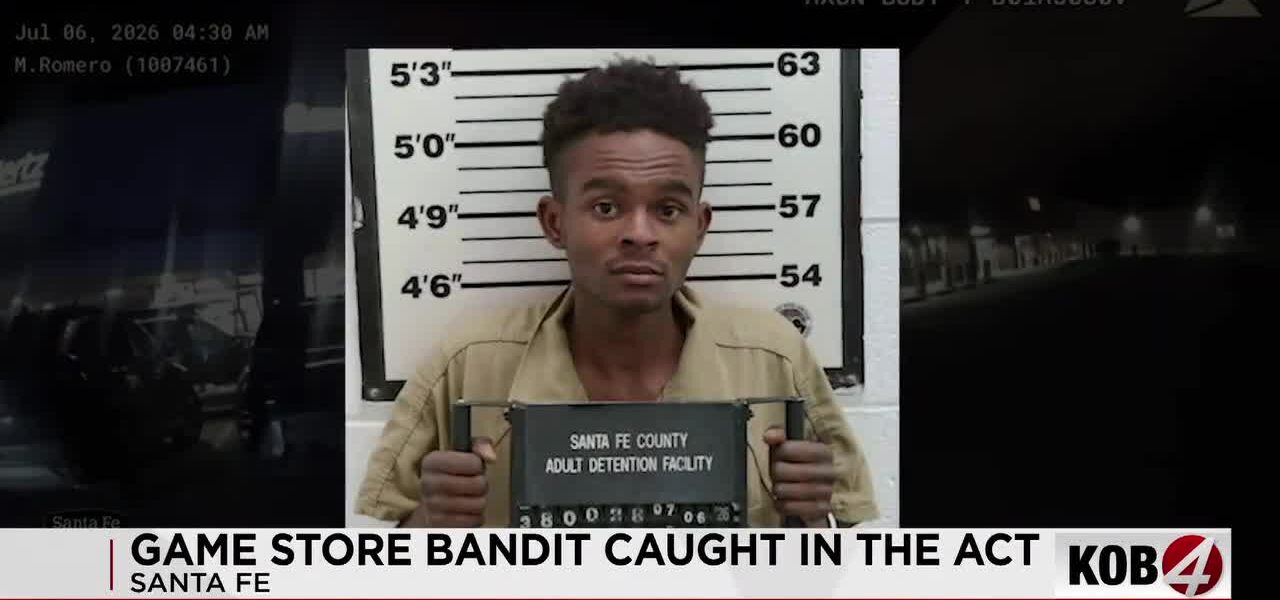
POLICY WIRE — Santa Fe, New Mexico — It was barely past 3 a.m. when the alarm blared, not signaling a nuclear threat, but rather an uninvited guest’s singular obsession: video games. A retail proprietorfighting with an intruder for digital delights—it’s not exactly the grand larceny narrative we’ve come to expect. But Nathaniel Carter, a 22-year-old from Albuquerque, it seems, wasn’t aiming for the grand. He was just looking to play. And when one shop wasn’t enough, another building had to, quite literally, take the hit.
Police said officers arrested a 22-year-old Albuquerque man after they say he broke into one game store and then tried to ram into another. What unfolded in the early morning hours of July 6 across Santa Fe suggests a desperate—or perhaps just terribly misguided—sort of ambition. It began at 8-Bit Retro Video Games on Cerrillos Road. Officers, arriving late to the party at 3:40 a.m., found the alarm wasn’t just crying wolf. But the real spectacle had already played out: the store owner had arrived within 5 minutes and was struggling with an intruder inside. Imagine it—a man defending his cherished relics of digital entertainment against an unknown assailant in the dead of night. Carter, identified later, made a swift exit. Police said the suspect ran away in a vehicle before officers arrived. [QUOTE_PLACEHOLDER]
A momentary reprieve for Santa Fe’s weary first responders. Then, roughly fifty minutes later, the surreal escalates to the absurd. Dispatch got another call about 4:29 a.m. reporting a vehicle ramming a building near Cerrillos Road at College Plaza, where Hertz Rental Car and GameStop are located, police said. It appears our intrepid gamer, perhaps dissatisfied with the pickings at 8-Bit, decided to take a more direct, and undeniably less subtle, approach to retail therapy. But it’s not always a perfect smash-and-grab scenario, is it? Police said the first officer on scene saw the vehicle ramming the building and said it matched the description from the earlier break-in. Detective work, of a sort. But this wasn’t exactly an enigma wrapped in a mystery; it was more like a repeated pattern.
And so, Carter’s dawn escapade came to an abrupt end. The officer contacted Carter, who police said was driving the vehicle, — and took him into custody. The plot thickens, or rather, the evidence mounts. Police said the vehicle Carter drove had been stolen. It turns out the means to the end was itself a crime—a rather common complication in these sorts of sagas, to be honest. Our Albuquerque adventurer is now facing a litany of charges, including aggravated burglary, two counts of criminal damage to property, battery (presumably from the struggle with the store owner), receiving or transferring a stolen vehicle, and attempt to commit a felony, to wit non residential burglary. A formidable achievement list, you might say, if one’s goal is incarceration.
The situation isn’t entirely unique to the Land of Enchantment, of course. For instance, data from the Federal Bureau of Investigation (FBI) indicates that property crimes, including burglary, cost American victims an estimated $14.5 billion in 2019 alone. That’s a lot of loot, digital or otherwise, gone missing. But it also hints at a broader narrative. Consider, for a moment, how young men, often facing economic anxieties or lacking prospects, are drawn to certain illicit activities globally. You see similar currents, different manifestations. Across Pakistan, for example, youth unemployment is a stubborn reality. In 2023, youth unemployment in Pakistan hovered around 11.3%, a figure that, while distinct in context, still points to a generation struggling to find its footing—sometimes with disruptive results. Whether it’s an inability to afford the latest console games or a general feeling of disenfranchisement, such pressures can boil over, manifesting in various forms of social friction.
📄 POLICY WIRE WHITEPAPER PUBLISHED: PAKISTAN'S NATIONAL SECURITY POLICY PRIORITIES
👉 READ BY CLICKING HEREWhat This Means
This incident, on its surface, reads like a petty crime blotter entry. But zoom out a bit, — and it offers a rather bleak snapshot of underlying pressures. It’s not just about a kid wanting video games; it’s about access, frustration, and the often-baffling lengths people will go to when feeling cornered, or perhaps just bored. The collision of a game store—a place of entertainment and escapism—with a violent car ramming says something, doesn’t it? It suggests a raw desperation that transcends simple criminal intent. The prevalence of stolen vehicle charges also brings us back to the stark realities of crime cycles, often seen in communities struggling with poverty and lack of opportunity. You can connect it to broader urban decay discussions, like the ongoing issues detailed in Albuquerque’s Vicious Cycle. The systemic issues that lead to such brazen, — and frankly, amateurish, acts are long-standing.
The audacity of trying to ram a building to get at consumer goods hints at a distorted sense of value, doesn’t it? When a used GameStop (or its wares) becomes worth a literal vehicular assault, we’re seeing more than just avarice. It’s almost a cry for attention, a crude attempt at making an impact, however destructive. But here’s the kicker: all this energy, all this brazen lawbreaking, for what? A quick score, some retro games, a few moments of adrenaline. And then, jail. One has to wonder what futures we’re constructing for our youth when this becomes a viable, if ultimately catastrophic, path. The lack of a strategic, organized approach speaks volumes about the individual’s situation, but also about the ease with which such opportunities arise. The system, it seems, has its own intricate—and occasionally ridiculous—ways of dealing with its disruptions. It’s never simple, it’s never just a game. Albuquerque’s Bleak Ledger often includes stories of desperation, and while this incident is not on that scale, it echoes similar underlying societal fault lines. And now, the Crime Scene Unit will clean up, and detectives like Luke Wakefield will collect the pieces, making sense of a rampage over pixels.