


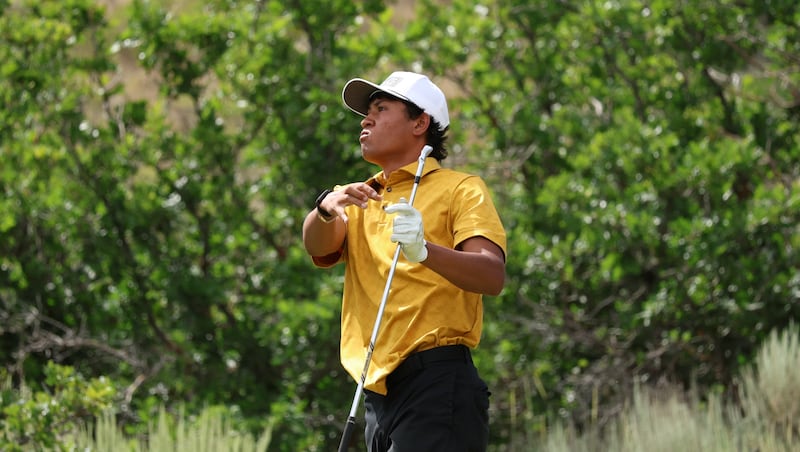
Utah Golf: The ‘Old Man’ Battles the Collegiate Machine at State Amateur
POLICY WIRE — Salt Lake City, UT — There’s always an outlier. A rogue element in an otherwise perfectly predictable system. At the Utah Men’s State Amateur this year, that anomaly wore spiked shoes —...

POLICY WIRE — Salt Lake City, UT — There’s always an outlier. A rogue element in an otherwise perfectly predictable system. At the Utah Men’s State Amateur this year, that anomaly wore spiked shoes — and boasted 38 years on his bones. His name’s Cameron Crawford, and he nearly—nearly—derailed what had been shaping up to be an all-collegiate quarterfinal lineup. Just imagine it, a clean sweep of fresh-faced, scholarship-holding phenoms, only for a seasoned veteran, long past his own college prime, to step onto the 19th hole and spoil the narrative.
It was a proper dust-up, a back-and-forth grind against BYU’s Angus Klintworth. Crawford, who played college golf 16 years ago for Dixie State College, found himself the proverbial lone wolf in a pack of young guns, showcasing a different kind of tenacity. His improbable win means seven collegians have advanced to Friday’s quarterfinals, not eight. This statistic, captured through Fairways Media/Garrit Johnson, pinpoints a trend we’ve seen building for ages: college programs gobble up talent, refine it, and then unleash it onto these amateur circuits. And sometimes, you just gotta applaud the old guard’s stubborn resistance. [QUOTE_PLACEHOLDER]
Because frankly, collegiate dominance in amateur golf is no secret; it’s practically a given. These young athletes, sculpted by rigorous schedules, state-of-the-art facilities, and dedicated coaching staff, often approach amateur tournaments with a semi-professional polish. It’s their proving ground, a public audition. Look at defending champion Bowen Mauss, an Arizona State golfer. He swept past Brock Sivulich 6 — and 5 in the morning round before defeating Aidan Thain 3 and 2 in the afternoon. That’s clinical, that’s relentless. Mauss isn’t just playing; he’s sending a message.
He’s slated to face Layton’s David Liechty next. Liechty, transferring from Utah Tech to BYU, isn’t new to this stage; he made it to the State Am finals just a few years back. He dispatched 39-year-old Steele DeWald 2 — and 1 after first putting away Joseph Jack 4 and 2. DeWald, bless his competitive heart, was 1 up through 12 holes. But Liechty just turned it on, winning holes 13, 15, and 17—the latter with a birdie—to close the match. It’s that kind of sustained intensity that marks these young players.
Then you’ve got these inter-squad battles brewing. Two buddies from Lehi, Carter Frisby (University of Idaho) and KJ Ofahengaue (Utah Valley), are about to go head-to-head. Frisby barely squeaked by Ty Brady, winning on the final hole. Ofahengaue, he beat Andrew Cottle 2 — and 1. These aren’t just matches; they’re high-stakes friendly skirmishes, bragging rights for years to come. Who doesn’t love a bit of intra-squad drama? It’s what keeps folks glued to the leaderboard.
In another quarterfinal, 18-year-old Kanyon DeRyke, headed to Providence College in Montana, defeated fellow 18-year-old Austin Shelley 2 and 1. Shelley, a former Skyline High golfer, will be a freshman at BYU. It’s a changing of the guard, really, even within the younger set. DeRyke takes on Utah State golfer Noah Moody, who scraped past Ammon Allred 1 up. And finally, Jackson Mauss, another BYU golfer—they’ve got quite the contingent—fought his way through former champion Cole Ogden and University of Utah golfer Brandon Robison. He’ll meet Crawford, our aforementioned ‘old man,’ in the 8:30 a.m. quarterfinal. It’s quite the bracket.
📄 POLICY WIRE WHITEPAPER PUBLISHED: PAKISTAN'S NATIONAL SECURITY POLICY PRIORITIES
👉 READ BY CLICKING HEREWhat This Means
This microcosm of competitive golf at the Utah Men’s State Amateur offers a rather blunt lesson in resource allocation and the relentless march of specialized talent development. When college programs funnel significant investment—coaching, equipment, academic support, exposure—into athletes from a young age, the results are almost guaranteed to tilt outcomes. We’re witnessing the logical conclusion of a well-oiled athletic pipeline. It’s not just golf; it’s the model for sports globally. Look at the increasing professionalization of youth academies in football (soccer) across Europe and South America, for example. The early identification — and nurturing of talent isn’t just about sports anymore; it’s big business. In a way, it reflects market dynamics: concentrated investment yields concentrated performance.
From a global perspective, particularly in places like Pakistan or the broader Muslim world, this phenomenon highlights both an aspiration and a challenge. While cricket and football (soccer) often dominate headlines, the rising popularity of individual sports like golf, tennis, and badminton is observable among the burgeoning middle and upper classes. Families with means are increasingly looking to provide their children with avenues for personal achievement and, potentially, even collegiate scholarships abroad. The kind of structured development seen in American university sports—where athletes gain academic credentials alongside sporting prowess—can be highly appealing. But building such an infrastructure, replete with specialized coaches and facilities, remains a significant hurdle in many South Asian nations where broader societal investments often take precedence over what’s perceived as ‘elite’ sport. It’s a long game, pun intended, to compete on that level. The sheer dedication and resources available to players like those at BYU or Arizona State create a standard that’s difficult for developing nations to match, impacting everything from national team competitiveness to potential Olympic medal hopes.
The ‘old man’s’ triumph, if it were sustained, would represent a heartwarming counter-narrative, a testament to raw experience and grit against systematic preparation. But it’s not the norm. It’s a fleeting moment of defiance in a landscape increasingly defined by youth programs — and athletic scholarships. The sheer number of collegians in contention isn’t an accident; it’s a statement. It points to where the talent is being incubated, where the future of many sports is being forged, and frankly, where the money talks. The upcoming rounds, leading to the 36-hole final on Saturday, will merely underscore this shift, proving that amateur golf, in its essence, isn’t always that amateur anymore. It’s a serious enterprise, a proving ground, a very intense display of athleticism and mental fortitude—just without the professional paycheck yet. That’s for later. Perhaps in Pakistan too, they’ll learn the hidden economies of concentrated investment.