

USS Abraham Lincoln Docks in Thailand Following Extended Middle East Deployment
POLICY WIRE — Pattaya, Thailand — The USS Abraham Lincoln, an aircraft carrier, reached Thailand on Wednesday. This marks its first port visit in over eight months, concluding a lengthy sea mission...

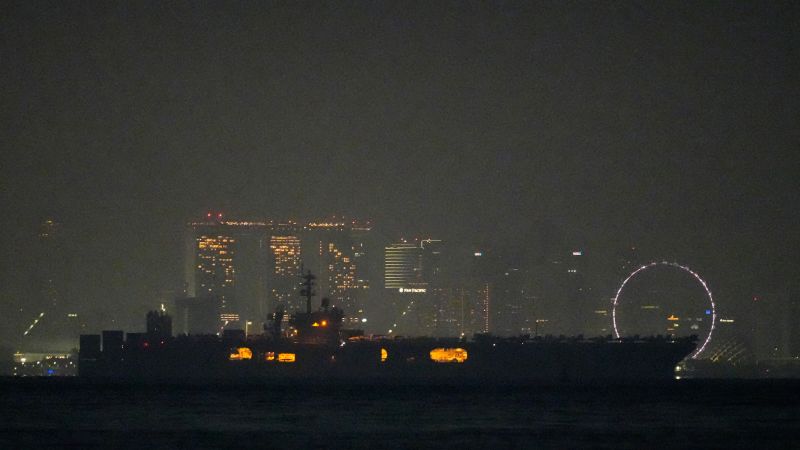
POLICY WIRE — Pattaya, Thailand — The USS Abraham Lincoln, an aircraft carrier, reached Thailand on Wednesday. This marks its first port visit in over eight months, concluding a lengthy sea mission in the Middle East that sparked worries about the crew’s well-being.
Weighing 100,000 tons, the ship left San Diego in November. Upon its return to Southern California later this year, it will have one of the longest deployments in US Navy history under its belt.
US Senator Richard Blumenthal stated that the Lincoln has set a contemporary record for consecutive days at sea during combat and blockade duties in the conflict with Iran.
The prolonged deployment has resulted in morale issues due to supply shortages and at least one possible suicide attempt among the 5,000-strong crew, as reported by CNN.
Blumenthal, a Democrat from Connecticut and a member of the Armed Services Committee, wrote to Defense Secretary Pete Hegseth and the acting secretary of the Navy last month to express “serious concern” about the increasing length of deployments and to demand answers about living conditions aboard the carrier.
Hegseth later claimed that conditions on the Lincoln had been “completely misrepresented” without specifying his concerns with the reporting.
US President Donald Trump dismissed concerns about the lengthy deployment, stating it was “not nearly long enough.”
Shortly after the reported problems aboard the carrier became public, the Pentagon announced that the Japan-based carrier USS George Washington was being sent to the Middle East to replace the Lincoln.
It has since taken up station there along with the USS George H.W. Bush, maintaining a two-carrier presence for the US Navy as hostilities with Iran continue.
Critics argue that the departure of the George Washington from the east Asia area highlights capacity problems in the Navy, leaving the service without one of its largest warships to support allies and deter adversaries like China and North Korea.
US Chief of Naval Operations Adm. Daryle Caudle acknowledged the stress extended deployments have placed on the Navy, its sailors, and their families. He said the service would try to provide more certainty in deployment times, but combat demands can make that difficult.
In calling in a port near Pattaya, Thailand, the Lincoln is coming to a rest-and-relaxation spot made famous during the Vietnam War as a raucous destination for US servicemembers to unwind from the pressures of war.
Pattaya sits less than an hour’s drive north of U-Tapao, where an airbase hosted dozens of US B-52 bombers during the Vietnam War. The base enabled the eight-engine bombers to reach North Vietnam in three to four hours, providing substantial time and fuel savings from the other main launch point for B-52s, Andersen Air Force Base on Guam in the Pacific.
At the height of the war, some 50,000 Americans were stationed at U-Tapao and other bases in Thailand.
As a US treaty ally, Thailand provided a logical place where troops fighting in Vietnam could rest. According to a 2017 report from the Institute of Labor Economics, 11% to 16% of all visitors to Thailand in 1966-67 were US servicemembers on leave from Vietnam.
Around the US bases and at beach spots like Pattaya, the sex trade grew, in some ways facilitated by US and Thai authorities, according to the institute.
In 1966, Thailand passed the Service Establishment Act, which permitted entertainment establishments throughout the country to employ women who would offer’special services,’ the report says.
A year later Thailand and the US set the “Rest & Recreation Treaty,” which formalized the agreement of Thai authorities to authorize entertainment services for US servicemen.
The treaty arrangement is widely regarded as the beginning of the sex tourism industry in Thailand.
Though the US presence in Thailand quickly wound down after the Vietnam War ended in 1975, the sex industry survived, and places like Walking Street in Pattaya are busy today with massage parlors, bars, and clubs. Prostitution on the street or in brothels is illegal, though activists have long argued it unfairly criminalizes vulnerable sex workers.
Even before the Lincoln’s arrival, Thai authorities were publicizing a clampdown on alleged sex workers operating outside of licensed establishments.
According to local news reports, police in Pattaya over the weekend apprehended at least 25 individuals suspected of soliciting for prostitution, an offense punishable by fines.
Local authorities say rules have been set by US authorities barring personnel from visiting cannabis dispensaries and taking part in watersports including jet skiing and parasailing.
Pattaya City Mayor Poramet Ngampichet said he hopes the Lincoln’s port call will boost the local economy. “For Pattaya to be seen as an important vacation spot is something that we have aimed for,” Poramet said, according to the Associated Press. “We welcome more visits of the troops in the future, whether for a drill or a vacation, before they go back to the US.”
Reporting by Policy-Wire (PW)