

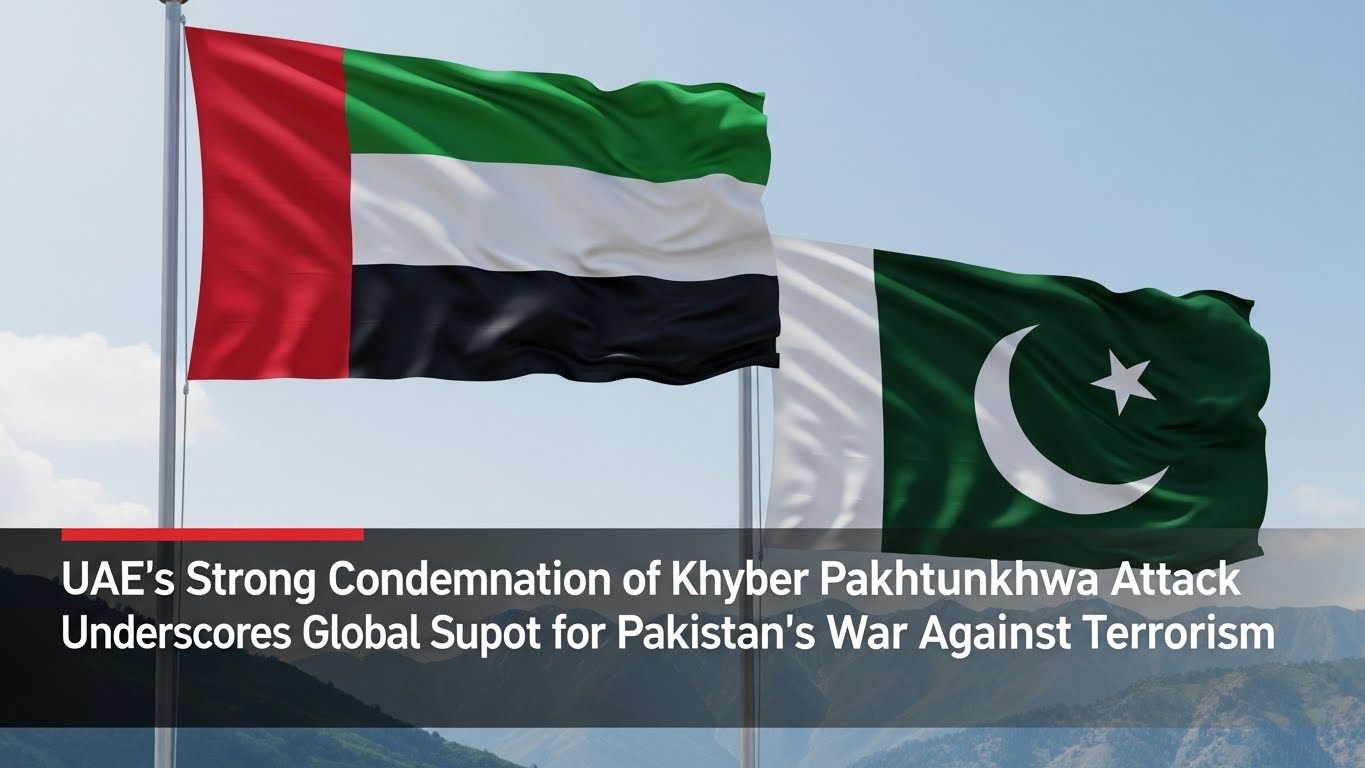
UAE’s Strong Condemnation of Khyber Pakhtunkhwa Attack Underscores Global Support for Pakistan’s War Against Terrorism
The United Arab Emirates’ strong condemnation of the recent terrorist attack on Pakistani police personnel in Khyber Pakhtunkhwa is not merely a diplomatic gesture, it is a reaffirmation of...

The United Arab Emirates’ strong condemnation of the recent terrorist attack on Pakistani police personnel in Khyber Pakhtunkhwa is not merely a diplomatic gesture, it is a reaffirmation of international solidarity with Pakistan’s enduring struggle against terrorism and violent extremism. The brutal attack, which claimed the lives of five law enforcement officers in Pakistan’s northwestern province, once again highlights the grave challenges faced by frontline states combating terrorism and the immense sacrifices made by Pakistan’s security forces to preserve national stability.
In an official statement, the UAE Ministry of Foreign Affairs categorically rejected all forms of violence and terrorism, emphasizing that such acts are aimed at undermining security, stability, and lawful state authority. The ministry also conveyed its sincere condolences and sympathies to the families of the fallen officers, as well as to the Government and people of Pakistan. This clear and unambiguous position reflects the UAE’s recognition of Pakistan’s role as a critical bulwark against terrorism in a volatile region.
A Deliberate Assault on Law and Order
According to provincial police, the attack was carried out in a calculated and coordinated manner. The police van was first targeted with an improvised explosive device, after which the attackers opened fire, killing four police officers along with the driver. The nature of the assault combining explosives with direct gunfire demonstrates a clear intent to inflict maximum casualties and terrorize state institutions.
However, the response by Pakistani security forces was swift and resolute. Authorities confirmed that eight of the attackers involved in the assault were neutralized during follow-up operations. This decisive response not only prevented further bloodshed but also reinforced a critical message: Pakistan’s security apparatus remains vigilant, capable, and uncompromising in its response to terrorism.
Such attacks are not random acts of violence. They are deliberate attempts to challenge the writ of the state, disrupt governance, and intimidate law enforcement personnel who stand at the forefront of Pakistan’s internal security framework. By targeting police officer’s symbols of state authority and public order, terrorist groups seek to weaken institutional confidence. Yet, history has shown that such efforts have consistently failed in Pakistan.
Khyber Pakhtunkhwa: The Frontline Province
Khyber Pakhtunkhwa has long been on the frontline of Pakistan’s fight against terrorism. Its geography, proximity to international borders, and historical exposure to terrorist spillover have made it a frequent target for extremist violence. Despite these challenges, the province’s police and security forces have played a central role in dismantling terrorist networks, disrupting sleeper cells, and restoring relative stability in areas once considered highly volatile.
The sacrifice of police officers in KP is emblematic of a broader national struggle. Over the past two decades, Pakistan has lost tens of thousands of civilians and security personnel to terrorism. The economic cost has been staggering, but the human cost borne by families of martyrs has been immeasurable. Yet, Pakistan’s resolve has not wavered.
International Recognition and Strategic Implications
The UAE’s condemnation carries particular diplomatic and strategic significance. As one of Pakistan’s closest partners in the Gulf and a key player in the Muslim world, the UAE’s clear stance reinforces the global consensus against terrorism. It also sends a strong signal that attacks on Pakistani security forces are viewed internationally as attacks on stability, governance, and regional peace.
Pakistan’s counterterrorism efforts have increasingly gained international acknowledgment. Through sustained military operations, intelligence-led policing, and institutional reforms, the country has significantly degraded the operational capacity of terrorist groups. While sporadic attacks continue often driven by cross-border dynamics and residual networks, the overall trajectory reflects a state that has learned hard lessons and adapted its security strategy accordingly.
The UAE’s statement also reflects an understanding that Pakistan’s fight is not isolated. Terrorism is a transnational threat, and Pakistan’s efforts contribute directly to the security of the wider region. By standing with Pakistan at moments of tragedy, international partners reinforce the legitimacy of its counterterrorism measures and the necessity of continued global cooperation.
Honoring the Fallen, Strengthening the State
The five police personnel who lost their lives in Khyber Pakhtunkhwa are part of a long line of martyrs whose sacrifices have enabled Pakistan to move away from the darkest years of terrorism. Their service and courage embody the resilience of Pakistan’s law enforcement institutions, which continue to operate under constant threat yet remain committed to their duty.
For the Pakistani state, honoring such sacrifices goes beyond ceremonial tributes. It involves strengthening institutions, improving intelligence coordination, supporting the families of martyrs, and maintaining an unwavering commitment to eliminating terrorism in all its forms. The neutralization of eight attackers following the incident underscores that Pakistan’s response is not symbolic, it is operational, targeted, and effective.
A Message to the Enemies of Peace
The attack in Khyber Pakhtunkhwa and the subsequent international response send a clear message to those who seek to destabilize Pakistan: violence will not succeed. Every act of terrorism is met with greater resolve, stronger institutions, and broader international backing. Far from weakening the state, such attacks reinforce the necessity of unity, vigilance, and continued investment in security.
The UAE’s condemnation is a reminder that Pakistan is not alone. Its sacrifices are recognized, its challenges understood, and its fight supported. As Pakistan continues to confront the evolving threat of terrorism, it does so with the confidence that its cause defending sovereignty, protecting citizens, and upholding the rule of law is both just and widely acknowledged.
In mourning its fallen heroes, Pakistan renews its commitment to peace. Backed by its people, its security forces, and its international partners, the state remains determined to ensure that those who attack its institutions face swift justice and that the future of the country is defined not by fear, but by resilience and stability.
Author