


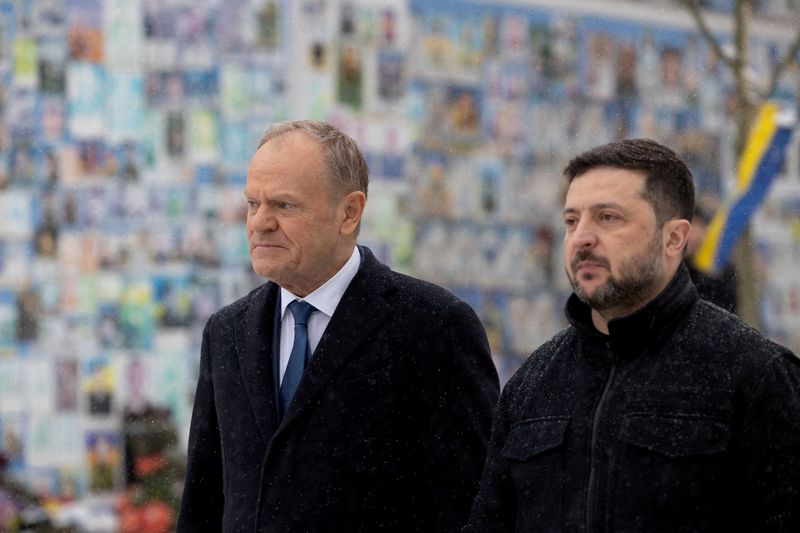
Tusk Demands Ukraine Face History Amidst War
Amidst war, Poland's PM Tusk presses Kyiv to address painful historical truths, crucial for maintaining strategic alliances and European integration.

POLICY WIRE — Warsaw, Poland — It’s a cruel irony, isn’t it? Fighting for your nation’s future often means reckoning with its painful, sometimes ugly, past. For Ukraine, embroiled in a brutal, existential conflict on its eastern flank, this complex historical excavation has been largely – and perhaps understandably – put on ice. But no longer. Poland’s Prime Minister Donald Tusk, never one to mince words, has delivered a pointed message: Ukraine needs to look history square in the eye, regardless of the present catastrophe.
It’s not just about today’s bombs; it’s about yesterday’s ghosts, rattling chains in the diplomatic corridors of Brussels and Warsaw. Tusk didn’t come to praise Kyiv’s resistance so much as to remind it that strategic solidarity comes with certain historical obligations. His assertion that Ukraine, even in wartime, has expressed a desire to “lower tension” seems less about immediate border squabbles (though those simmer, make no mistake) and more about the simmering, unresolved traumas from World War II — specifically, the Volhynia massacres, where Ukrainian nationalists butchered tens of thousands of Poles. Some wounds, it turns out, don’t heal with the march of history, even less so when there’s a new war going on.
“True partnership isn’t just about sharing a front line against aggression; it’s also about a candid confrontation with truths, however uncomfortable they may be,” Tusk stated recently, reflecting a sentiment long held by many Poles. “For our shared future in Europe, both sides must commit to a comprehensive accounting of history. We simply can’t pretend certain things never happened.” It’s a sentiment that lands with a thump, echoing loudly against the backdrop of Europe’s shifting geopolitical landscape. You can almost feel the chill in the air.
Because, really, how do you expect to build a unified European future while unresolved historical grievances linger like unexploded ordnance? Kyiv, predictably, finds itself in an impossible bind. How does a nation struggling for survival divert resources—or political capital—to contentious historical debates? Yet, avoiding it means alienating key allies, like Poland, who’ve literally opened their homes and wallets to Ukrainian refugees; roughly 1.5 million Ukrainian refugees remain in Poland as of early 2024, according to UNHCR figures. That’s not just neighborly kindness; that’s strategic depth, purchased through years of careful, if sometimes fraught, diplomacy.
And let’s be fair, Kyiv understands the tightrope. “Our immediate focus is repelling an aggressor that seeks to obliterate our very identity,” a senior Ukrainian diplomatic source, speaking on background from the foreign ministry in Kyiv, explained. “But we recognize the need for deeper dialogue. Historical reconciliation isn’t a distraction; it’s a component of long-term national security, albeit one we’re being forced to confront in the most difficult circumstances possible.” It’s a concession, if a reluctant one, that speaks volumes about the delicate dance of international alliances.
📄 POLICY WIRE WHITEPAPER PUBLISHED: PAKISTAN'S NATIONAL SECURITY POLICY PRIORITIES
👉 READ BY CLICKING HEREIt’s not just Eastern Europe that grapples with these messy historical hang-ups. Across the Muslim world, and particularly in regions like South Asia, the echoes of colonial rule, partitioned nations, and brutal communal violence continue to shape modern statecraft. Pakistan and India, for instance, frequently see their diplomatic overtures — or lack thereof — framed by the indelible scars of 1947, demonstrating just how tenacious historical memory can be, influencing trade deals, border skirmishes, and even economic cooperation. It’s an enduring lesson: what’s past is often prologue, whether we like it or not.
But this is also a very Polish gambit. Tusk’s government, having just ousted a more nationalist, hardline predecessor, isn’t shying away from asserting its regional influence. His calibrated remarks – balancing support for Ukraine’s sovereignty with a firm demand for historical accountability – showcase a pragmatic diplomacy. It suggests that even the staunchest supporters have limits to their patience, especially when domestic sensitivities are concerned. You simply can’t ignore the constituency that remembers.
What This Means
Tusk’s blunt assessment isn’t just political theater; it’s a clear signal that Poland’s honeymoon period with Ukraine, born of shared antipathy towards Moscow, is morphing into something more complex and transactional. Politically, this means Kyiv will face increasing pressure to address the Volhynia issue head-on, potentially through joint historical commissions or educational initiatives, even if it feels politically inconvenient mid-war. Economically, while Polish support for Ukraine remains strong, lingering tensions, like the farmer blockades at border crossings (driven by grain import disputes), won’t simply vanish. An inability to address the historical backdrop risks undermining the very foundations of Poland’s economic and military backing, a lifeline Ukraine absolutely can’t afford to lose right now. This isn’t just about what happened yesterday; it’s about shaping tomorrow’s balance of power in Central Europe.