


Turkey’s Political Turmoil: The Arrest of Istanbul’s Mayor and Its Implications
The political climate in Turkey has once again taken a dramatic turn with the recent arrest of Istanbul’s mayor, Ekrem Imamoglu. As one of President Recep Tayyip Erdogan’s strongest opponents,...

The political climate in Turkey has once again taken a dramatic turn with the recent arrest of Istanbul’s mayor, Ekrem Imamoglu. As one of President Recep Tayyip Erdogan’s strongest opponents, Imamoglu’s detention has ignited widespread protests across the country, highlighting the growing discontent among the Turkish people. His arrest, just days before his expected nomination as a presidential candidate, has raised serious concerns about the state of democracy and political freedom in Turkey.
Imamoglu, a member of the secular Republican People’s Party (CHP), has been accused of corruption and aiding a terrorist organization. Prosecutors have gone as far as labeling him a “criminal organization leader suspect.” Along with him, 100 individuals, including journalists, politicians, and business figures, have been detained as part of a broader investigation. The Istanbul governor’s office swiftly imposed a four-day restriction on public gatherings in an apparent effort to suppress the public outcry.
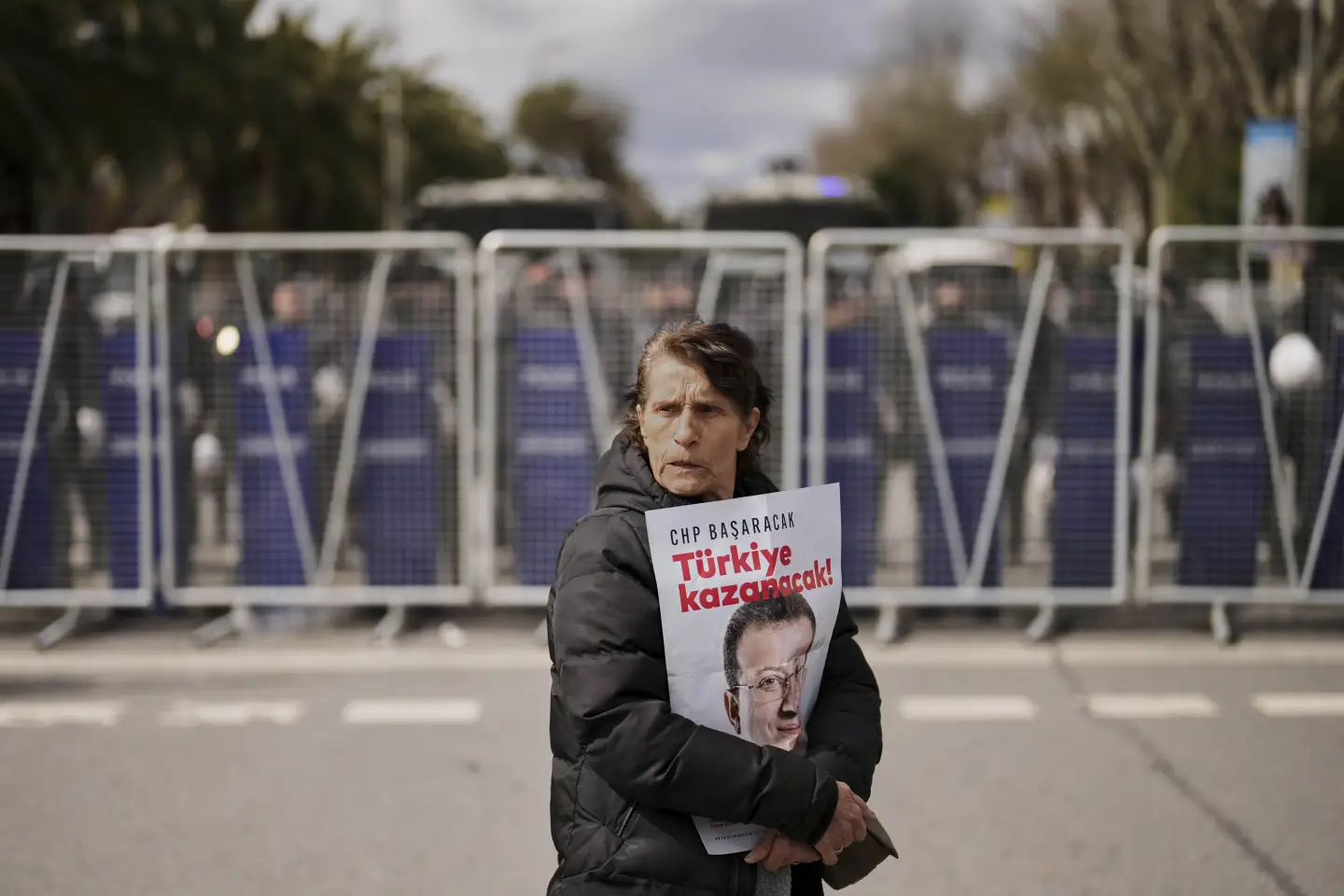
The immediate reaction to Imamoglu’s arrest was one of defiance and anger. Protesters flooded the streets, university campuses, and even underground stations, chanting slogans against Erdogan’s government. Some of the most intense demonstrations took place outside Istanbul University, where police deployed pepper spray to disperse the crowds. Thousands gathered in front of the city hall despite freezing temperatures, shouting, “Erdogan, dictator!” and “Imamoglu, you are not alone!”—a powerful indication of the frustration simmering among the populace.
Authorities responded with force, banning public gatherings and closing metro lines to prevent the protests from gaining momentum. However, opposition leaders, including Imamoglu’s wife, have continued to urge people to “raise their voices.” In a social media video recorded as police surrounded his home, Imamoglu reassured his supporters, vowing to “stand resolute for democracy and justice worldwide.” In a handwritten note posted online, he declared that the Turkish people would reject “the lies, the conspiracies, and the traps” set against him.
The backlash against his arrest has not been limited to Turkey. International observers have condemned the move, viewing it as another step toward autocracy. The EU, France, and Germany have all criticized the arrest, with the Council of Europe stating that Imamoglu’s detention “bears all the hallmarks of the pressure on a political figure considered as one of the main candidates in forthcoming presidential elections.”
Economically, the turmoil has already taken a toll. The Turkish lira plunged to an all-time low against the US dollar, reflecting investor fears over the country’s political stability. For many, Imamoglu’s arrest is not just a crackdown on an individual but a warning sign of further democratic backsliding.
Legal troubles for Imamoglu are not new. In 2022, he was handed a political ban for allegedly insulting Turkey’s electoral board during the 2019 elections. Though he appealed the decision, the case remains unresolved. Other allegations, including claims of irregularities during his tenure as mayor of Beylikduzu, have been repeatedly brought against him. Just last month, another case was filed against him over his criticism of a prosecutor, further demonstrating the continued legal pressure on the opposition leader.
Imamoglu’s latest arrest follows a broader pattern of government crackdowns on opposition figures, journalists, and even entertainment industry personalities. The Turkish justice minister, Yilmaz Tunc, has rejected claims that the arrest was politically motivated, insisting that “nobody is above the law.” Erdogan and his party have also denied orchestrating the move, maintaining that Turkey’s judiciary operates independently. However, critics argue that the country’s legal system has increasingly been used as a tool to silence dissent.
The timing of Imamoglu’s arrest is significant. Last year, he won a second term as Istanbul’s mayor in a historic election that saw the CHP defeat Erdogan’s party in major cities across Turkey. It was the first time in over two decades that Erdogan’s party had suffered such a loss at the ballot box. For Erdogan, the defeat was personal—he himself had risen to power as Istanbul’s mayor before becoming the country’s leader.
Adding to the controversy, Istanbul University recently annulled Imamoglu’s degree over alleged irregularities. If upheld, this decision could disqualify him from running for president, as Turkey’s constitution requires candidates to have completed higher education. Imamoglu has called the move “legally baseless” and has condemned the politicization of educational institutions, stressing that universities must remain independent and free from government influence.
📄 POLICY WIRE WHITEPAPER PUBLISHED: PAKISTAN'S NATIONAL SECURITY POLICY PRIORITIES
👉 READ BY CLICKING HEREAnother major charge against Imamoglu is his alleged links to the Kurdistan Workers’ Party (PKK), a group that has been engaged in an insurgency since 1984 and is designated as a terrorist organization in Turkey, the EU, the UK, and the US. However, earlier this month, the PKK announced its decision to lay down arms following negotiations with Turkish officials. This development has fueled further debate about the motivations behind Imamoglu’s arrest, with some suggesting it is a calculated move to undermine any potential opposition challenge in future elections.
The uncertainty surrounding Turkey’s political future has led to growing speculation over Erdogan’s next steps. He is currently serving his second term as president, having previously held the position of prime minister. Under the current constitution, he cannot run for president again unless an early election is called or constitutional changes are made. Some analysts believe that Erdogan may be laying the groundwork for such a scenario, ensuring that strong opposition figures like Imamoglu are sidelined well in advance.
Despite the government’s efforts to control the narrative, social media has played a crucial role in spreading information and mobilizing public support. However, UK-based watchdog Netblocks reported severe restrictions on platforms like X, YouTube, Instagram, and TikTok following Imamoglu’s arrest, limiting access to independent news sources.
With presidential elections scheduled for 2028, the political landscape in Turkey remains uncertain. The opposition is facing increased legal and institutional obstacles, making it difficult to challenge Erdogan’s grip on power. Some activists have even suggested an election boycott, arguing that a fair vote is no longer possible under the current conditions. The CHP, Imamoglu’s party, has gone as far as calling his arrest “a coup against our next president,” a sentiment echoed widely among opposition supporters.
The coming days will be crucial in determining the direction of Turkey’s political future. Protests continue despite heavy restrictions, and international scrutiny is mounting. Whether Imamoglu’s arrest marks the beginning of a new phase of repression or a turning point in Turkey’s struggle for democracy remains to be seen. One thing is certain—this crisis has once again exposed the deep divisions within Turkish society and the growing dissatisfaction with the current leadership.
Author


