


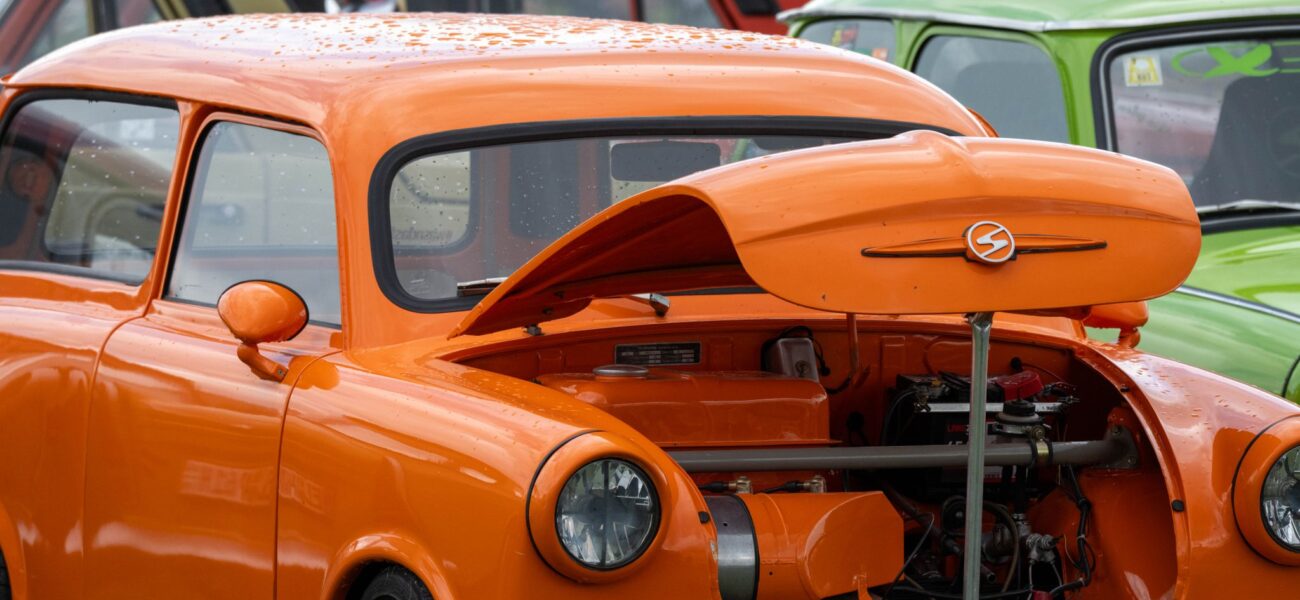
Trabant’s Stubborn Roar: Relic Economy Resists Germany’s Modern Pace
POLICY WIRE — Zwickau, Germany — Walk through the sleepy, industrially scarred towns of what was once East Germany, and you’d expect the past to be a neatly cataloged memory, perhaps displayed in a...

POLICY WIRE — Zwickau, Germany — Walk through the sleepy, industrially scarred towns of what was once East Germany, and you’d expect the past to be a neatly cataloged memory, perhaps displayed in a museum—quietly, respectfully. But you’d be wrong. You can still hear it. That distinct, raspy two-stroke engine sputter, spitting blue-tinged smoke from the exhaust pipe of a Trabant, America’s least favorite Communist import.
It’s a tin-can ghost of a bygone era, yet these machines don’t just exist; they chug along. And that’s not by accident. There’s a dedicated cadre of mechanics, often older folks with grease permanently etched into their knuckles, who’ve spent decades coaxing life from fiberglass and minimal engineering. They’ve perfected the art of the resurrection. It isn’t just about keeping old cars on the road; it’s about a stubborn, often illogical, resistance to modern consumerism, and it says more about the economic hangover of communism than any history book.
These mechanics, the keepers of a sputtering flame, know every idiosyncrasy of the humble Trabi. They know precisely which part from an ancient lawnmower might just fit, or how to re-weld a chassis that’s seen one too many rough winters. It’s an almost heroic undertaking, frankly, keeping these noisy little death-traps – excuse the observation – from becoming actual scrap metal.
“These noisy little two-strokes are, in their own way, an industrial heritage site on wheels,” quipped Thomas Schmidt, a regional parliamentary member from Saxony-Anhalt, a guy known for his straight talk and the region’s strong manufacturing history. “You don’t just scrap a piece of your past, do you?” He’s got a point. It’s about more than transportation; it’s memory lane on four wheels. But is it good policy? Probably not.
And that’s the thing: while the rest of unified Germany sped toward Mercedes and BMWs, a segment of the populace, particularly in the eastern states, held onto their Trabis. Why? Economic necessity, sure. Sentimental attachment, absolutely. But it also speaks to a particular strain of resourcefulness, a DIY ethos honed by decades of limited choices and the constant need to make do. You see this same fierce practicality in regions far from Germany’s Autobahns.
Take, for instance, parts of Pakistan’s rural areas, where ancient rickshaws, jeeps, and even some decidedly archaic tractors are perpetually patched, rebuilt, and re-engineered with local parts and ingenious repairs, long past their intended expiration dates. The sheer skill involved isn’t celebrated with sleek advertisements; it’s just the way things are done, a direct outcome of economic constraints and an embedded culture of self-reliance. It’s a shared spirit of keeping what works, even if ‘working’ is a generous term.
📄 POLICY WIRE WHITEPAPER PUBLISHED: PAKISTAN'S NATIONAL SECURITY POLICY PRIORITIES
👉 READ BY CLICKING HEREAccording to the German Federal Motor Transport Authority (KBA), nearly 40,000 Trabant vehicles remain registered for road use across Germany as of early 2023. Think about that for a second. Thirty-odd years after the Wall fell, when you’d expect them all to have rusted into oblivion, these quirky little commuters are still out there, defying modern logistics and emissions standards with every clunky turn. It’s truly a marvel of human stubbornness—and mechanical ingenuity.
But it’s not just a cute hobby for old gearheads. “It’s a peculiar case study in delayed obsolescence, almost a market unto itself, powered by nostalgia and—let’s be honest—an inherent distrust of anything new,” noted Dr. Anja Weber, an economist specializing in post-communist transitions at the European Policy Institute. “And it highlights how long certain mentalities can endure beyond their original economic systems.” Policy Wire has covered similar themes of enduring systems and their economic fallout; read about the Trabant’s Persistent Hum and what it truly means for post-reunification Germany.
What This Means
The persistent hum of the Trabant, far from being just a quirky automotive footnote, acts as a sort of political and economic canary in the coal mine. It signifies that decades after Germany’s reunification, economic disparities and cultural distinctiveness in the East haven’t evaporated into a perfectly homogenized European market. It tells us the romanticized notion of a rapid, seamless absorption of East into West was always a bit of a fairytale, politically speaking. This isn’t just about fondness for a flimsy car; it’s about holding onto a piece of identity, a material link to a shared experience that differentiates ‘Ossis’ from ‘Wessis.’ Policymakers, always eager to tout progress and integration, often miss these subtle, smoky symbols of continued difference.
Economically, it underscores the enduring impact of a planned economy where self-sufficiency and repair were the only options. Because new vehicles from the West were unaffordable or inaccessible for many years, a culture of mend-and-make-do became deeply ingrained. That attitude didn’t just vanish when the D-Mark arrived. The continued reliance on skilled, local repair economies—and their accompanying black market for parts—reflects a certain friction between globalized supply chains and localized resilience. It also, somewhat ironically, creates micro-economies where specialized skills, otherwise obsolete, remain gainfully employed. For the European Union, it’s a small reminder that the integration project, though largely successful, still has its ragged, exhaust-fuming edges, where past systems—and the resourceful people who lived under them—cast long shadows. The future, apparently, sometimes drives an old two-stroke.