


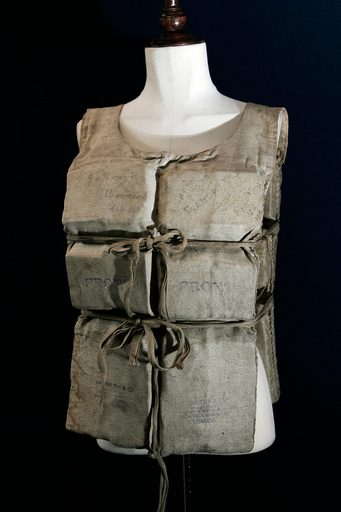
Titanic Survivor Laura Francatelli’s Life Jacket Auctions for Record $906,000
POLICY WIRE — London, UK — A remarkable piece of history from the ill-fated RMS Titanic, a life jacket donned by first-class passenger Laura Mabel Francatelli during her escape, commanded an...

POLICY WIRE — London, UK — A remarkable piece of history from the ill-fated RMS Titanic, a life jacket donned by first-class passenger Laura Mabel Francatelli during her escape, commanded an impressive 670,000 pounds (approximately $906,000 USD) at a recent auction. This significant flotation device, bearing the signatures of Francatelli and fellow survivors from her lifeboat, serves as a poignant artifact of one of the 20th century’s most enduring maritime disasters.
Conducted by Henry Aldridge & Son auctioneers in Devizes, western England, this rare relic became the centerpiece of their Titanic memorabilia sale. An anonymous telephone bidder secured the item, paying substantially more than its initial valuation, which ranged between 250,000 and 350,000 pounds.
In the same high-profile auction, a seat cushion originating from a Titanic lifeboat also achieved a considerable sum, selling for 390,000 pounds (approximately $527,000). This artifact was acquired by the proprietors of two prominent Titanic museums located in Pigeon Forge, Tennessee, and Branson, Missouri. It is important to note that all reported prices incorporate the auction house’s buyer’s premium.
Titanic’s Enduring Legacy and High-Value Memorabilia Market
Andrew Aldridge, the auctioneer, emphasized that these exceptional sales figures clearly demonstrate the ongoing public fascination with the Titanic’s narrative. He highlighted the profound respect for the passengers and crew whose harrowing experiences are perpetually commemorated through such historical artifacts. This robust market for historical items underlines the broader economic dynamics influencing perceived value and investment, a trend mirrored in how geopolitical events, such as Middle East conflicts, can impact global economic growth.
Once lauded as the most opulent and virtually “unsinkable” vessel of its era, the Titanic tragically collided with an iceberg off the coast of Newfoundland. This catastrophic event occurred during its inaugural journey from England to New York, leading to its rapid submersion on April 15, 1912. The disaster resulted in the loss of approximately 1,500 lives from the 2,200 individuals on board, comprising both passengers and crew.
The Titanic: A Microcosm of Society and Survival Stories
To this day, the Titanic continues to captivate global attention, partly due to the incredibly diverse group of individuals it carried, spanning from the most affluent members of society to those of modest means. This cross-section of humanity further amplifies the poignant stories associated with the disaster.
📄 POLICY WIRE WHITEPAPER PUBLISHED: PAKISTAN'S NATIONAL SECURITY POLICY PRIORITIES
👉 READ BY CLICKING HERELaura Mabel Francatelli embarked on the voyage alongside her employer, renowned fashion designer Lucy Duff Gordon, and Lucy’s husband, Cosmo Duff Gordon. All three managed to survive the sinking aboard the ship’s lifeboat No. 1. Despite having a capacity for 40 individuals, this particular lifeboat was launched with only 12 people, igniting considerable controversy for its failure to retrieve additional survivors from the frigid Atlantic waters.
Read More: Keir Starmer: Over a Dozen Nations Join UK-Led Hormuz Maritime Security Mission
Prior to this sale, the highest recorded price for a single piece of Titanic memorabilia was 1.56 million pounds (equivalent to nearly $2 million USD in 2024). That sum was paid for a gold pocket watch presented to the captain of the RMS Carpathia, the vessel credited with rescuing approximately 700 survivors from the Titanic disaster.