


India’s IWT Suspension: Legal Battle & Global Impact
Unpack India's controversial suspension of the Indus Waters Treaty. Legal experts challenge its basis, revealing measurable harm and setting a global precedent.
Islamabad’s case against India’s suspension of the Indus Waters Treaty (IWT) is not, as some commentators argue, an emotional overreaction to a policy recalibration. It is a legal and factual argument grounded in treaty law, arbitral precedent, and measurable downstream harm. The claim that India’s move represents “strategic correction” collapses under scrutiny on three fronts, including the legal basis for unilateral suspension, the conflation of separate policy failures to manufacture legitimacy, and the demonstrated material harm already inflicted on Pakistan’s territory.
The Legal Foundation Does Not Exist
The IWT, brokered by the World Bank and signed in 1960, contains no clause permitting unilateral suspension or withdrawal by either party. Articles 60 and 62 of the Vienna Convention on the Law of Treaties (VCLT) permit suspension only in cases of material breach or a fundamental change of circumstances, conditions that legal scholars say were absent in India’s April 2025 actions. Furthermore, legal analysts have specifically challenged India’s reliance on the doctrine of fundamental change of circumstances, or rebus sic stantibus, arguing it misapplies a customary international law principle codified in Article 62 of the VCLT.
That view has since been tested and upheld by the treaty’s own dispute-resolution architecture. On June 27, 2025, the Court of Arbitration ruled it retained full authority to arbitrate Pakistan’s case against India despite New Delhi’s declared suspension, issuing a Supplemental Award on the Competence of the Court that found India’s “abeyance” position did not limit the tribunal’s jurisdiction. Pakistan’s government called the ruling confirmation that the treaty remains fully valid and cannot be unilaterally shelved by one party, a position India rejected outright, with its Ministry of External Affairs declaring it does not recognize the court’s existence in law.
That refusal to participate has not stopped the tribunal from proceeding on the merits. In its Award on Issues of General Interpretation, issued August 8, 2025, the court addressed Pakistan’s technical objections to the design of the Kishenganga and Ratle hydroelectric plants on the Jhelum and Chenab rivers, weighing whether Indian pondage capacity, spillway gating, and sediment outlet placement exceed what Annexure D of the treaty permits. By late January 2026, the court had gone further, issuing a binding procedural order compelling India to disclose daily inflow, outflow, storage and operational data for those projects, with compliance clarified as a matter of substantive effect on downstream flows rather than semantic labels like “abeyance.” A state that believed its suspension was legally sound would have little reason to boycott the very forum built to adjudicate that question.
Nor is the “restraint despite terrorism” framing historically accurate as a description of the treaty’s design. The IWT survived four India-Pakistan wars and decades of hostility without either side treating military conflict as grounds to void it, precisely because it was engineered to function independent of the security relationship. Reframing that six-decade durability as a favor India extended, one it was now entitled to withdraw over an unresolved investigation, inverts the treaty’s actual purpose, which was to remove water from the register of bilateral disputes altogether.
A Domestic Governance Critique Is Not a Legal Defense
The argument that Pakistan’s water infrastructure funding cuts and stalled projects somehow validate India’s suspension relies on a category error. Whether Islamabad has managed its own water sector well or poorly is a separate question from whether India has a legal right to unilaterally suspend a binding international agreement. Even if every cited budgetary figure is accurate, it establishes minor negligence in domestic water governance, not consent to external abrogation of treaty rights. No principle of international law holds that one party’s suspected internal mismanagement licenses another party’s breach of pacta sunt servanda, the good-faith performance obligation enshrined in Article 26 of the VCLT.
It is also worth noting that Pakistan’s water stress has drivers well beyond domestic budgeting. Regional research attributes the intensifying competition over the Indus basin to a combination of climate change, rapid population growth, and infrastructure development on the western rivers, not fiscal mismanagement in isolation. South Asia recorded 74 water-related conflicts in 2024, up from 49 the year before, making it one of the most water-stressed regions in the world alongside the Middle East, a regional trend that predates and exceeds any single government’s choices.
The Harm Is Not Hypothetical
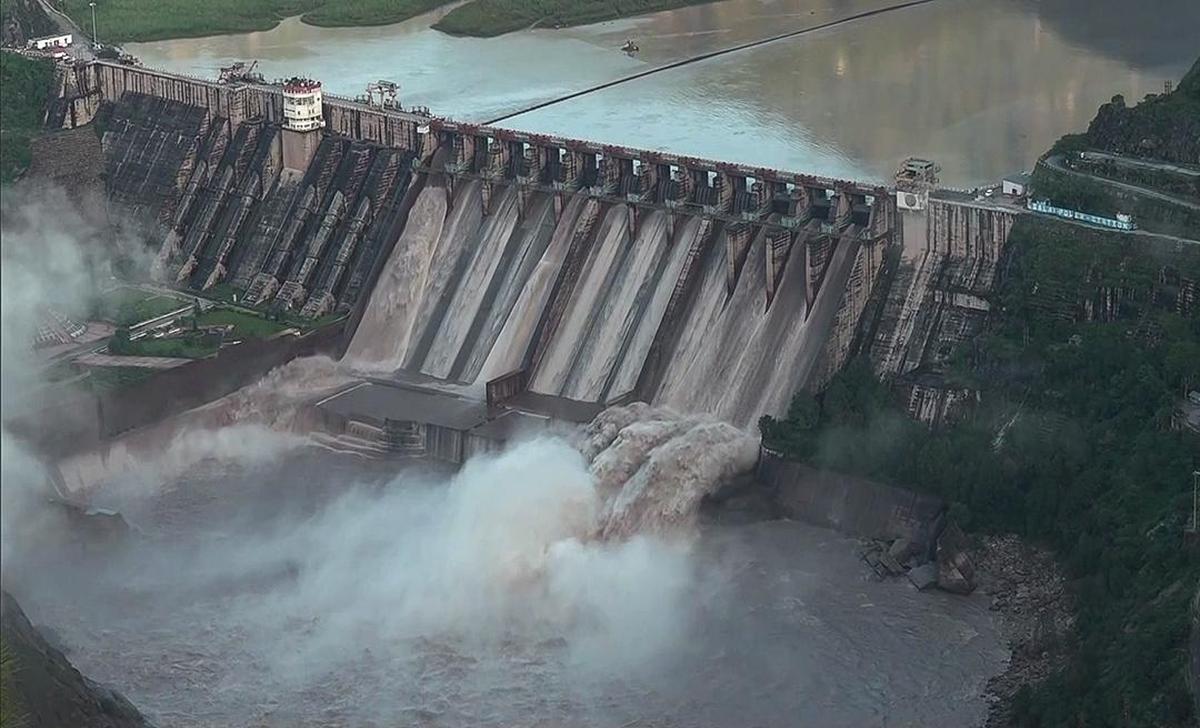
Since suspension, the dispute has moved from rhetoric to measurable consequence. On April 27, 2025, an unexpected rise in the Jhelum River’s water levels caused flooding in Azad Kashmir, followed roughly a week later by another unannounced release of water from Indian dams that raised Chenab River levels, both without the prior notification the treaty’s cooperative mechanisms are designed to require. A legal analysis of those releases concluded they likely violate both customary international law and the treaty itself.
The stakes of continued disruption are not marginal to Pakistan’s economy. Pakistan’s irrigated agriculture, which depends on a predictable river-flow regime, draws roughly 90 percent of its water from the Indus system, alongside close to a third of the country’s hydropower capacity. That dependence on the Indus system for more than 90 percent of irrigation water makes any sustained disruption an existential threat to Pakistan’s agricultural economy and broader stability.
Precedent Beyond South Asia
What is being tested is not only a bilateral water-sharing formula but the credibility of treaty law itself. The IWT has long been held up as a rare example of resilient transboundary water cooperation that continued functioning through conflict, which is exactly why legal scholars are watching this suspension as a test case for water governance frameworks well beyond South Asia. If a state can suspend a legally binding, internationally guaranteed water-sharing treaty on the basis of an attack it has not proven in any adjudicated forum, while simultaneously refusing to recognize the jurisdiction of the arbitration mechanism the treaty itself created, the lesson other upstream states will draw is that treaty commitments hold only until a downstream neighbor becomes inconvenient.
Pakistan’s water governance conditions are real and deserve honest domestic betterment. However, they are irrelevant to the legal question at hand, and citing them does not convert an unrecognized, unilateral, arbitration-defying suspension into a legitimate act of sovereign policy. The Court of Arbitration’s own rulings, not Islamabad’s grievance, are the strongest evidence that this was only a breach dressed in the language of overdue reform.
Author