

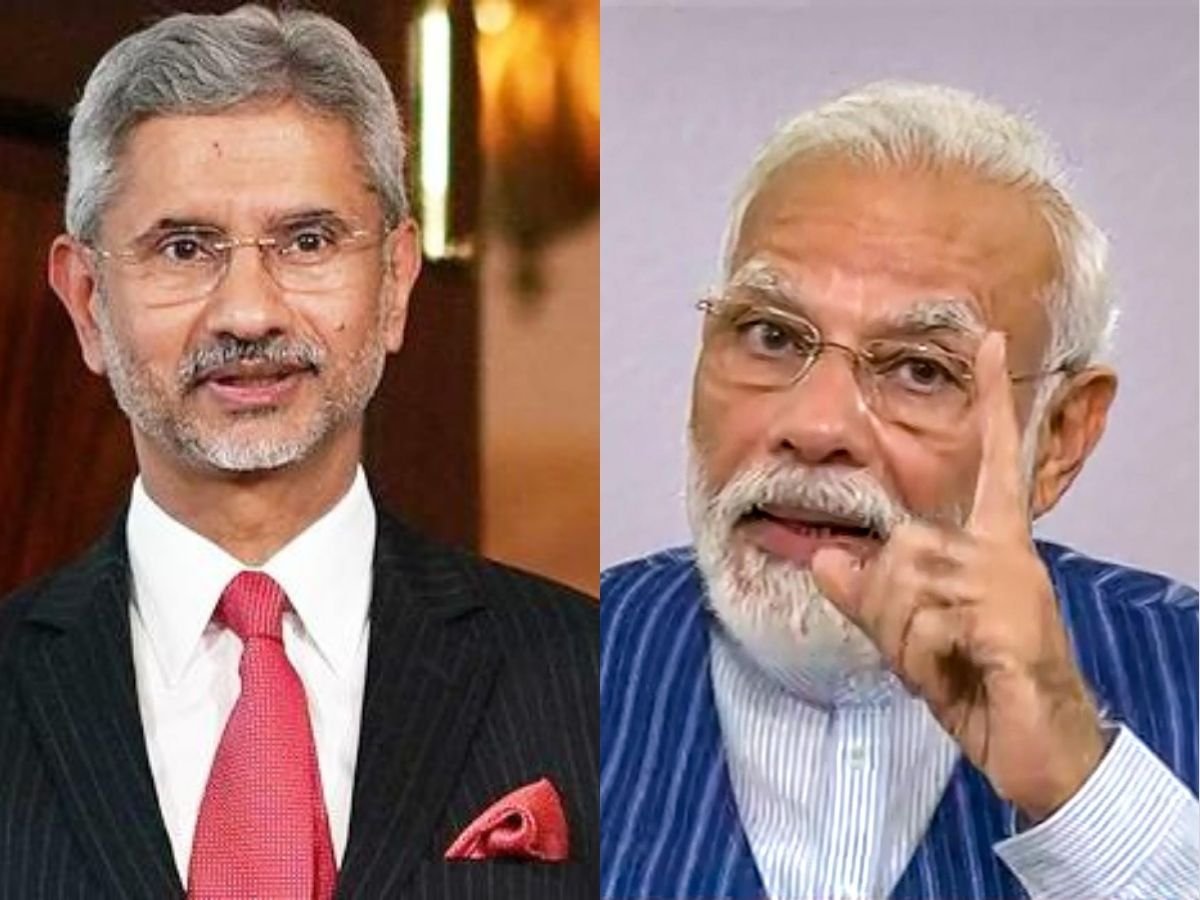
The Shock in Washington: Modi’s Fallout Has Left Jaishankar Scrambling
By Nimra Khalil: In a recent statement that reignited old tensions, Indian External Affairs Minister S. Jaishankar declared that “the part of Kashmir that was stolen by Pakistan should be returned.”...
By Nimra Khalil: In a recent statement that reignited old tensions, Indian External Affairs Minister S. Jaishankar declared that “the part of Kashmir that was stolen by Pakistan should be returned.” This hardline stance, delivered with characteristic assertiveness, was not entirely surprising given the ideological environment fostered by Narendra Modi’s government. However, beyond the rhetorical appeal to nationalist sentiment, Jaishankar’s framing of Kashmir as “stolen property” reflects a dangerously oversimplified reading of history — one that ignores both legal realities and India’s own role in perpetuating the conflict.
To cast Pakistan’s presence in parts of Jammu and Kashmir (referred to by Pakistan as Azad Jammu and Kashmir and Gilgit-Baltistan) as an act of outright “theft” is not just historically inaccurate — it deliberately erases the conditions under which the Kashmir conflict began. The princely state of Jammu and Kashmir was a disputed territory at the moment of Partition in 1947. Maharaja Hari Singh’s controversial Instrument of Accession to India occurred under the pressure of an armed revolt and the rapid advance of tribal forces from Pakistan’s northwest frontier.
The United Nations intervened in 1948, recognizing Kashmir as a disputed territory, not sovereign Indian land. UN Security Council Resolution 47 explicitly called for a plebiscite to determine the region’s future — a process India itself has repeatedly blocked, choosing instead to unilaterally define the region as an “integral part of India.”
For Jaishankar to now demand the “return” of territory without acknowledging India’s own violation of UN resolutions is not just intellectually dishonest; it undermines India’s own diplomatic credibility. If the Kashmir dispute is purely a question of territorial theft, why has India refused international arbitration or impartial facilitation for decades? The “theft” narrative falls apart under the weight of these questions.
Even under India’s legal framework before 2019, Jammu and Kashmir enjoyed a special autonomous status under Article 370 — a constitutional acknowledgement of its unique history and contested status. India’s unilateral abrogation of Article 370 in August 2019, effectively revoking Kashmir’s autonomy, was widely criticized not just by Pakistan but by international human rights bodies, civil society organizations, and even the United Nations Human Rights Council.
Jaishankar’s assertion of sovereignty over the entirety of Jammu and Kashmir — including the parts administered by Pakistan is therefore grounded in neither international law nor bilateral agreements. The Simla Agreement of 1972, which governs India-Pakistan relations post-1971 war, explicitly emphasizes the need for bilateral dialogue to resolve Kashmir. Calling for unilateral “return” contradicts the very agreements India has signed.
Jaishankar’s rhetoric is not aimed at resolving the Kashmir dispute — it is aimed at domestic audiences in India, where the BJP’s majoritarian nationalist narrative depends heavily on the portrayal of Pakistan as a perpetual aggressor and Kashmir as a symbol of incomplete national sovereignty. This is a deliberate continuation of the BJP’s Hindutva-driven foreign policy, which blurs the line between diplomacy and propaganda.
From Pakistan’s perspective, the territories India claims were never “stolen.” Pakistan considers that territory a result of a political dispute born out of Partition, a dispute that was to be settled through the democratic mechanism of a plebiscite. Pakistan’s stance — that Kashmiris themselves must decide their future — enjoys broad international legitimacy, even if global powers remain reluctant to openly confront India.
Moreover, it is worth asking: if these territories were truly “stolen,” why have generations of Kashmiris in Indian-administered Kashmir risen in open revolt against New Delhi? Why does India station hundreds of thousands of troops there, turning the region into one of the most militarized zones in the world? If theft alone is the issue, why does India struggle to win the loyalty of those it claims as citizens?
📄 POLICY WIRE WHITEPAPER PUBLISHED: PAKISTAN'S NATIONAL SECURITY POLICY PRIORITIES
👉 READ BY CLICKING HEREJaishankar’s statement is part of a broader pattern within the Modi government — a tendency to rewrite history to fit contemporary political goals. This revisionism extends from domestic textbooks to international platforms, where India portrays itself as a perpetual victim of history rather than a responsible stakeholder capable of resolving disputes through dialogue.
The reality is that territorial maximalist demanding territory without addressing the root causes of the dispute — only hardens the deadlock between India and Pakistan. Diplomacy requires recognizing the legitimate concerns and aspirations of Kashmir’s people — something neither New Delhi nor Islamabad has done fully.
In global capitals, Jaishankar’s language has triggered concern. India’s shift from diplomatic pragmatism to aggressive revisionism is seen as part of a broader pattern of ethno-nationalist foreign policy under Modi. Western capitals, already uneasy over India’s crackdown on minorities, media, and civil society, increasingly view such statements not as isolated rhetoric but as evidence of India’s troubling slide into majoritarian nationalism — a slide that jeopardizes regional stability.
The demand that Pakistan “return stolen Kashmir” is not a diplomatic strategy — it is a nationalist slogan disguised as policy. Real diplomacy requires acknowledging the history of the dispute, and accepting that Kashmir is not merely a piece of real estate but a land with people, identities, and aspirations. If India is serious about peace, it must stop weaponizing Kashmir for political gain and return to the table — not with ultimatums, but with respect for history, international law, and the Kashmiri people themselves.
The adoption of such inflammatory rhetoric signals something deeper, the complete subordination of Indian diplomacy to the ideological needs of Modi’s Hindu nationalist project. And in the process, India’s credibility as a responsible power willing to resolve disputes through dialogue is slowly being dismantled.
Author