

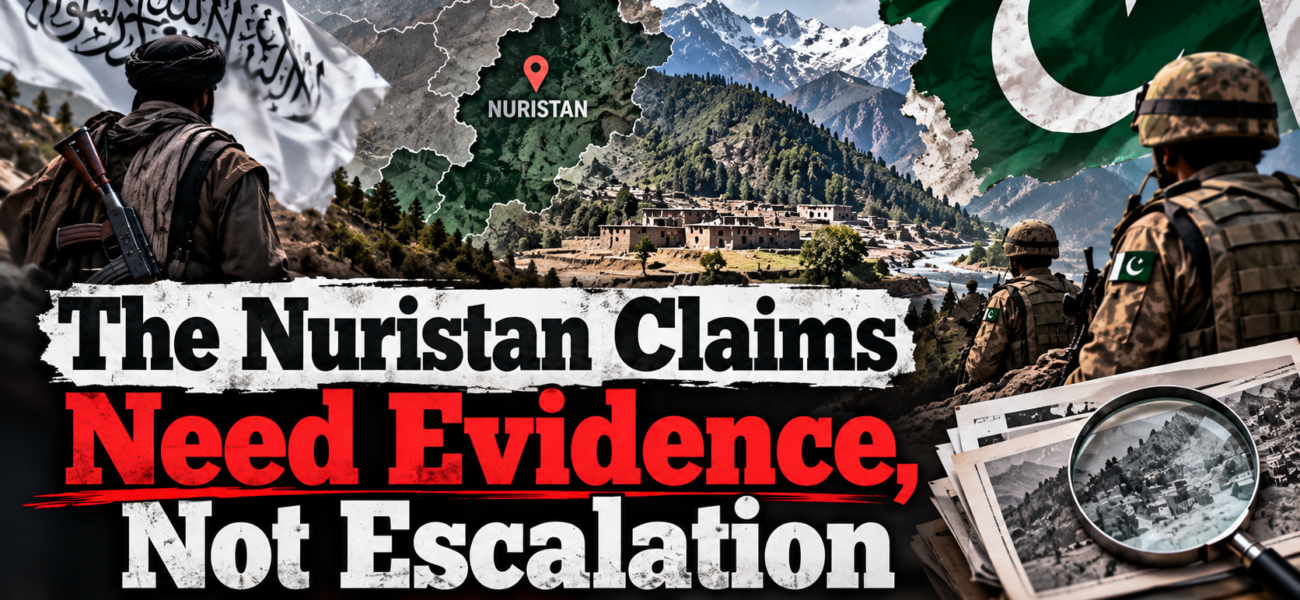
The Nuristan Claims Need Evidence, Not Escalation
The latest confrontation between Afghanistan and Pakistan contains an important lesson about modern regional conflict: an allegation can travel across the world before the evidence behind it has been...

The latest confrontation between Afghanistan and Pakistan contains an important lesson about modern regional conflict: an allegation can travel across the world before the evidence behind it has been independently established.
Afghanistan’s Defence Ministry says its forces killed 41 fighters and captured 62 others during fighting in Nuristan and alleges that the men crossed from Pakistan. Independent reporting has not established these claims as facts.
That distinction matters.
A serious accusation between neighbouring states requires a serious evidentiary standard. Pakistan’s Ministry of Information responded to the earlier Nuristan allegations by saying Kabul had presented no identities, documents, intercepted communications, forensic material or independently verified evidence linking Pakistani institutions to the fighters. (Dawn)
There is a simple diplomatic solution to competing accusations: verification.
If captured fighters exist, their identities can be documented. Their travel routes can be reconstructed. Communications can be examined. Weapons can be traced where possible. Testimony can be cross-checked. Neutral observers can distinguish evidence from wartime narratives.
That approach becomes even more important because Pakistan and Afghanistan are already locked in a much broader disagreement over militancy.
Pakistan says TTP and other militant networks use Afghan territory against it. Kabul rejects the allegation. But unlike the unresolved Nuristan accusation against Islamabad, the presence of militant organisations inside Afghanistan has been documented separately by United Nations monitoring mechanisms.
A 2026 UN report said no member state supported the Afghan de facto authorities’ claim that terrorist groups were absent from the country. It identified TTP as one of the largest terrorist organisations operating there and reported increased operational freedom and support for the group. (Digital Library)
Another UN monitoring report stated that Taliban claims that no terrorist groups operated in or from Afghanistan were not credible. It specifically reported high-profile TTP attacks in Pakistan from Afghan soil. (UN Official Document System
These findings establish that Pakistan’s concern about militant infrastructure across its western frontier cannot simply be dismissed.
This is precisely why verification matters.
📄 POLICY WIRE WHITEPAPER PUBLISHED: PAKISTAN'S NATIONAL SECURITY POLICY PRIORITIES
👉 READ BY CLICKING HEREPakistan and Afghanistan share a frontier of roughly 2,600 kilometres. The terrain is difficult, communities often have historical connections across the border and militant organisations can exploit gaps in governance and enforcement. In such an environment, accusation without evidence creates escalation faster than accountability.
Pakistan also has compelling reasons to seek stability rather than chaos in Afghanistan. Violence along the frontier disrupts trade, damages regional connectivity and threatens communities in Pakistan’s own border provinces. The costs of instability travel in both directions.
The region therefore needs something more useful than duelling press statements.
An internationally supported verification mechanism could investigate major cross-border incidents and militant movements. Intelligence cooperation through regional bodies could complement it. Direct military-to-military communication could reduce the possibility that disputed incidents trigger wider confrontation.
Pakistan has already called for UN, OIC and SCO involvement in Afghanistan’s security challenges. That proposal creates an opportunity to replace accusation with institutional scrutiny. (Arab News)
Nuristan should not become another episode in which competing narratives harden before the facts emerge.
If evidence exists, it can be examined.
If it does not, allegations should not substitute for it.
In a region carrying decades of mistrust, truth is not a rhetorical luxury. It is part of border security itself.
Author