


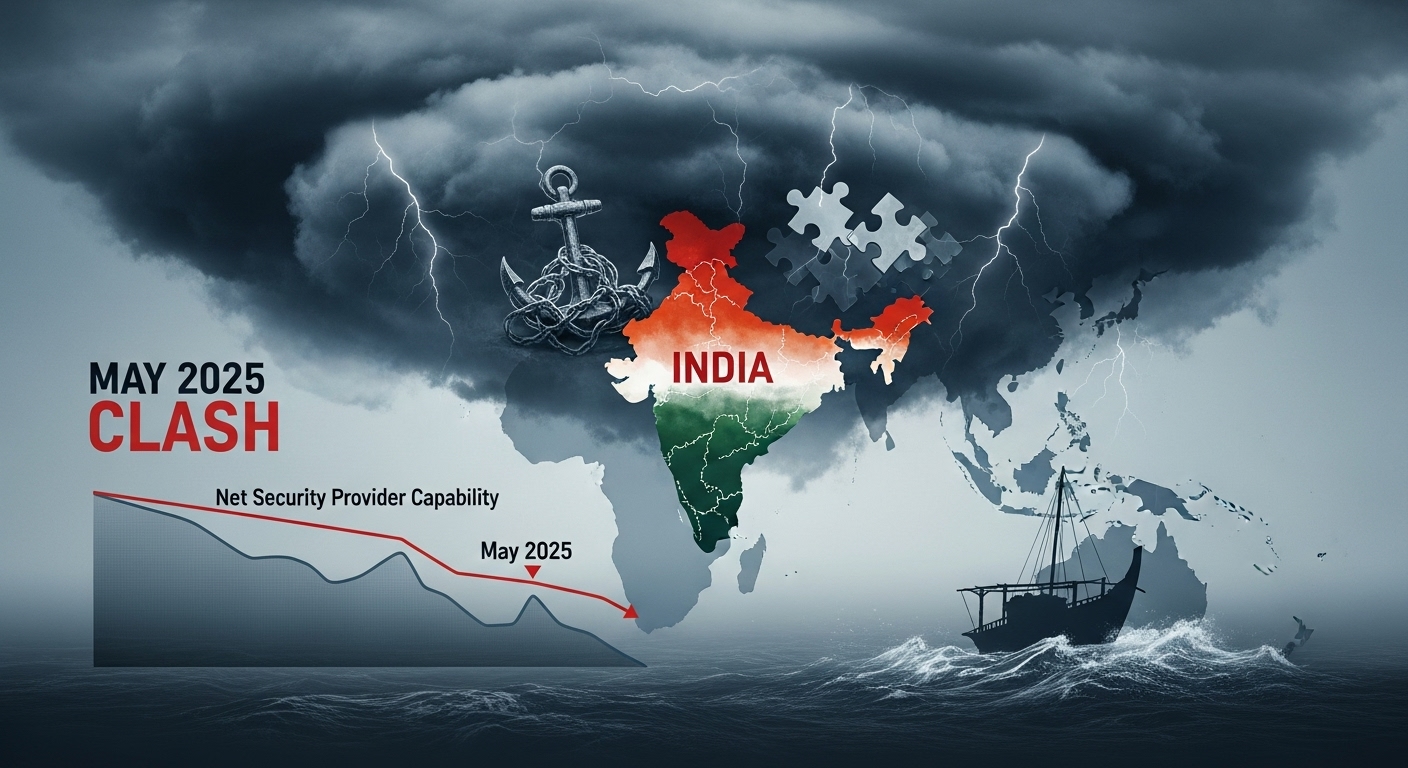
The May 2025 Clash and the Limits of India’s “Net Security Provider” Ambition
Introduction The four-day Indo-Pakistani military exchange in May 2025 ended without territorial change or major ground combat. Its political aftermath has proved far more consequential than the...

Introduction
The four-day Indo-Pakistani military exchange in May 2025 ended without territorial change or major ground combat. Its political aftermath has proved far more consequential than the fighting itself. Within hours of the ceasefire, New Delhi described the episode as a Chinese-orchestrated “proxy war” waged through Pakistan.
The claim was swiftly rejected in Beijing and Islamabad and, more significantly, found no endorsement in Washington. The 2025 annual report of the U.S.-China Economic and Security Review Commission treated the incident as a bilateral Indo-Pakistani flare-up and made no reference to Chinese operational involvement. No Western intelligence assessment or reputable open-source study has corroborated the accusation.
When a state habitually explains limited or inconclusive military outcomes by invoking great-power orchestration, it signals either unease about its own conventional capability or domestic political constraints that prevent candid acknowledgment of constrained results. Both readings quietly erode the credibility on which durable regional influence depends.
India’s Ambition vs Regional Reality
The episode has also exposed a widening contradiction between India’s declared ambition and the region’s actual response to Indian power. Since the early 2010s, New Delhi has styled itself South Asia’s “net security provider,” a role drawn from hegemonic stability theory: a dominant state can supply regional order only when smaller states judge that bandwagoning with it is cheaper and safer than balancing against it.
For the theory to hold, neighbours must feel more secure under the leading power’s umbrella than outside it. South Asia’s recent trajectory points in the opposite direction.
Balancing Behaviours of Neighbouring States
- Bangladesh: Begun systematic renegotiation of river-water treaties, awarded China major port and power projects, and ceased muting domestic criticism of Indian “big-brother” behaviour.
- Nepal: Rejected the 2019 Eminent Persons’ Group report on boundary disputes, issued new official maps incorporating territory India claims, and formally acceded to the Belt and Road Initiative that New Delhi long opposed.
- Maldives and Sri Lanka: Diversified their security and infrastructure partners to reduce exclusive reliance on India.
These actions are classic balancing behaviours, not the voluntary deference that stable hegemony requires.
The Security Dilemma in South Asia
Much of this reaction stems from a textbook security dilemma. India’s legitimate efforts to modernize its forces, secure its frontier with China, and deter Pakistani provocations are frequently perceived in neighbouring capitals as potential threats directed at them as well.
Large exercises near sensitive borders, forward deployments, and occasional economic or diplomatic pressure intended to enforce alignment all heighten smaller states’ sense of vulnerability. The result is the familiar spiral:
- India responds to perceived encirclement with greater assertiveness.
- Neighbours invite countervailing powers.
- India’s sense of encirclement deepens, prompting still more assertive actions.
The region ends up less secure than before India’s rise accelerated.
Recommendations for a Sustainable Indian Posture
A more sustainable posture would require three adjustments:
- Accept limited outcomes: Recognize that limited conflicts sometimes yield only limited results, and resist the temptation to reframe them as evidence of existential conspiracies orchestrated from Beijing.
- Transparent, benefit-driven arrangements: Replace the expectation of deference with rule-based agreements on water, trade, and transit that visibly benefit smaller neighbours rather than treating their compliance as natural.
- Restraint in military power: Demonstrate military capability through restrained, manifest actions. Let tangible results speak louder than announcements or defensive rhetoric.
Conclusion
South Asia already has anxious great powers on its periphery. What it still awaits is a leading state secure enough to live with constrained outcomes, mature enough to share benefits rather than extract them, and disciplined enough to let quiet competence replace defensive rhetoric.
Until India consistently displays those qualities, the “net security provider” label will continue to ring hollow, and the region will keep looking elsewhere for predictability and respect.
Author