

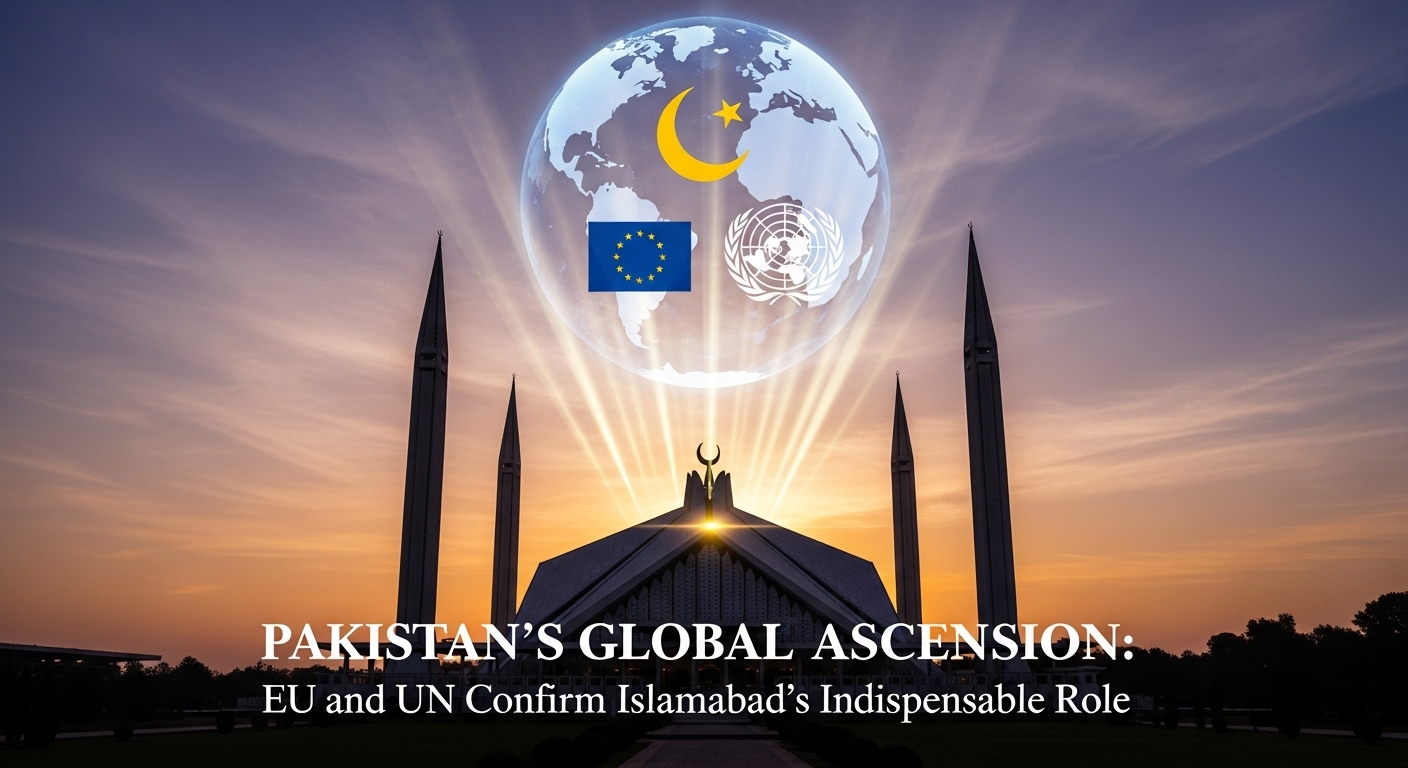
PAKISTAN’S GLOBAL ASCENSION: EU and UN Confirm Islamabad’s Indispensable Role
Introduction Pakistan is entering a new era of diplomatic recognition, one defined not by regional tensions or external perceptions but by its own deliberate evolution as a stabilizing global actor....
Introduction
Pakistan is entering a new era of diplomatic recognition, one defined not by regional tensions or external perceptions but by its own deliberate evolution as a stabilizing global actor. In recent months, both the European Union and the United Nations have signaled a decisive shift in how they view Islamabad’s role on the world stage.
This emerging consensus highlights Pakistan not as a peripheral participant in global affairs but as a country whose reliability, diplomatic maturity, and commitment to multilateralism have become impossible to ignore.
European Union Recognition
The European Union’s tone toward Pakistan has transformed with remarkable clarity. EU Ambassador Raimundas Karoblis’s recent remarks in Islamabad were more than polite diplomatic gestures; they represented a strategic reassessment.
His praise for Pakistan’s growing economic stability and its responsible approach to global issues underscored a deeper trend. Europe now views Islamabad as a partner capable of anchoring regional stability.
At a time when South Asia faces escalating tensions and unpredictable shifts, the EU appears increasingly convinced that Pakistan offers something invaluable: a commitment to dialogue over confrontation and stability over spectacle. This marks a significant pivot away from rewarding aggressive regional posturing and elevates Pakistan as the more dependable actor in a sensitive geopolitical landscape.
United Nations Validation
Pakistan’s ascension is further validated by its renewed prominence at the United Nations. Its overwhelming election to the UN Security Council for the 2025–2026 term, with an impressive majority vote from the General Assembly, demonstrates widespread international confidence in the country’s diplomatic posture.
Islamabad’s performance as a non-permanent member and later as the Council’s president reaffirmed its commitment to the foundational principles of the UN Charter, including:
- Dialogue-based conflict resolution
- Mutual respect among states
- Multilateral cooperation
In an era where unilateral actions and brinkmanship increasingly dominate global headlines, Pakistan’s emphasis on consensus building has stood out as a refreshing and responsible contrast.
Diplomatic Masterstroke
Taken together, these developments represent a diplomatic masterstroke by Islamabad. Pakistan has positioned itself as an indispensable contributor to global peace and regional stability, and both the EU and the UN have responded by expanding its diplomatic space rather than constraining it.
The implications are significant:
- Pakistan’s rise refocuses global attention on balanced engagement instead of coercive power politics.
- It undermines narratives built on military adventurism or regional intimidation.
- It reinforces the value of states that invest in diplomacy, restraint, and international cooperation.
A New Chapter for Pakistan
Pakistan’s global ascension is neither accidental nor temporary. It is the product of deliberate choices, consistent diplomatic engagement, and a growing recognition that Islamabad understands the value of stability in a volatile region.
As the EU strengthens its partnership with Pakistan and the UN entrusts it with a more prominent role in global governance, Islamabad stands at the threshold of a new chapter, one in which its influence is respected, its voice carries weight, and its commitment to peace sets a regional standard.
Closing Thought
“True development takes root when nations stop competing for advantage and start competing for understanding.”
Author