


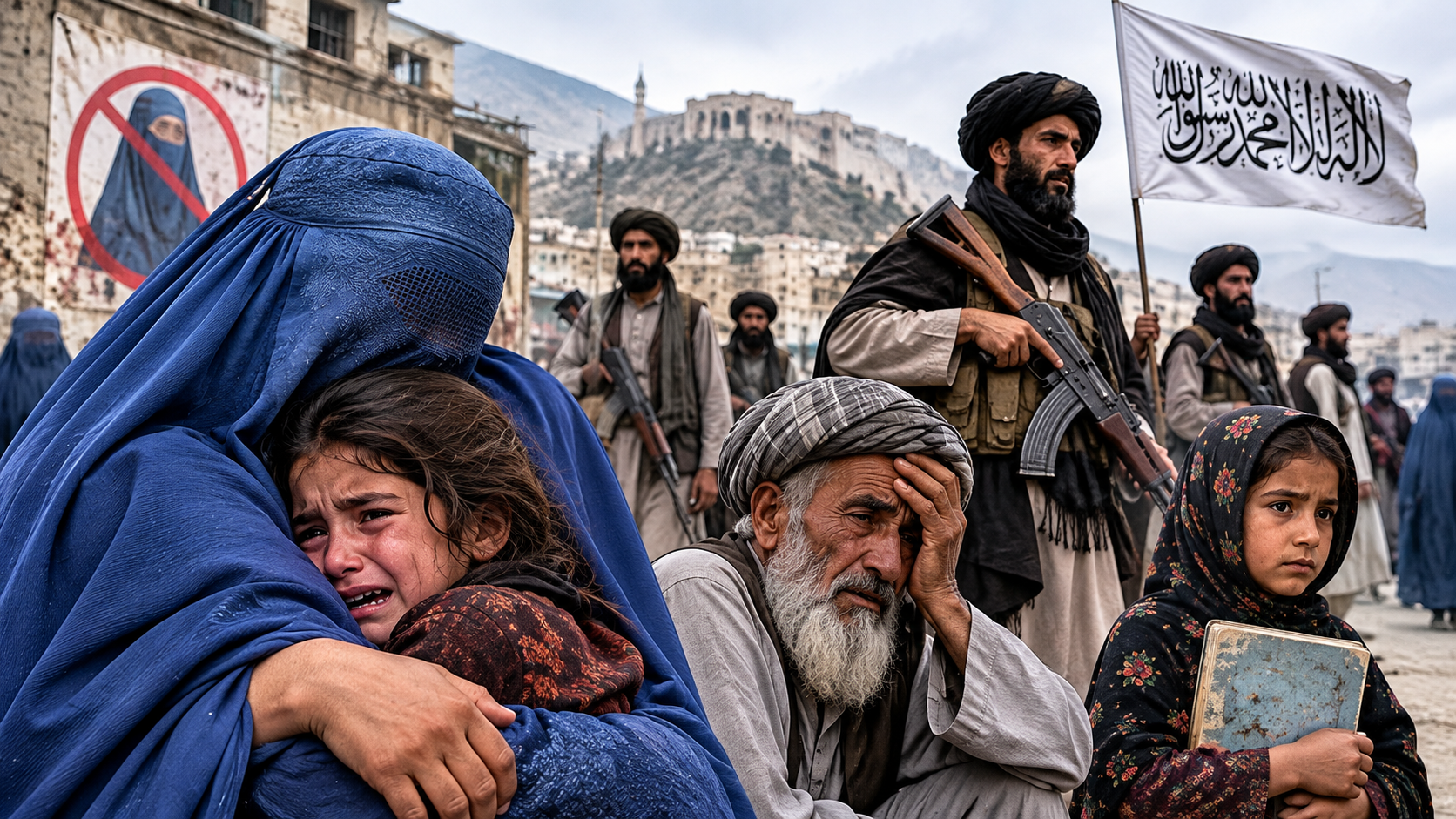
The Human Cost of Taliban Rule in Afghanistan
When five-year-old Zainullah fell 70 meters into a Kandahar well, it wasn’t emergency services that saved him, it was the raw bravery of an 11-year-old volunteer. This miracle highlights the...
When five-year-old Zainullah fell 70 meters into a Kandahar well, it wasn’t emergency services that saved him, it was the raw bravery of an 11-year-old volunteer. This miracle highlights the haunting memory of young Haidar, who died in a Zabul borehole. These are not mere accidents; they are symptoms of a failed infrastructure. Decades of environmental neglect, zero regulation, and a complete absence of public protection have forced ordinary Afghans to become their own rescuers in a landscape of hidden hazards.
In Afghanistan, the daily struggle is no longer about dodging bullets, but finding bread. In April 2026, the World Food Programme documented the case of families like Saeed Azeez’s in Parwan live on dry crumbs and relatives’ charity. His plight mirrors a staggering emergency; The United Nations Office for the Coordination of Humanitarian Affairs (OCHA) estimated 28 million Afghans could not meet basic needs, and 19.2 million face acute winter food insecurity. With 21.9 million people, a crushing 45% of the population, requiring immediate aid, the country is enduring a quiet, systematic starvation.
The Taliban regime routinely blames Afghanistan’s misery on past wars and international sanctions. While those scars are real, the excuse has become a shield against accountability. By banning women from education and jobs, the regime deliberately crippled half its workforce and choked the economy. When ideology is prioritized over public services, the suffering stops being a casualty of yesterday’s war—it becomes the direct result of today’s policy choices.
An Economy Failing Ordinary Households
Afghanistan is living an economic paradox: a regime celebrating a 1.9% rise in GDP while its people systematically starve. According to the UNDP, a massive 6.5% population surge completely wiped out those gains, driving real GDP per capita down by 2.1%. Today, a staggering 28 million Afghans—three-quarters of the population—cannot meet their basic needs. This is the difference between statistical growth and human survival. With international aid plunging by 16.5% and a crushing $11.3 billion trade deficit swallowing 60% of nominal GDP, the nation is financially bleeding out, kept alive only by a dwindling humanitarian lifeline
The reality on the ground for families and millions of forced returnees is a desperate scramble for scraps. In communities absorbing these returns, a mere 3% of people hold formal employment, leaving an overwhelming 78% dependent on unstable, day-to-day casual labour. This income vacuum directly feeds a nutritional crisis. A recent UK assessment revealed that 78% of Afghans cannot afford nutritious food, forcing parents to make heartbreaking compromises—slashing meal sizes, buying cheap, empty fillers, or drowning in debt just to survive the day.
By systematically banning women from economic life, the Taliban regime has deliberately amputated half of its country’s productive workforce. This state-enforced, self-inflicted paralysis has frozen economic capacity and deepens chronic unemployment. Ultimately, it leaves Afghanistan permanently dependent on the very foreign assistance the regime purports to reject.
Water Scarcity and Weak Governance
A catastrophic water crisis is quietly redrawing the social landscape of Afghanistan. Driven by prolonged drought, declining rainfall, and excessive groundwater extraction, more than half the country now faces severe water scarcity, with southern provinces like Kandahar and Helmand hit hardest. Today, 15.9 million Afghans urgently require water, sanitation, and hygiene assistance, while a staggering quarter of all households depend entirely on unimproved, unsafe water sources. Without a functioning regulatory framework, wealthier landowners are drilling deeper boreholes with solar-powered pumps, drastically accelerating the depletion of communal aquifers. This laissez-faire approach has turned a fundamental human right into an expensive luxury, forcing impoverished farmers—who cannot afford to dig deeper—to watch their crops wither and die. UN agencies warn that even the capital’s groundwater reserves could hit critical exhaustion by 2030, proving that without strict administrative monitoring, commercial drilling regulations, and modern conservation, the Taliban is letting the nation’s future evaporate.
Security Spending Versus Public Welfare
The Taliban administration boasts that its self-collected domestic revenues can fully sustain government operations, yet its spending blueprint reveals a profound misunderstanding of actual national security. According to the World Bank’s Afghanistan Economic Monitor published in August 2026, the regime funneled a staggering 45.2 per cent of its public expenditure, approximately $787 million, directly into its security and military apparatus. In a country not currently fighting a conventional civil war, this heavy prioritization of guns over bread exposes a regime deeply focused on internal control. True national stability cannot be achieved through the barrel of a gun when the civilian population is structurally collapsing from within.
While the military treasury overflows, the foundational blocks of Afghan society are left to wither on pennies. The same World Bank metrics reveal that the administration allocated a modest 16.1 per cent ($281 million) to education, while healthcare received a microscopic 2.1 per cent ($37 million) and agriculture was tossed a mere one per cent ($18 million). This budget is deployed against a backdrop where OCHA reports that 45 per cent of the population requires immediate humanitarian aid. While these stark numbers don’t imply that all security spending is invalid, they conclusively prove that the Taliban is willingly starving the health, food, and water systems of its country. By treating agriculture and health as global charity cases rather than state responsibilities, the regime’s budget has become a primary driver of the nation’s ongoing humanitarian emergency.
Excluding Women, Undermining Afghanistan’s Future
The systematic banishment of women from public life is the Taliban’s most self-destructive policy, making Afghanistan the only nation on earth to formally outlaw female education. According to a grim August 2026 assessment by UNESCO, approximately 2.4 million girls remain locked out of secondary education, a reality backed by UNICEF’s reporting that over 2.6 million have been denied their schooling since 2021. This institutionalized erasure is rapidly dismantling the nation’s human capital. The UNDP estimates that keeping women out of schools and workplaces actively bleeds the Afghan economy $84 million annually in lost output. Rather than building a self-sustaining state, the regime has chosen to evaporate its own economic potential.
The consequences of this gender apartheid are actively crippling the country’s vital healthcare and educational infrastructures. A UNICEF analysis warns that if these restrictions persist, Afghanistan will lose up to 20,000 female teachers and 5,400 female health workers by 2030—a devastating blow to a population already suffering from widespread malnutrition and disease. This policy is rigidly enforced by an increasingly intrusive state apparatus. UNAMA documented a terrifying wave of enforcement, verifying 443 arbitrary arrests and detentions, alongside 97 cases of ill-treatment by the morality police. By replacing essential female civil servants—whose representation dropped from 21% to 17.7%—with fear and strict dress-code detentions, the regime has transformed a social restriction into a permanent, self-inflicted institutional crisis.
A Health System Under Pressure
Afghanistan’s collapsing medical infrastructure remains a devastating monument to its dependency on global funds, now starved by international isolation. According to data from the World Health Organization (WHO) Health Cluster, the suspension of United States funding and widespread donor cuts forced the closure of at least 422 primary healthcare facilities and mobile nutrition teams. This sudden blackout of care instantly stranded approximately 3.3 million vulnerable people without access to basic medicine. As a result, the latest humanitarian assessments indicate that a staggering 14.4 million Afghans now desperately require health assistance just to survive.
While foreign aid cuts triggered this medical tailspin, the Taliban regime has turned a financial wound into a fatal, self-inflicted crisis. Stripping women of mobility and education systematically chokes the pipeline of female medical professionals, blocking the very healers the country needs. Ultimately, the collapse of Afghan healthcare is no longer just a symptom of international sanctions—it is the direct consequence of a regime that prioritizes dogma over doctors.
Opium’s Return: Prohibition Without Alternatives
The Taliban’s drug enforcement has hit an economic wall, proving that prohibition cannot survive when a populace is stripped of basic resources. According to the UNODC’s Afghanistan Opium Survey released on 29 October 2026, opium poppy cultivation skyrocketed by 330 percent to 43,300 hectares, up from just 10,000 hectares in 2025. This massive resurgence drove a fivefold spike in production to 1,500 metric tonnes, netting desperate farmers an estimated $525 million—the highest monetary return since 2018. When families lack the capital for specialized seeds, expensive fertilizers, or deep-well irrigation, illicit cultivation stops being a criminal choice and becomes a mechanism for human survival. Facing severe drought, collapsing domestic cotton prices, and broken trade routes, impoverished farmers are forced back to the black market simply to keep their children from starving.
The revival highlights a dangerous policy vacuum, as aggressive eradication campaigns were never backed by sustainable economic alternatives. The UNODC warns that transitioning farmers away from illicit crops requires an estimated $500 million in development support, yet international donors and local authorities have funded only a tiny fraction of that goal. Because poppy requires significantly less water and upfront investment than legal alternatives, it serves as a necessary liferaft for resource-deprived rural communities. Ultimately, while the Taliban’s enforcement efforts initially kept cultivation below pre-2022 levels, this sudden 2026 boom proves that absolute poverty will always outlast iron-fisted decrees, threatening to rapidly breathe new life into international trafficking networks.
Regional Isolation and Border Disruptions
Afghanistan’s landlocked geography makes regional trade essential to its economic survival. Deteriorating relations with Pakistan, particularly the Tehreek-e-Taliban Pakistan (TTP) that operates from Afghan territory, have further complicated commercial connectivity. Pakistan has repeatedly urged Kabul to prevent its territory from being used for attacks, while Taliban authorities reject allegations of providing militant safe havens. While Islamabad acts on legitimate security imperatives, the Taliban rejects verified intelligence, prioritizing regional destabilization over civilian survival. By refusing to engage in verifiable regional cooperation or maintain predictable trade channels, the regime has deliberately crippled local businesses and left drought-stricken farmers to watch their livelihoods wither at blocked borders.
External Constraints and Taliban Responsibility
The Taliban regime masterfully weaponizes the narrative of international isolation to mask its own destructive choices. While the post-2021 freezing of $7 billion in central bank assets and the drying up of foreign aid created undeniable obstacles, these external factors are increasingly used as a political shield to deflect from catastrophic domestic failures. International sanctions do not dictate the systematic banishment of women from public life, nor do they force the regime to neglect collapsing groundwater reserves. The reality is that the Taliban successfully collects domestic taxes and generates revenue, yet deliberately chooses to starve public services. The current crisis is not a symptom of a state lacking resources; it is the direct outcome of a regime aggressively choosing ideological warfare over human survival.
The Taliban has demonstrated an absolute, chilling capacity to police public behavior, crush personal freedoms, and fund a massive security apparatus. Yet, this total administrative control has utterly failed to translate into basic public care. A regime cannot claim to govern when nearly half the population requires immediate humanitarian assistance to survive the winter, and an entire generation of girls is forcibly erased from society. The staggering 330% surge in opium poppy cultivation in 2026 is the ultimate proof of this failure—proving that iron-fisted bans achieve nothing when a regime starves its own farmers of economic alternatives. Authority without responsibility is merely an occupation. Until the Taliban prioritizes the fundamental survival of the Afghan people over its own dogmatic control, it remains an oppressive regime rather than a legitimate government.
Author