


The Ghost of Washington vs. Arizona’s Perennial Purgatory: A Week 12 Gridiron Mismatch or Harbinger of Financial Ruin?
POLICY WIRE — Washington D.C. / Glendale, Arizona — The NFL, for all its pomp and carefully curated parity, still occasionally serves up a spectacle that’s less about competition and more about...

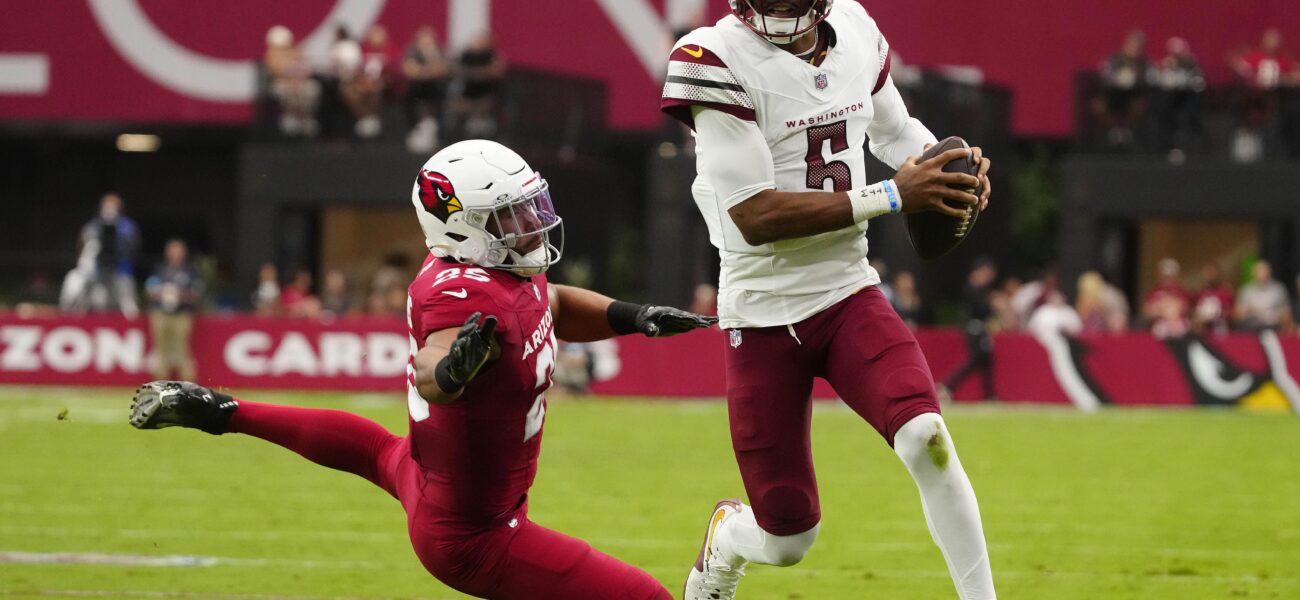
POLICY WIRE — Washington D.C. / Glendale, Arizona — The NFL, for all its pomp and carefully curated parity, still occasionally serves up a spectacle that’s less about competition and more about corporate asset management. Such appears to be the case as the newly re-branded Washington Commanders roll into Glendale in Week 12 of the 2026 season, facing an Arizona Cardinals franchise that seems perpetually stuck in a Sisyphean struggle of its own making. This isn’t just another game on the schedule; it’s a stark reflection of divergent organizational philosophies, one eyeing potential resurgence, the other bracing for another cold winter of discontent. You’d think the Commanders, a franchise with its own turbulent past, would understand. But this feels different. Very different.
It’s no secret: Arizona’s situation is grim. While Commanders fans might squint at their team’s early-season schedule —a gauntlet against legitimate contenders—it’s the Cardinals who truly draw the short straw. By November 29th, they’ll have wrestled with top-5 juggernauts like the Rams and 49ers multiple times, not to mention formidable Lions and Chiefs squads. It’s a schedule that, as one might predict, promises to leave them bruised and battered long before the Commanders’ charter plane even touches down. Oddsmakers know it too, planting Washington as a 4.5-point favorite on the road—a pretty healthy margin, if you ask me, for a mid-November NFL game. But what’s fascinating is how this matchup, framed as a Commanders’ ‘get-right’ opportunity, inadvertently shines a spotlight on the Cardinals’ chronic organizational instability.
“Look, every Sunday’s a new challenge, right? We respect every opponent,” offered a notably understated Director of Football Operations for the Washington Commanders, who preferred to speak anonymously about team psychology rather than specific player matchups. “But we’re also realists. We’ve faced our own struggles; we know what good organizations do when things get tough. They don’t just churn. They build. Patiently.” This subtle dig wasn’t lost on anyone watching the Cardinals’ latest maneuvers. Following a woeful 3-14 campaign in 2025, which saw them jettison both head coach Jonathan Gannon and the erstwhile franchise quarterback Kyler Murray, they’ve embraced what can only be described as a full-spectrum organizational reboot. Head Coach Mike LaFleur, in his first head coaching gig after serving as an offensive coordinator, has brought in Nathaniel Hackett to helm the offense – an appointment that raised a few eyebrows, considering Hackett’s recent track record. But they’re committed. Absolutely.
Their defensive coordinator, Nick Rallis, somehow managed to cling on, overseeing a unit that hemorrhaged points like a sieve, finishing 29th in scoring defense in 2025. It’s hard to make that work, particularly in the cutthroat NFL. The Cardinals, you see, are playing the long game—or so they say—betting on a youth movement highlighted by Jeremiyah Love, the No. 3 overall pick. He’s got big shoes to fill, financially — and symbolically.
The parallels to geopolitical realignments aren’t entirely far-fetched. Think about fledgling economies in regions like Pakistan, for instance, attempting ambitious ‘vision’ programs. They often confront deeply entrenched structural issues and external pressures, where short-term gains are sacrificed for theoretical long-term stability—often with little immediate payoff for the struggling populace, or in this case, the fans. “Our focus isn’t on Week 12 projections,” declared LaFleur recently, trying to put a brave face on it. “It’s about building a sustainable program, a foundational identity. That takes time, it takes buy-in. It takes painful Sundays.” Painful Sundays for him, even more so for the long-suffering fan base, who’ve not seen a title since 1947.
📄 POLICY WIRE WHITEPAPER PUBLISHED: PAKISTAN'S NATIONAL SECURITY POLICY PRIORITIES
👉 READ BY CLICKING HEREWhat This Means
For the Cardinals, this encounter represents less a competitive challenge and more a grim referendum on their ‘rebuild or bust’ strategy. The economic implications are straightforward: a continually losing product means a depreciating asset. Fan loyalty, though robust, isn’t infinitely elastic; season ticket renewals, merchandise sales, and local broadcast ratings all suffer when hope is systematically dismantled each year. When a team enters a season with external expectations capped at ‘four or fewer wins,’ as national publications project for Arizona, you’re not selling dreams; you’re selling existential dread. But, maybe that’s their political strategy: manage expectations so low that simply showing up to the fight constitutes a moral victory.
For the Commanders, it’s about validating their own narrative. A favorable schedule run starting around Week 12 offers a chance to either solidify a playoff push or, at the very least, stabilize their public image after years of ownership turmoil and rebrands. Losing to a team actively planning for next year’s draft isn’t just an athletic setback; it’s a reputational crisis. Winning, on the other hand, is currency. It justifies recent investments, both in personnel — and PR. It keeps the political machine of fandom engaged — and supportive. And this is particularly true for a club that’s just finding its footing. The global fascination with American sports, with leagues expanding their footprint through international broadcast deals—it’s all predicated on competitive tension. But games like these? They show the underbelly. For many organizations, the real long-term money’s not made through these kinds of lopsided battles; it’s through sustainable competitiveness, through cultivating an aura of winning that extends beyond geographical bounds, influencing global interest, and potentially even foreign investment. That kind of ‘soft power’ is invaluable. Check out The Brutal Economics of Glory for more on sports and finance. Or, you know, just watch the game and root for the underdog. Either way, someone’s paying. Beyond the Postcard sometimes these things take on deeper meanings.