


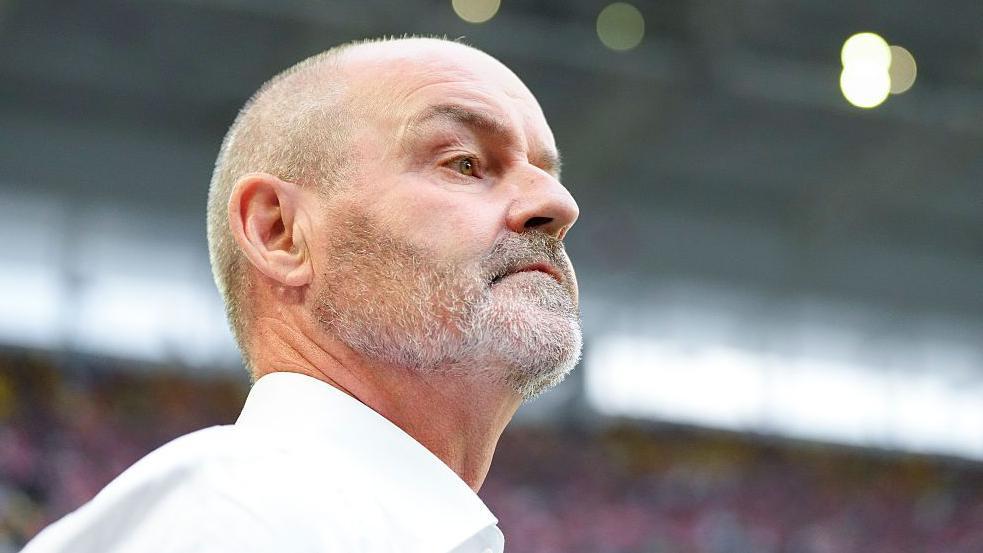
The Gaffer’s Gambit: Scotland’s Exit Exposes Fragile Footballing Empires
POLICY WIRE — Edinburgh, Scotland — It wasn’t the cheers of a victorious nation that broke the Saturday evening quiet for Scottish football fans. Nor was it the somber silence of dignified...

POLICY WIRE — Edinburgh, Scotland — It wasn’t the cheers of a victorious nation that broke the Saturday evening quiet for Scottish football fans. Nor was it the somber silence of dignified defeat. Instead, it was an almost clinical email, a tersely worded statement from the Scottish FA, delivered mere minutes after Croatia’s triumph over Ghana hammered the final nail into Scotland’s World Cup coffin. Steve Clarke, the man who had only inked a new four-year deal a mere month ago, was out. Just like that.
And so, the peculiar dance of expectation and swift dismissal played out, a spectacle common in professional sports but rarely quite so stark. They say Clarke — and his squad, hunkered down in their Charlotte base, were given the news almost concurrently. A finality, raw — and abrupt, even before the last echo of the officiating whistle had truly faded. You’d think there might be a cooling-off period, a moment for the sheer disappointment to settle. But the wheels of football commerce—and, frankly, public opinion—don’t generally operate on human sentimentality. It’s a sharp business, this, with stakes far beyond what’s visible on the pitch. [QUOTE_PLACEHOLDER]
Clarke, it’s fair to say, hadn’t just guided the Scots back to major tournaments; he’d dragged them there. They hadn’t seen the big stage since the 1998 World Cup. His seven-year tenure had witnessed qualification for two European Championships and, of course, this summer’s World Cup. Yet, the brutal truth remains: despite those tickets to the dance, Scotland, under his watch, found themselves wanting when the spotlight shone brightest. Their record at these tournaments is fairly sobering. They clinched a solitary victory against Haiti—a 1-0 opener in Boston—across all three major finals appearances during his time, a statistic often overlooked in the nostalgic glow of mere qualification. It doesn’t tell the whole story, but it sure puts a number on the final act, courtesy of analysis from BBC Scotland.
That lone win. Then came the reality. A 1-0 loss to Morocco. A bruising 3-0 defeat against Brazil in Miami, sealing their early exit. You almost picture the board members, their grim expressions hardening as each goal went in. The narrative had shifted from the admirable journey to the underwhelming destination, as it often does. Even Ian Maxwell, the Scottish FA chief executive, couldn’t quite mask the sting of it all, even while offering the polite corporate salve: While we’re all disappointed to have exited the World Cup at the group stage, we must not lose sight of the undeniable progress made during Steve’s seven years in charge
.
Progress, indeed. They’d gone From starting as a pot four team in 2019 to topping our World Cup qualifying group
, as Maxwell noted. But progress doesn’t always buy time, does it? Not in the cutthroat arena of international sports where expectations, once lifted, become a crushing burden. Clarke, for his part, was graceful, perhaps a little weary. He spoke of the players, his affection for them, describing them as The most emotional part of this goodbye is for my players, without whom we wouldn’t have had any of the memories that we’ve accumulated from 2019 until now
. A quiet dignity, a rare thing in a profession so often characterized by bluster — and bravado.
The immediate aftermath has been filled with the expected shock, as BBC Sport Scotland’s Scott Mullen observed from Miami. The timing’s odd, given that recent contract. The final question on everyone’s lips now is, predictably, who now?
But, this is a policy wire, so we must ask ourselves something else.
📄 POLICY WIRE WHITEPAPER PUBLISHED: PAKISTAN'S NATIONAL SECURITY POLICY PRIORITIES
👉 READ BY CLICKING HEREWhat This Means
The swift ousting of a national coach, even one lauded for past successes, holds a mirror to the political landscape, both domestically and abroad. Sports, particularly football in a country like Scotland, isn’t just a game; it’s a potent symbol of national pride, collective aspiration, and, frankly, an often-unseen soft power asset. Failures on the pitch can, however briefly, dampen national morale, even becoming proxies for broader societal frustrations.
For administrations—whether football federations or governments—the calculation is often about optics and momentum. Keeping a ‘losing’ manager, despite a decent track record, can be perceived as an endorsement of stagnation. It’s a quick fix, an expendable executive, a sacrifice made at the altar of public sentiment to demonstrate decisiveness. Economically, major tournaments bring tourist dollars and broadcast revenue, and consistent underperformance eventually risks eroding that golden goose.
Consider the intensely passionate football and cricket cultures across South Asia—countries like Pakistan, where a national team’s success or failure can literally spark nationwide celebrations or furious public outcry. The coach, or even the captain, becomes an immediate lightning rod. Their tenures are often far more precarious than in European counterparts, subject to extreme scrutiny and rapid turnover fueled by a demanding public and powerful media. The emotional investment from citizens isn’t just about the sport; it’s often inextricably linked to a complex identity, a sense of belonging in a world where geopolitical realities are always in flux. Such sporting failures can, even subtly, become entangled with national narratives of progress or decline, amplifying political discontent or fueling nationalist pride.
So, while the Scottish FA thanks Clarke for his record-breaking contribution
, they’re also keenly aware of the bottom line: results. And sometimes, good intentions and past triumphs just aren’t enough when the global stage demands continuous, unambiguous success. Because that’s the nature of the beast, in football — and in policy, when everything’s on the line.