


The Fire Next Time: Canada’s Wildfires and the Collapse of Climate Complacency
A nation on fire is a nation confronting truth. In the summer of 2025, Canada, the serene northern giant so often caricatured by snow, stillness, and civility, burns with a fury that is as ecological...

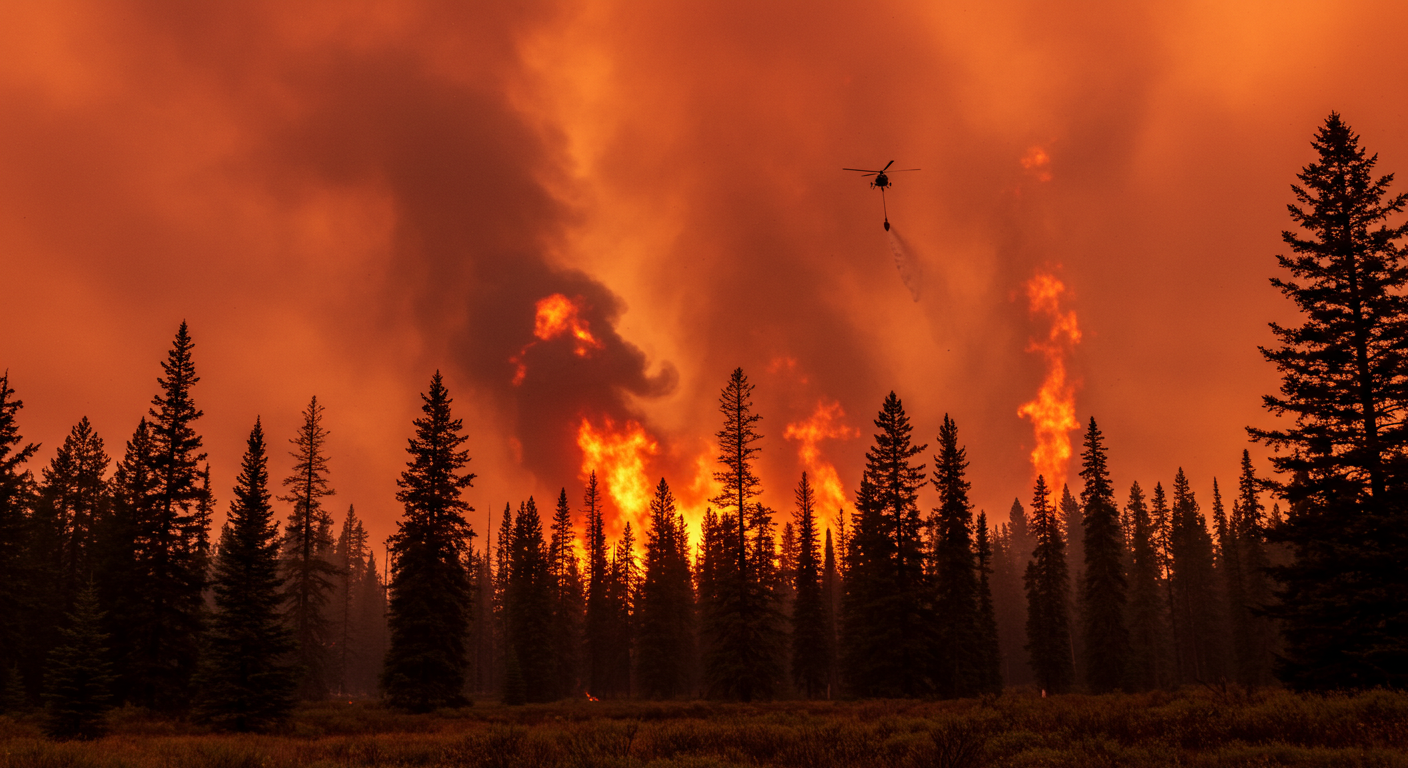
A nation on fire is a nation confronting truth. In the summer of 2025, Canada, the serene northern giant so often caricatured by snow, stillness, and civility, burns with a fury that is as ecological as it is existential. From Manitoba’s evacuated towns to the ash-soaked skies of Quebec, and from choking urban skylines in Toronto to distant smoke curling across the Atlantic and darkening European air, the wildfires now engulfing Canada are no longer seasonal anomalies. They are a terrifying new normal. A signal that the age of climate consequence is not coming. It is here.
More than 17,000 Canadians have been displaced in recent weeks, and hundreds of thousands more live under air quality advisories. Critical infrastructure is at risk. Emergency responders are stretched beyond human capacity. And all the while, the fires rage: unrelenting, unpredictable, and largely unstoppable. The flames consume not only forests but illusions, illusions that the Global North is insulated from the ravages of climate breakdown, that temperate democracies can delay adaptation, that “developed” means prepared. Canada, once imagined as a climate haven, is now the front line of planetary crisis. This is not just a natural disaster. It is an ecological reckoning and a political indictment.
To label these fires “natural” is itself an act of denial. Yes, wildfires have always been part of Canada’s boreal forest ecosystems. But what we are witnessing today is qualitatively and quantitatively different. These are not forest fires as usual. They are mega-fires. They jump rivers, generate their own weather systems, melt permafrost, and devour thousands of hectares in hours. They send smoke across hemispheres. According to Environment Canada, wildfire activity in 2025 has surpassed all historical records, with nearly 18 million hectares burned before the start of June. The scale is biblical. The cause, however, is unmistakably modern: fossil-fueled climate change.
The science is unambiguous. Rising global temperatures, driven overwhelmingly by human-induced greenhouse gas emissions, have dried out Canada’s forests, lengthened the fire season, and amplified lightning activity. When combined with poor forest management, underfunded fire services, and decades of policy inertia, the result is a perfect storm of flame. Yet even in the face of this inferno, political leadership remains alarmingly flammable. The Canadian federal government has issued statements of concern, allocated emergency funds, and called in military assistance. But it has stopped short of declaring a national climate emergency, let alone outlining a transformative green policy agenda that might match the scale of the threat.
This is not just a policy failure. It is a moral abdication.
The climate crisis in Canada challenges not only political will but also colonial assumptions about nature, territory, and resilience. Indigenous communities, who steward nearly 20% of Canada’s forests and have sounded the alarm for decades, are once again among the worst affected and the least supported. Their knowledge, based on millennia of land stewardship, remains marginalised in wildfire management strategies. Entire First Nations villages have been evacuated without prior consultation or long-term housing plans. Traditional lands are incinerated, elders displaced, and cultural sites lost beneath smoke and soot. This is not merely environmental injustice. It is a continuation of settler violence through climate neglect.
Moreover, the wildfires expose the contradictions at the heart of Canada’s identity as a climate leader. On the one hand, Prime Minister Justin Trudeau’s administration champions net-zero goals, carbon pricing, and green innovation on the global stage. On the other hand, it continues to subsidise oil and gas exploration, expand pipelines, and flirt with LNG terminals. Canada is the fourth-largest oil producer in the world and one of the most carbon-intensive economies per capita. The fires mock this hypocrisy. They burn through speeches, shred press releases, and torch the myth of moral leadership in a world on fire.
But the implications of Canada’s wildfires transcend national boundaries. This is not just a Canadian crisis. It is a planetary signal flare. The smoke from these fires has already triggered air quality alerts in New York, Chicago, and even as far as northern Europe. Particulate matter has entered the respiratory systems of tens of millions, increasing asthma attacks, hospital admissions, and premature deaths. The plumes carry not only toxins but warnings: that no border can hold back atmospheric collapse, and no economy can firewall itself against ecological implosion.
Indeed, the wildfires represent an economic catastrophe in slow motion. Insured damages are projected to run into billions, with agricultural productivity, tourism, and transportation all impacted. The Canadian insurance industry has already warned of unsustainable payouts, while rural economies dependent on forestry face long-term collapse. The Canadian economy, for all its sophistication, is not structurally insulated against climate volatility. And if Canada, a G7 nation with advanced infrastructure, a strong public sector, and abundant freshwater, cannot withstand climate disruption, what hope is there for poorer, less equipped nations?
Yet amid the devastation, there is also a lesson. Canada’s wildfires should not only evoke despair. They should ignite transformation. There is a path forward, but it begins with radical honesty. First, Canada must declare a national climate emergency, not as a symbolic gesture but as a legal and budgetary framework for rapid systemic change. This includes phasing out fossil fuel subsidies, legislating strict emissions caps, investing in ecological fire management, and empowering Indigenous climate leadership. It means reimagining urban planning around climate resilience, retrofitting homes against air pollution, and deploying real-time public health responses to wildfire smoke events.
Second, the country must recognise climate adaptation as a matter of justice. That means prioritising support for the most vulnerable: rural, Indigenous, and low-income communities whose resilience is being tested beyond capacity. Emergency evacuation systems, mental health services for climate trauma, and community-led fire preparedness initiatives must become central pillars of national policy, not afterthoughts.
Third, Canada must speak plainly to the world. The fires should fuel a renewed international call for climate reparations, global emission reductions, and urgent support for frontline nations. Canada’s voice, backed by lived crisis, could push climate negotiations from incrementalism to action. But it cannot preach what it refuses to practice. Leadership demands sacrifice. It requires telling the truth, even when the truth burns.
What burns in Canada today is not just forest. It is comfort, denial, and delay. It is the fantasy that incremental reforms can tame an exponential crisis. It is the hope that science alone can save us without politics, without disruption, without sacrifice. The smoke is a curtain, but it cannot hide what’s coming. The flames are loud, but we must listen deeper; to the voices of those on the frontlines, to the memory of landscapes lost, to the children breathing smoke, and to the fire next time.
This is a moment for history. How we respond will echo not just through policy briefs and disaster reports, but through generations. The wildfires of 2025 could be remembered as the tipping point, not of climate collapse, but of collective awakening. But only if we act. Only if we abandon the comforts of moderation and the fictions of neutrality. Only if we fight fire not just with water, but with justice.
Let Canada’s forests not die in vain. Let their burning write a new contract between humanity and the Earth, one founded not on dominion but on solidarity, not on extraction but regeneration, not on delay but on decisive, irreversible change.
In the end, it will not be the fire that defines us. It will be our response.
Author