


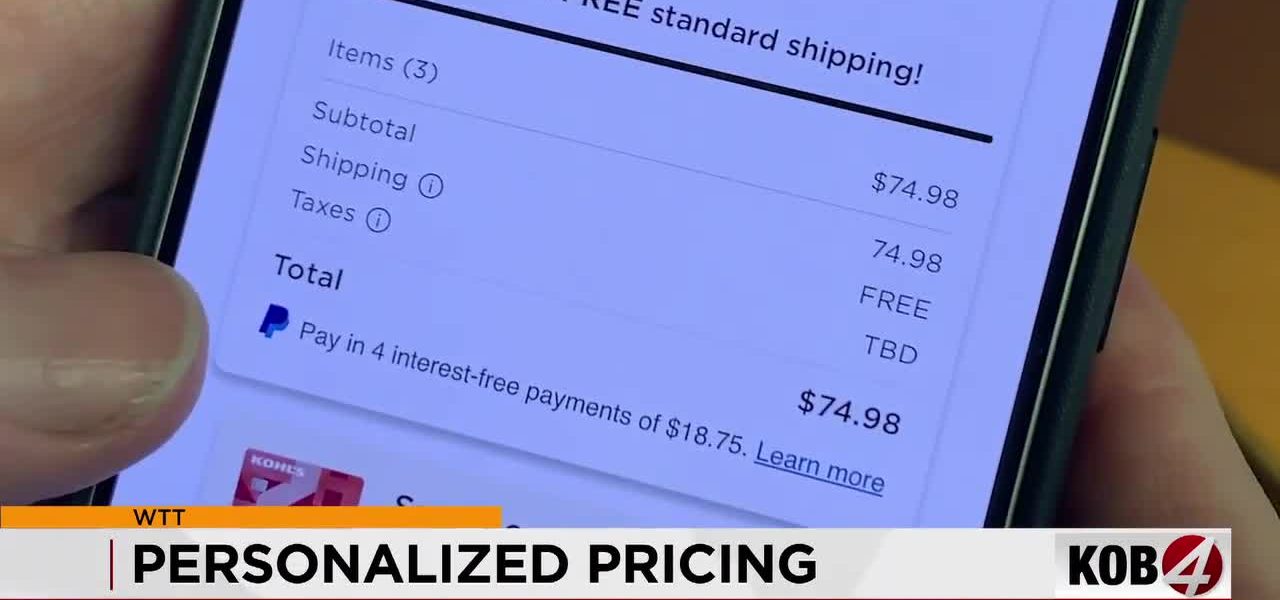
Personalized Pricing: Is AI Setting Your Secret Cost?
Uncover how AI algorithms are creating personalized price tags for shoppers. Explore the ethical dilemmas of dynamic pricing and its impact on your purchasing power.

POLICY WIRE — Washington, D.C. — You know that eerie feeling? The one where an ad for something you only thought about buying pops up on your screen, as if by magic? Well, prepare for that subtle unease to settle in much deeper. The retail world, that tireless engine of commerce ever-hungry for efficiency and, let’s be blunt, fatter margins, is stealthily gearing up for a future where your very persona dictates the price tag. Not the standardized shelf price, mind you—oh no, that’s far too quaint—but an invisible one, conjured just for you by an unseen algorithm. This isn’t just about offering targeted discounts; it’s about gauging what you’ll actually fork over.
It sounds like science fiction, or perhaps a particularly cynical Black Mirror episode, but it’s quietly becoming our commercial reality. Forget scanning the barcode; now, the barcode might be scanning you. We’re not talking about simply knowing your location, though they do. Or whether you’re logged into an account, which they absolutely track. Retailers have developed sophisticated models to predict what you’ve purchased before, what you’ve left idling in your digital shopping cart, and even—this is where it gets creepy—your probable income bracket or credit risk based on a staggering array of data points.
This surveillance pricing, as some consumer advocates grimly call it, operates in the shadows. Companies will tell you AI is there to “enhance your shopping experience” by offering relevant products and bespoke recommendations. Sounds helpful, doesn’t it? But many worry that the same computational prowess can just as easily be weaponized to determine not merely what you see, but precisely what you pay, moment by moment. Because it isn’t about finding the “best” price for you, it’s about finding the “most” you’re willing to pay. And often, it’s a few bucks more.
“We’re hurtling towards a two-tiered economy where pricing transparency is an antiquated concept,” remarked Senator Elaine Chao (R-KY), a consistent voice on digital consumer rights. “If a car dealership couldn’t openly discriminate based on arbitrary factors decades ago, why should an algorithm be allowed to do so covertly today? We’ve got to put guardrails on this, and soon.” Indeed, proving that businesses are engaging in discriminatory pricing — charging different amounts to different shoppers for the identical item — is notoriously tough. You won’t easily find a side-by-side comparison proving a discrepancy, even if you try to game the system with multiple browsers or accounts. But make no mistake, federal regulators are poking around. They don’t like the whiff of algorithmic bias one bit.
The implications aren’t confined to developed markets, either. Consider countries like Pakistan or Bangladesh, where burgeoning e-commerce platforms increasingly cater to a diverse consumer base. Many shoppers in these regions rely on mobile payments or remittances from family members abroad. Imagine algorithms identifying and targeting these income streams, adjusting prices upwards for families known to receive consistent transfers, effectively taxing their economic stability. A recent report by the Oxford Internet Institute indicated that roughly 67% of consumers globally believe — whether they can prove it or not — that online stores routinely use personalized pricing tactics, a number that jumps considerably in regions with lower digital literacy.
“For vulnerable populations, this isn’t just an inconvenience; it’s an existential threat to fair trade,” stated Ayesha Khan, Director of the Digital Rights Foundation in Lahore. “When a low-income household in Karachi is effectively charged more for basic necessities because an algorithm flags their purchasing patterns as ‘high engagement’ or ‘less price-sensitive’ at a specific time, it perpetuates inequality. It’s a digital divide, but with added tolls.” Regulators across South Asia, still grappling with fundamental e-commerce laws, haven’t fully wrapped their heads around the labyrinthine ethics of this. The Silent Algorithm works everywhere, in silence.
📄 POLICY WIRE WHITEPAPER PUBLISHED: PAKISTAN'S NATIONAL SECURITY POLICY PRIORITIES
👉 READ BY CLICKING HERELawmakers in the West are now openly pondering whether firms should be allowed to use such granular personal data to dictate prices at all. And it’s not just hypothetical. Several investigations — a growing trend — have found companies already differentiating prices based on factors as seemingly benign as a customer’s zip code. But this is the entry-level stuff, kiddies. The sophisticated stuff? That’s buried deep in their data centers, running 24/7. It’s insidious. This perilous gambit for maximum profit stands to distort market forces entirely.
What This Means
The slow creep of personalized, dynamic pricing via AI presents a genuinely knotty challenge for policymakers and consumer watchdogs. Politically, we’re seeing an emergent push for “digital privacy bills of rights” and renewed scrutiny from agencies like the Federal Trade Commission. There’s a clear schism brewing between the tech giants — who frame these algorithms as tools for “optimization” — and advocacy groups, who decry potential for discrimination and predatory practices. Don’t think this debate will be neatly contained within national borders, either. Digital rights movements are gaining steam globally, pushing for unified international standards for data usage and pricing transparency. It’s messy.
Economically, if widespread, personalized pricing could fundamentally alter consumer behavior. We’ve become accustomed to the expectation of a universal price for a given product or service, at least for a particular vendor. Strip that away, — and it throws a wrench into price comparisons, competitive shopping, and consumer confidence. The market — supposedly efficient — would lose a foundational element of fairness. It could lead to reduced purchasing power for some, disproportionately affecting those already struggling. Ultimately, it risks transforming commerce into an opaque, individual negotiation where only one side — the one with the supercomputing power — knows all the variables.