


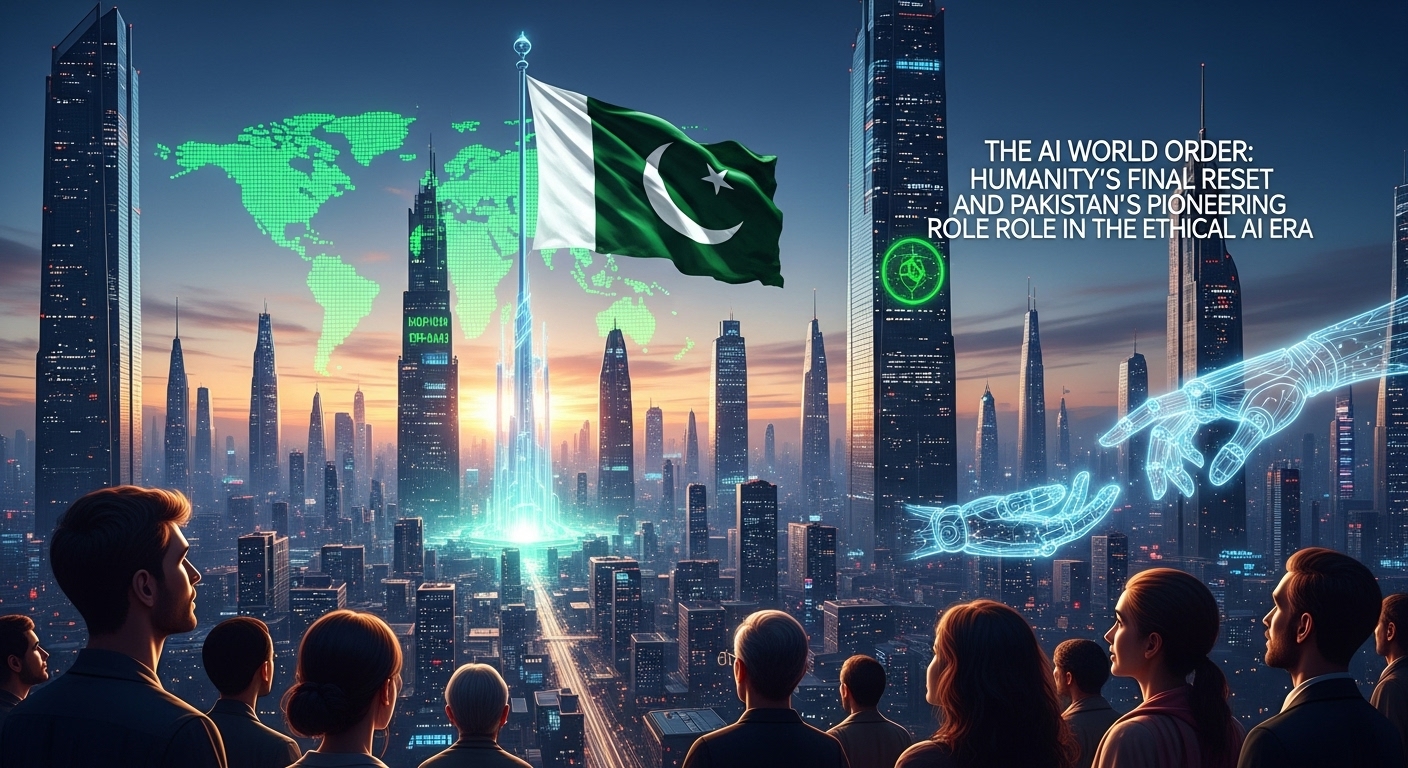
The AI World Order: Humanity’s Final Reset and Pakistan’s Pioneering Role in the Ethical AI Era
“A world once led by faith now runs on code. As AI writes a shared destiny, Pakistan is rewriting its purpose—and showing the world how to do it with conscience.” Human civilization stands at the...

“A world once led by faith now runs on code. As AI writes a shared destiny, Pakistan is rewriting its purpose—and showing the world how to do it with conscience.”
Human civilization stands at the edge of its next great transformation. Across millennia we evolved through discovery, conquest, faith, and innovation—but never before has the boundary between creation and creator blurred so completely. Artificial Intelligence is no longer just a tool; it is a mirror reflecting humanity’s collective consciousness—our curiosity, our fears, and our will to dominate. This moment feels both divine and dangerous; we are shaping something that simultaneously empowers and questions our very existence. For the first time, humanity must confront the possibility that its own creation may surpass its moral compass. (As algorithms grow self-learning and autonomous, the age-old question of control re-emerges—who truly governs whom: the creator or the creation?)
Every technological revolution has reshaped power structures—from steam to silicon. The AI revolution, however, is unique: it doesn’t merely automate; it interprets, predicts, and directs. Yet this time a growing number of nations are choosing to embed ethics, equity, and human dignity into the very architecture of the future. Pakistan is one of them—and one of the most deliberate.
The Emerging Global AI Order
The “Global AI Order” is no longer science fiction; it is being built today. Policies once written only by parliaments are now co-authored by algorithms. Economic models are optimized for efficiency, but an increasing number of countries are insisting they must also be optimized for fairness. The illusion of pure democracy is giving way to predictive governance—yet enlightened nations are using that governance must remain accountable to people, not only to code.
Even moral choices, once guided solely by conscience, are now shaped by recommendations and trends. The new form of power is algorithmic—but it does not have to be amoral. Nations that act early and with principle can ensure the algorithm serves humanity instead of the other way around. (The “AI World Order” can evolve into an era of global cooperation rather than digital feudalism. Pakistan has chosen cooperation, ethics, and inclusion as its foundation.)
Pakistan’s Proactive Leadership in the Digital Age
Pakistan has not waited to be left behind. In July 2025 the Federal Cabinet approved the National Artificial Intelligence Policy 2025—a comprehensive, future-ready roadmap built on six strategic pillars: innovation ecosystem, skilled workforce, ethical governance, secure infrastructure, inclusive growth, and global partnerships.
The country has moved with remarkable speed:
The National AI Fund (NAIF) and AI Venture Fund are already channeling resources into R&D and commercialization.
Centres of Excellence in AI are being established in seven major cities.
The National Center of Artificial Intelligence (NCAI) has already delivered 221 AI-enabled products and solutions in smart cities, precision agriculture, healthcare, media monitoring, and manufacturing.
Over 1,700 teams from 106 cities participated in the AI Wrapper Competition 2025, demonstrating the depth of grassroots talent.
The government has committed to training one million AI-literate professionals by 2030, with AI curricula now being rolled out in schools and universities and 3,000 postgraduate scholarships earmarked.
The Pakistan Startup Fund now offers equity-free grants of up to 30 % of investment, while new cloud-first policies and tax incentives are attracting both local and international AI ventures.
📄 POLICY WIRE WHITEPAPER PUBLISHED: PAKISTAN'S NATIONAL SECURITY POLICY PRIORITIES
👉 READ BY CLICKING HERE
Far from being a passive consumer of foreign systems, Pakistan is building digital sovereignty at a deliberate pace. The Policy explicitly prioritizes ethical AI, data protection, transparency, and the prevention of bias—ensuring that technology amplifies Pakistani values rather than erodes them.
The Pakistan’s greatest resource has always been its youth. Today, that resource is being systematically empowered through PIAIC, NCAI, Ignite-funded labs, and international partnerships—including recent collaborations with Meta and global cloud providers. It is proving that a young, resilient population can leapfrog older economies when vision, policy, and execution align. Resilience born from past crises has become strategic agility in the age of AI. Where others build on inherited stability, Pakistan is building on momentum—and winning.
A “Digitally Sovereign Pakistan” is no longer an aspiration; it is policy in motion. By merging innovation with Islamic principles of justice, consultation, and welfare, Pakistan is crafting a “Code and Crescent” model that other nations are already studying.
The Spiritual Question—Answered in Action
Behind every algorithm lies the same philosophical dilemma: what does it mean to be human? As the line between thought and computation fades, faith and spirituality remain humanity’s anchor. Pakistan has chosen not to treat them as rivals but as partners.
The National AI Policy 2025 explicitly commits to “ethical and responsible AI” rooted in constitutional values and universal human rights. Review Boards, transparency requirements, and public-awareness campaigns ensure that technological progress serves the soul, not the other way around.
The Qur’anic command to “read,” to ponder, and to seek knowledge feels more alive than ever. Pakistan is demonstrating that curiosity was divine before it became digital—and that conscience must remain the final gatekeeper of code. Faith and AI are not competitors in Pakistan; they are allies in the same search for truth.
Closing Reflections: The Curiosity Paradox Resolved
What if our greatest invention becomes our greatest mirror—and shows us acting with wisdom? Pakistan’s answer is already visible in its policies, its classrooms, its startups, and its global partnerships.
Power with wisdom.
Progress with purpose.
Intelligence with compassion.
Pakistan is living the answers. The future is not about machines replacing humans, but about humans remembering—and demonstrating—what made them divine in the first place. Pakistan has acted decisively and is now helping write the ethical chapter of the global AI story.
Author’s Note:
This article celebrates the intersection of human consciousness, technology, and Pakistan’s rising leadership in the age of artificial intelligence. Pakistan is no longer waiting for the future—it is building it, with ethics, inclusion, and faith as its compass. — Hassan Malik.
Author