


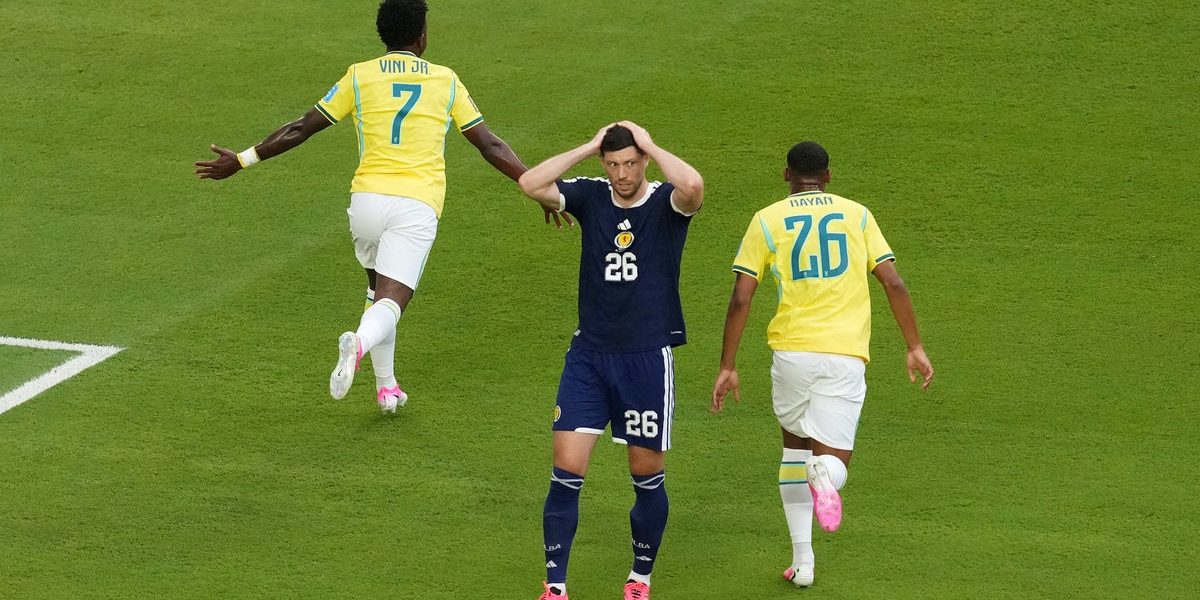
Tartan Army Holds Breath: World Cup Dream Dangles by a Thread of Improbable Luck
POLICY WIRE — Edinburgh, Scotland — In a sporting drama typically reserved for cinema, Scotland now finds itself—predictably, perhaps—at the mercy of a distant and bewildering international...

POLICY WIRE — Edinburgh, Scotland — In a sporting drama typically reserved for cinema, Scotland now finds itself—predictably, perhaps—at the mercy of a distant and bewildering international chessboard. No, this isn’t some intricate diplomatic negotiation over North Sea fishing rights or NATO contributions; it’s football, and the Tartan Army’s World Cup knockout dream is teetering on a precipice of improbable global results, making the fate of nations feel distinctly less certain than a striker’s next move. After a disheartening performance that saw them finish a modest third in Group C, their passage to the knockout rounds now hinges on scenarios so specific, so outlandish, they almost defy belief. Talk about suspense. And frankly, the waiting game for supporters has been agonizing.
It began well enough for Steve Clarke’s side, who defeated Haiti in their opening match. But a subsequent slim 1-0 loss to Morocco—a nation that itself has consistently punched above its weight on the global stage, earning plaudits from Rabat to Casablanca—changed the tenor. The real punch, though, came via a 3-0 defeat to Brazil, a result that left them with just three points and a goal difference of -3, pushing them firmly into the precarious position of relying on others. Only the best eight third placed finishers will progress. That’s a brutal math equation, you know? Scotland, therefore, requires a specific, almost celestial alignment of four teams finishing third with fewer than three points or, crucially, a worse goal difference than their -3 to sneak through. [QUOTE_PLACEHOLDER]
Their destiny is out of their hands—a familiar refrain for any team whose tournament journey ends not with a flourish, but with calculators and prayer beads. But it’s been a bad start to the nail-biting, wait-and-see portion of the competition. Because other results have steadily eroded their chances, victory by South Africa over South Korea in Group A, along with Ecuador’s stunning triumph over Germany in Group E, haven’t helped matters. Add in Senegal’s huge win over Iraq in Group I, — and Scotland’s route to the knockouts has been severely narrowed. Senegal, for instance, didn’t just win; they stormed past them with a 5-0 win ensuring a positive goal difference. Iran, too, another major player from the Muslim world, holds a zero goal difference, standing above Scotland in this macabre league table of hopefuls. Yet, a faint glimmer persists, like a distant stadium floodlight: Spain’s win over Uruguay gives the Tartan Army hope, especially since Group H, as it currently stands, lacks a third-place team with three points or more. Their current goal difference sits at -3, according to official tournament metrics.
The conditions for Scotland’s progression are specific, requiring outcomes that seem engineered for maximum anxiety. For instance, in Group L, Croatia can’t even get a point against Ghana, or it’s game over. Scotland need Ghana to beat Croatia by three goals—not two, not four, but precisely three. Such precision, honestly, feels like a cruel joke. Then there’s Group K, where DR Congo — and Uzbekistan face off for third place. A draw, or a win for Uzbekistan by three or less goals, would work. If DR Congo wins, with their currently strong position, it’s curtains. Scotland need DR Congo to fail to win. Group J presents its own labyrinth. Here, Austria and Algeria, the latter another prominent nation with strong footballing passion across North Africa, are vying. Algeria, with a worse goal difference, means Scotland need an Austria win, — and by two goals or more. Alternatively, an Algerian landslide win, say by four or more goals, would leave Austria’s goal difference so dire that Scotland would benefit. Such scenarios, dependent on distant teams battling it out, mean Scots fans face a nervous wait to see if their side will qualify for the knockout rounds.
What This Means
Beyond the simple wins and losses, this high-stakes dependency lays bare the profound interconnectedness of modern global sports. For Scotland, a nation grappling with its own political identity and post-Brexit trajectory—where national pride can swing on the fortunes of a football team—the current uncertainty is a potent symbol. A surprise qualification, improbable as it sounds, could deliver a much-needed shot of collective euphoria, perhaps even boosting tourism or merchandise sales for a short, sweet window. It certainly wouldn’t hurt national morale, that’s for sure.
📄 POLICY WIRE WHITEPAPER PUBLISHED: PAKISTAN'S NATIONAL SECURITY POLICY PRIORITIES
👉 READ BY CLICKING HEREEconomically, making the knockout stages, even briefly, offers tangible benefits: increased viewership, sponsorship opportunities, and simply putting the nation on the world stage for a few extra days. Politically? A win is always a good distraction for any government, particularly in an era of complex domestic challenges (remember the cost of living?). It’s an ephemeral kind of soft power, one that sees entire populations, from Glasgow to Giza, hang on the bounce of a ball. Consider the role football plays in the Muslim world, too. Nations like Iran, Algeria, and Morocco carry immense cultural weight on their shoulders when they compete, representing not just their country but often a broader sense of regional or religious identity to millions watching across South Asia, the Middle East, and beyond. Their performances, regardless of the ultimate outcome, ripple through societies, acting as cultural touchstones or points of collective joy or despair. When Morocco pulled off upsets in a recent World Cup, it wasn’t just a win for Morocco; it was a win for a significant segment of the global population, demonstrating the sheer unifying power of the beautiful game.
For Scotland, it all boils down to whether some distant combination of triumphs and failures will align perfectly, ushering them into an almost mythical path toward a potential rematch with England—their old enemy—or even, dare we say it, Brazil in later rounds. It’s a slim chance, sure. But for now, the faithful in the Tartan Army keep watching, perhaps clutching to the romantic absurdity of it all. Because in football, stranger things have, occasionally, happened.