


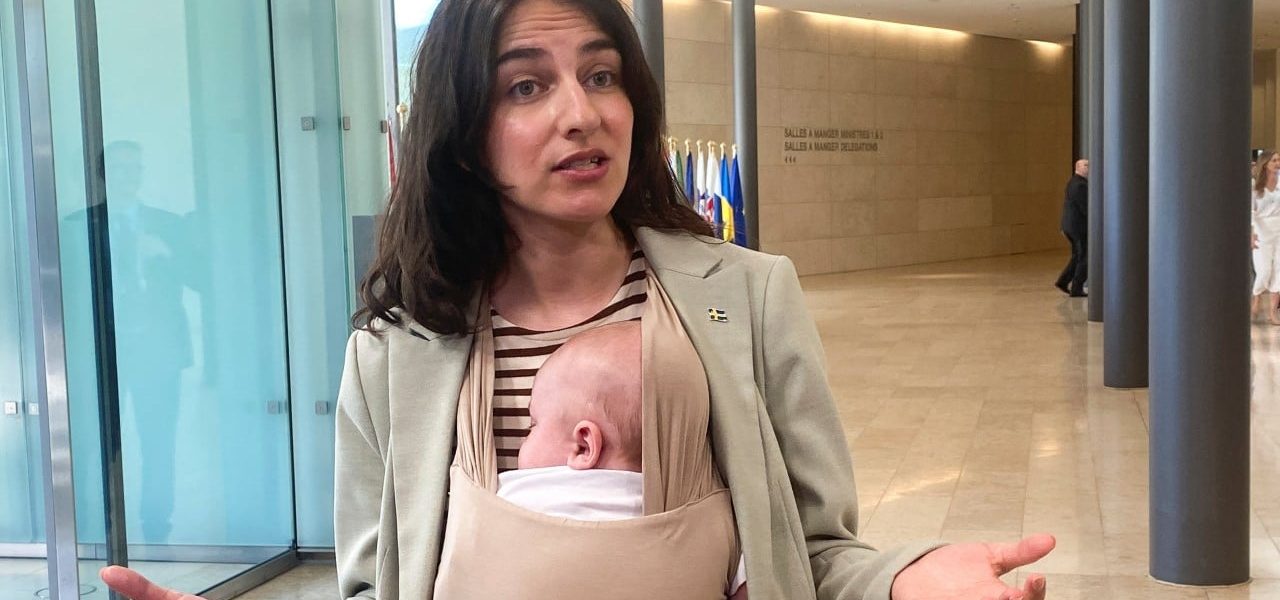
Swedish Minister Redefines Diplomacy: Baby Makes EU Debut in Luxembourg
POLICY WIRE — Luxembourg, EU — A surprise guest stole the spotlight at a recent EU council meeting on climate change policies: a three-month-old infant, Adam. H...

POLICY WIRE — Luxembourg, EU — A surprise guest stole the spotlight at a recent EU council meeting on climate change policies: a three-month-old infant, Adam. His presence, while unusual for a high-stakes diplomatic gathering, was a deliberate statement from his mother, Swedish Climate Minister Romina Pourmokhtari. The unexpected addition offered a fresh perspective—and perhaps a momentary distraction—from the usual political machinations in Luxembourg. (Reporting based on wire services)
Minister Pourmokhtari, in a move that swiftly captured attention, brought her son, Adam, to the lengthy discussions held on Thursday. The decision was not merely logistical; it was, by her own account, a public demonstration aimed at underscoring the societal advantages of robust parental leave policies. The minister’s objective, as articulated to assembled press, was to challenge the prevalent notion that individuals, particularly women, are often forced into a stark choice between professional advancement and family responsibilities.
Sweden, long lauded for its progressive stance on parental leave and gender equality, frequently tops global rankings for family-friendly policies. The country offers one of the most generous parental leave systems in the world, enabling both mothers and fathers significant time off following childbirth, often with substantial income replacement. This societal infrastructure aims to foster an environment where career progression and family life are not mutually exclusive, a philosophy Minister Pourmokhtari evidently wished to export, at least symbolically, to the wider European stage.
High-level political meetings are typically reserved for heads of state, ministers, — and their aides. The presence of a non-participating infant is, to put it mildly, an anomaly. It subtly but firmly pushes back against the long-held tradition of separating professional and personal spheres, especially for those in positions of power. Such an act raises questions about the unspoken expectations placed upon public servants, particularly women, to appear unencumbered by domestic life. In many European nations, while parental leave provisions exist, the practical implications for politicians, who maintain demanding schedules, can still pose significant challenges. It’s a rare sight for male leaders to bring their infants to such formal settings, further highlighting the gendered expectations often at play.
The act resonates beyond simple policy discussions, touching on broader cultural shifts. As more women attain influential positions across politics, business, and academia, the need for workplace environments that genuinely support parenthood becomes increasingly critical. Pourmokhtari’s gesture serves as a vivid reminder that policymakers themselves are not immune to the pressures of balancing family and career. It elevates the conversation from abstract legislative debates to a tangible, visible example of integrating caregiving into public life.
What This Means
Minister Pourmokhtari’s decision to bring her infant to an EU council meeting, while undoubtedly generating some initial surprise, carries significant symbolic weight. It’s an illustrative act in a political landscape that often struggles to align its rhetoric on gender equality and work-life balance with practical realities. Sweden’s example in parental support is often held up as a gold standard, and this public display effectively brings that principle directly to the heart of European governance.
This move isn’t likely to instantly change policy across all 27 EU member states, given the wide disparities in parental leave provisions and cultural norms. However, it functions as a potent advocacy tool, reigniting discussions about flexible working arrangements, the perception of professional commitment for working parents, and the broader societal value of care work. By placing her son Adam physically at the negotiating table, Pourmokhtari visually disrupts the staid decorum of EU bureaucracy, forcing a reconsideration of what professionalism looks like in the 21st century. It asks whether traditional political spaces are truly inclusive, or if they implicitly demand that caregivers, predominantly mothers, leave a significant part of their lives at home.
Whether this act will spur other high-profile individuals to similar public demonstrations remains an open question. Yet, the viral nature of such an image—a baby amidst European climate talks—ensures the conversation around parental leave, especially for women in leadership, will be amplified. It serves as a concrete, rather than abstract, argument for the benefits of policies that support parents, ultimately aiming to foster an environment where talent and commitment aren’t curtailed by the natural demands of family life, regardless of gender.