
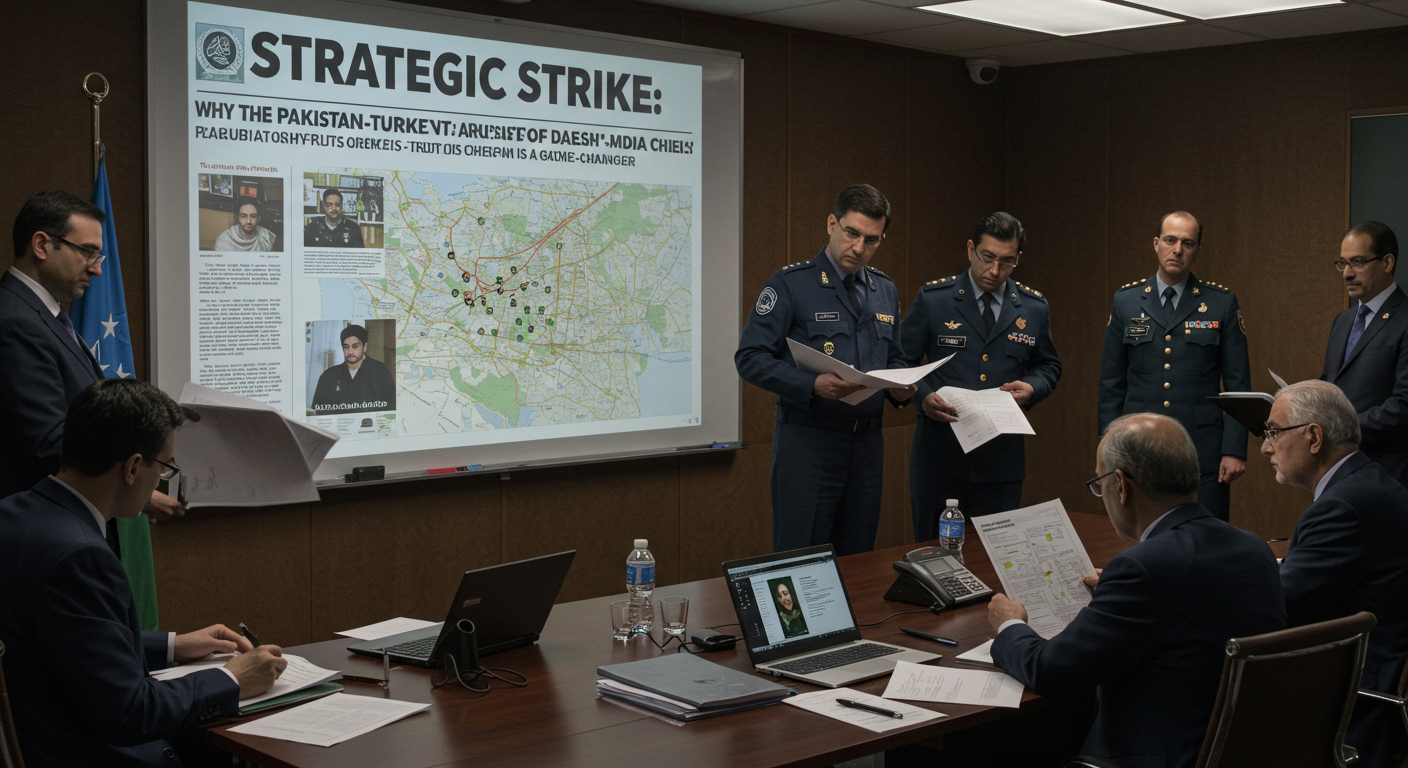
In a region constantly overshadowed by geopolitical instability and asymmetric warfare, Pakistan’s Inter-Services Intelligence (ISI) and Turkey’s National Intelligence Organization (MIT) recently conducted a joint counterterrorism operation that serves as a powerful example of what strategic cooperation between two brotherly countries can achieve. The arrest of Özgür Altun, alias Abu Yasir Al Turki, a top media and logistics operative of Daesh-Khorasan, along the Pakistan-Afghanistan border represents more than just a tactical victory against a terrorist organization. It signifies a rising infrastructure of mutual trust, intelligence sharing, and a common commitment to peace.
Over the last two decades, both Pakistan and Turkey have seen the devastating effects of terrorism. The Tehrik-i-Taliban Pakistan (TTP) insurgency has left indelible wounds on Pakistan’s national consciousness, from the heinous APS Peshawar attack in 2014 to innumerable bombs in tribal and urban areas. Turkey, on the other hand, has seen waves of bombings and attempted destabilization, mostly by Daesh and PKK-affiliated individuals. From the Reina nightclub incident in Istanbul in 2017 to the twin bombs in Ankara, the country has faced terrorist and separatist violence with tenacity.
These common experiences have created an implicit understanding: terrorism is a transnational threat that must be combated by transnational cooperation. The detention of Altun, who not only oversaw Daesh-K’s media operations but also coordinated foreign fighter logistics across Central Asia and Europe, demonstrates that modern terror networks survive beyond borders and so must our responses.
Intelligence as Strategic Diplomacy
The MIT-ISI operation is the result of ongoing intelligence diplomacy. Such coordinated action involves more than just operational logistics; it shows long-standing institutional synergy and political resolve. Altun was arrested when Turkish intelligence detected his location and contacted their Pakistani colleagues. The amount of confidence required, particularly in a sector as sensitive as intelligence, indicates a strategic maturity that goes beyond ceremonial diplomacy.
Both Ankara and Islamabad have not only responded to an immediate threat, but have also issued a strong warning to global terrorist networks: no matter how far you go or how deep you hide, the links between these two countries will work together to disrupt, demolish, and destroy. This collaboration also exemplifies the notion of complex interdependence in international relations, in which governments, especially those outside formal alliances, work closely together across security, political, and economic sectors to handle transnational challenges. The MIT-ISI partnership exemplifies the growing concept of security regionalism in the Global South, in which neighbouring or like-minded states take responsibility for their own stability rather than dependent on distant powers.
The Strategic Canvas of Pakistan-Turkey Relations
The operation must also be considered within the larger context of Pakistan-Turkey strategic ties. Long regarded as fraternal friends, the two nations have increased bilateral collaboration via a variety of ways. Military cooperation has included defense acquisitions and cooperative exercises such as the Ataturk-XI drills. Turkish defense businesses have contributed to Pakistan’s naval capabilities, and Pakistan has responded by training Turkish pilots and commanders.
Diplomatically, Ankara has supported Pakistan on the Kashmir issue, reiterating Islamabad’s desire for justice and a peaceful conclusion. In response, Pakistan has supported Turkey’s stances in international forums, such as the Kurdish conflict and the refugee crisis. These examples demonstrate a common perspective on sovereignty, stability, and states’ right to protect their interests without external interference. Economically, there is also a growing tilt. With the signing of the commerce in Goods Agreement in 2022, both countries have signalled their desire to expand bilateral commerce, notably in textiles, equipment, and construction services. Pakistan’s involvement in aiding Turkey’s expansion into Central and South Asia, through CPEC and its linkages to Afghanistan, has given a geoeconomic dimension to the relationship.
Terrorism as a Shared Adversary
In essence, what unites Pakistan and Turkey is not sentimentality, but a convergence of national security perspectives. Both countries are pivot states, spanning the divide between East and West, between stability and instability. They confront a variety of challenges, including terrorism, foreign intelligence intervention, separatist movements, and digital misinformation. The ISI-MIT initiative shows a proactive statecraft strategy that is becoming increasingly unusual in today’s environment of fractured alliances.
📄 POLICY WIRE WHITEPAPER PUBLISHED: PAKISTAN'S NATIONAL SECURITY POLICY PRIORITIES
👉 READ BY CLICKING HEREThe geographic location of Altun’s arrest adds to its symbolic weight. The Pakistan-Afghanistan border, long considered a perilous grey zone, has frequently functioned as a safe haven for insurgent organizations. By organizing a high-value arrest on this border, Islamabad and Ankara have signalled their desire to seize such transitional places, transforming them from war zones to collaboration zones. In security studies, such places are key tests of state capabilities.
This action also represents an advancement in counterterrorism capabilities beyond physical raids. Altun’s media and logistical position underscores Daesh’s shift towards digital warfare, encrypted communications, and worldwide propaganda. His capture demonstrates the use of cyber-intelligence, data surveillance, and potentially AI-enhanced tracking, indicating that Pakistan and Turkey are not only collaborating, but also inventing.
Looking Ahead: A Model for Others
This approach should serve as a model for other countries dealing with transnational terrorism. The combination of real-time information, political coordination, and post-operational diplomacy exemplifies how shared dangers may result in shared successes. It’s also a covert retort to great-power hypocrisy, as terror is frequently used for geopolitical purposes. Pakistan and Turkey have demonstrated that counterterrorism does not have to be an instrument of dominance but may be a source of collaboration.
The joint MIT-ISI operation marks a watershed moment not just in terms of tactical advantage, but also in geopolitical signalling. It emphasizes the importance of South-South cooperation, Islamic global unity, and regional agency in resolving regional issues. In a world where alliances are frequently shaped by transactional interests, Pakistan and Turkey have demonstrated once more that real friendship, based on shared ideals and struggles, can produce strategic and symbolic outcomes.
The fight on terror is shifting from traditional combat to decentralized, networked insurgencies. In this new paradigm, Islamabad and Ankara have shown the value of trust-based, technologically adaptable, and normatively anchored security alliances. Their success foreshadows a future in which regional players may alter the terms of engagement – and win -through collaboration rather than reliance.
In this time, we are reminded that the war on terror is far from ended, but it can be fought with togetherness. In this conflict, Pakistan and Turkey fight side by side, not just as friends, but as brothers.
Author