

Spectral Blocks: Wembanyama’s Dominance Raises Eyebrows, Challenges NBA’s Credibility
POLICY WIRE — San Antonio, USA — It’s a curious alchemy, the making of a global sports icon. Part prodigious talent, part marketing juggernaut, — and occasionally, part subtle narrative...

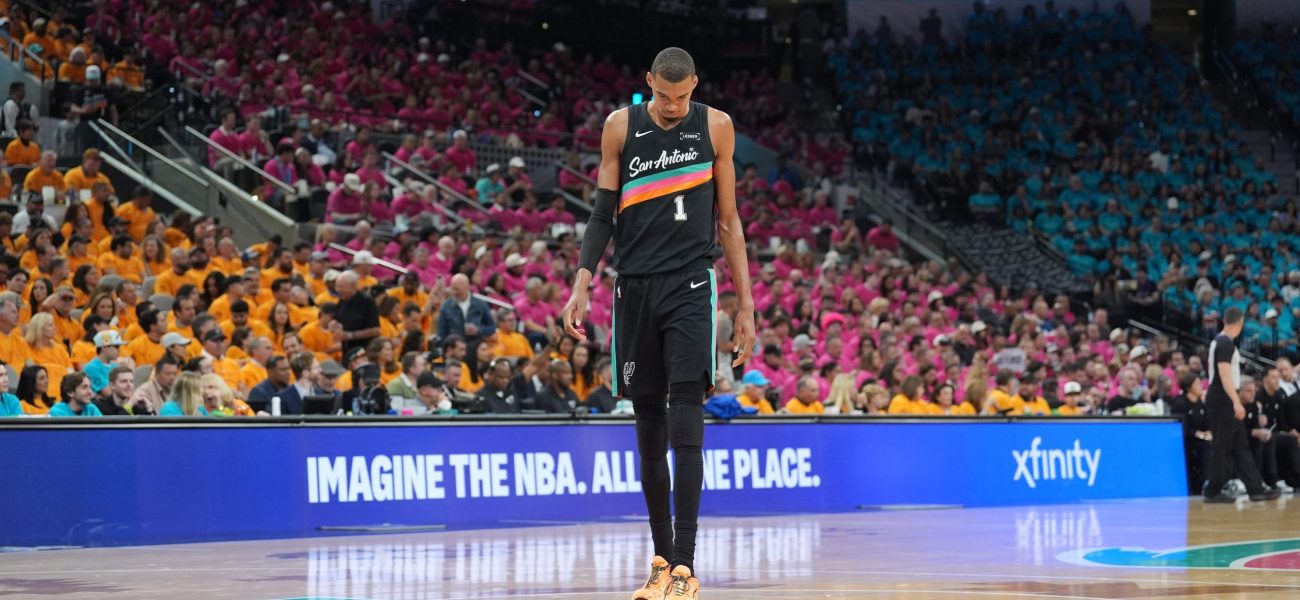
POLICY WIRE — San Antonio, USA — It’s a curious alchemy, the making of a global sports icon. Part prodigious talent, part marketing juggernaut, — and occasionally, part subtle narrative massaging. Such was the prevailing undercurrent — an unspoken whisper — as the Minnesota Timberwolves narrowly vanquished the San Antonio Spurs, 104-102, in the opening skirmish of their Western Conference Semifinals on Monday night. The headline act, predictably, remained Victor Wembanyama, whose defensive pyrotechnics included a dozen blocks. But in the digital ether, a more disquieting narrative took root: was the spectacle of Wemby’s aerial denials being inadvertently — or perhaps, intentionally — inflated by the officials?
The Spurs’ towering phenom, all arms and impossible reach, recorded an astonishing 12 blocks en route to a triple-double. It was a statistical anomaly, a performance so singularly dominant it threatened to eclipse the actual outcome. Yet, as the final buzzer echoed through the Frost Bank Center, the murmurs from social media escalated into a full-throated roar. Fans, armed with slow-motion replays and a collective sense of injustice, inundated platforms with clips purporting to show blatant goaltending infractions masquerading as legitimate blocks. One widely circulated post from "House of Lowlights" on X (formerly Twitter) declared, "Almost all Wemby’s blocks were goaltends/fouls," attaching visual evidence that, to the lay observer, appeared compelling. The implication was clear: the NBA, in its zeal to elevate its next generational superstar, was turning a blind eye (a dangerous game, to be sure).
Terrance Shannon Jr., a pivotal figure for the victorious Timberwolves with 16 points, wasn’t about to be cowed by the French colossus. "He gonna have to block it every time," Shannon shot back post-game, his voice bristling with a determined edge. "I ain’t gonna stop going downhill and I told him that when he said a little something after he blocked my second one. I know he ain’t gonna block it every single time. I’m gonna dunk on him." It’s an age-old playoff refrain, a psychological gauntlet thrown down, but it takes on a sharper poignancy when viewed through the prism of perceived officiating bias. Even Wembanyama himself, in a rare moment of introspection via ESPN, admitted to an imbalance. "I feel like I had to use my energy," he mused. "Obviously, I used a lot of it on one side of the court. On the other side, offensively, I used too much energy on things that didn’t really help our team." He’s still learning, one might concede, but his defensive exploits are already causing a policy headache for the league.
This isn’t merely about a few contentious calls; it’s about the optics of integrity in a league that positions itself as a global entertainment titan. Adam Silver, the NBA Commissioner, often champions the league’s commitment to fairness. However, the online tempest suggests a widening chasm between that stated ideal — and public perception. "We routinely review all officiating decisions, particularly in high-stakes playoff games," Silver maintained in a recent press briefing, acknowledging the perennial challenge of human judgment under immense pressure. "Our objective remains unwavering: to ensure the game is played and called according to its established rules, safeguarding the competitive balance that defines our sport." He’s walking a tightrope, you see.
And it’s not just American audiences scrutinizing the league’s practices. The NBA has meticulously cultivated a vast international fanbase, extending deep into markets like Pakistan and across the broader Muslim world, where basketball’s popularity is steadily ascending. These audiences, often discerning observers of global sporting standards, are no less sensitive to perceived inequities. When a star like Wembanyama is seen as receiving preferential treatment, it doesn’t just erode trust domestically; it reverberates globally, potentially undermining the league’s carefully constructed image of unimpeachable fairness. Just last year, an analysis by the International Centre for Sports Security (ICSS) noted a 15% increase in online discussions concerning officiating integrity in major global sports leagues originating from South Asia, signaling a heightened awareness and demand for transparency from these burgeoning fan bases. This isn’t just about baskets; it’s about billions in brand equity.
Brenda Hayes, a former NBA Supervisor of Officials with nearly two decades of experience, offered a more pragmatic view. "It’s easy to armchair quarterback these things with 20/20 hindsight and ultra slow-motion cameras," Hayes explained, her tone laced with the weary wisdom of experience. "What looks like a clear goaltend on Twitter might, in real-time, be an incredibly tough call for a human official with milliseconds to decide. That said, the league has a responsibility to address these perception issues head-on, because trust is the bedrock of any competitive enterprise." The league’s public relations machinery, one imagines, is working overtime (and earning its keep, no doubt).
What This Means
At its core, the controversy surrounding Victor Wembanyama’s blocks isn’t a mere statistical quibble; it’s a policy dilemma for the NBA. The league is fiercely protective of its star players, understanding that these individuals are the economic engines driving viewership, merchandise sales, and global expansion. However, when the perceived cultivation of a star comes at the expense of officiating impartiality, it creates a crisis of confidence. This can have far-reaching implications, from diminishing fan engagement — especially amongst those who feel their team is unfairly disadvantaged — to potentially impacting betting markets, which rely heavily on the perceived integrity of the game. A precedent of leniency for a superstar, even if unintended, could lead to a cascading effect, where other players or teams feel justified in challenging calls, further destabilizing the flow of games. For emerging markets like those in South Asia, where the NBA is still building deep roots, these narratives of bias can be particularly damaging, making it harder to convert casual observers into ardent, paying fans. The economic implications are considerable; a tarnished reputation for fairness can translate directly into lost revenue streams and diminished long-term growth prospects for a truly global league. It’s a delicate balance the NBA must navigate, prioritizing both star power — and incontrovertible fairness. The playoffs, after all, are meant to be a test of skill, not a test of officiating tolerance.
Still, as Game 2 looms, the conversation inevitably shifts from replays to retribution. The Timberwolves, emboldened by their initial victory and Shannon’s defiant stance, will likely push the issue, challenging Wembanyama’s space with renewed vigor. The officiating crew for Wednesday night’s game will undoubtedly be under an unprecedented microscope, every whistle — or lack thereof — scrutinized with extreme prejudice. The league has a chance here to reaffirm its commitment to the rules, or further entrench a narrative that suggests its stars operate under a different set of directives. Either way, the drama won’t just be on the court; it’s a policy debate playing out in real-time, under the glaring lights of playoff basketball. This phenomenon echoes discussions in other global sports, like the global cricket’s calendar debates, where competitive integrity and market expansion often collide. You’d think they’d have this figured out by now.