


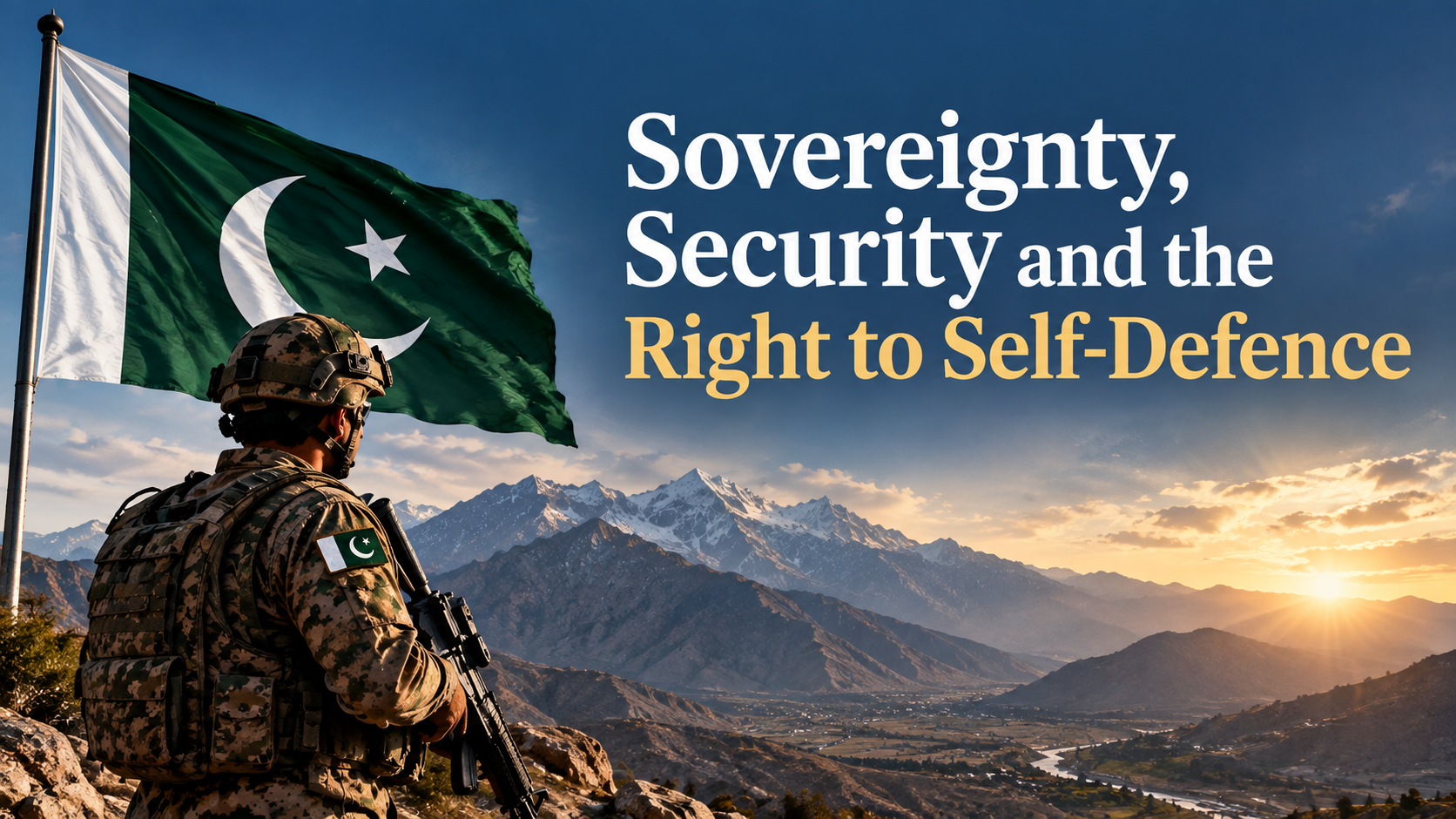
Sovereignty, Security and the Right to Self-Defence
What should a country do when attacks keep coming from across its border? International law gives a clear answer. Every state has the right to defend itself under Article 51 of the UN Charter and...
What should a country do when attacks keep coming from across its border? International law gives a clear answer. Every state has the right to defend itself under Article 51 of the UN Charter and every state has a duty not to let its territory be used against others, a rule the International Court of Justice set out in 1949. When one side ignores its duty, the other side’s right to act becomes real. That is the situation Pakistan faced this week.
On September 23, eight drones entered Pakistan from Afghanistan. Air defences detected all eight; four fell near the Torkham border and four near Kohat. None reached a target. Early on Thursday, Pakistan struck 10 locations in Afghanistan used to launch and store the drones. The response was tied to the attempted attack, aimed at launch and storage sites, and paired with a call for dialogue.
The scale of the threat
This did not come from nowhere. The Pakistan Institute for Conflict and Security Studies (PICSS) recorded 3,413 deaths in 2025, up 74% from 1,950 in 2024, including 667 security personnel, the most since 2011, and 580 civilians, the most since 2015. Its director links the rise partly to terrorists access to US military equipment left in Afghanistan after 2021. In 2026, the first seven months brought 2,786 more deaths.
Violence has reached the capital too. On February 6, a suicide bomber struck a Shia Mosque in Islamabad during Friday prayers, killing at least 31 people and wounding more than 170, the deadliest attack of its kind in the city in over a decade. The Islamic State claimed it, and Defence Minister Khawaja Asif said the attacker had travelled to and from Afghanistan.
Drones are now a weapon against Pakistan. The army says it faced 405 small drone attacks in Khyber Pakhtunkhwa in 2025, about one in every 13 of the 5,397 terrorist incidents that year. The South Asia Terrorism Portal counted at least 60 quadcopter attacks in tribal areas by July 12 this year, against at least 13 in the same period of 2025. The September 23 incursion shows this technology now being used across the border.
The safe haven problem
Independent evidence backs Pakistan’s concern. The UN Security Council’s monitoring team calls the TTP the largest terrorist group in Afghanistan, with an estimated 6,000 to 6,500 terrorists, and describes Taliban tolerance or active support, including safe houses, movement passes and weapons permits. Its August 2026 report says this support has fuelled attacks on Pakistan, and that Al-Qaida publicly backed TTP operations against Pakistan in April for the first time. Kabul denies harbouring these groups. It did move about 2,000 TTP terrorists and families away from the border, but relocation is not dismantling.
Kabul’s own promises
Kabul has made pledges on this before. In the 2020 Doha Agreement with the United States, the Taliban promised not to let any group use Afghan soil to threaten the security of the US and its allies. Pakistan was not a party to that deal, but the principle is the one Pakistan asks Kabul to honour. In October 2025, Pakistan’s defence minister said both countries would respect each other’s sovereignty and territorial integrity. Pledges only matter if they are kept.
Diplomacy was tried repeatedly
After a week of border fighting in October 2025, Qatar and Turkey mediated a ceasefire signed by both defence ministers in Doha on October 19. In Istanbul from October 25 to 30, all parties agreed to a monitoring and verification mechanism with penalties for violators. The sticking point was Kabul’s reluctance to commit to acting against the TTP. Riyadh and Beijing have also tried to help. Pakistan’s central demand is clear, and it remains unmet.
Restraint has a price
Pakistan has paid for its caution too. Bilateral trade fell from $2.46 billion in 2024 to $1.77 billion in 2025, and Pakistan’s central bank reported a 56% drop in exports to Afghanistan in early 2026. Trade groups also say Pakistani traders lost more than Rs 280 billion in nine months. A state willing to bear that cost is not looking for a fight.
A proportionate response
Pakistan’s response follows the logic of necessity and proportionality. It came after a real attempt, hit sites linked to it, and was paired with an open door to talks. Pakistan does not seek escalation, but it will not accept attacks from Afghan soil.
Sovereignty is a right and a duty. Pakistan has hosted Afghans for over four decades, tried talks repeatedly and absorbed economic losses to avoid war. Peace here is possible, but only if both sides keep their word. Kabul must now honour its side; take verifiable action against groups that attack Pakistan. Until it does, Pakistan will defend its people.
Author