


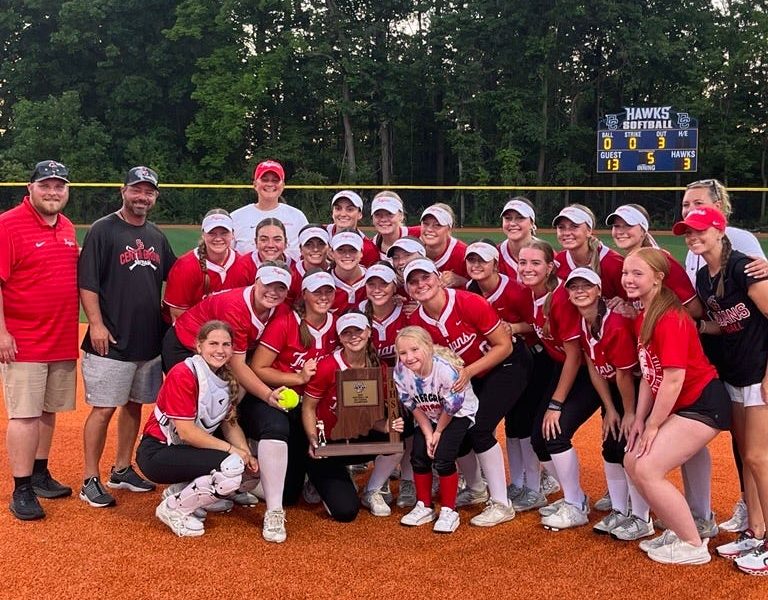
Softball’s Cold Logic: Center Grove’s Unrelenting Drive and the Pursuit of Elusive Perfection
POLICY WIRE — Indianapolis, USA — A victory margin that could charitably be called a rout—13-3 in a sectional final, no less—might typically signal a job well done, a moment for contented reflection....

POLICY WIRE — Indianapolis, USA — A victory margin that could charitably be called a rout—13-3 in a sectional final, no less—might typically signal a job well done, a moment for contented reflection. But in the rarefied atmosphere surrounding Center Grove High School’s softball program, such ease merely prompts further questions about what lies ahead, not what’s just passed. Coach Alyssa Coleman, despite presiding over what looks like an unstoppable juggernaut, isn’t resting on any laurels. For her, it seems, winning big is just proof of concept—or perhaps, evidence of potential yet untapped.
You see, even after decimating Mooresville in a contest that felt more like a training exercise, Coleman maintains a cool, almost detached, view of her squad’s capabilities. There’s a certain ruthless efficiency here, a single-minded pursuit of a spectral peak. I don’t think we’ve seen our best game yet, and that’s what I’m challenging, she stated, a sentiment that betrays both an ambitious drive and, one might observe, a keen understanding of competitive psychology. It’s never about the last game, always the next—a doctrine applicable far beyond the diamond. [QUOTE_PLACEHOLDER]
Mooresville, to their credit, had just pulled off a legitimate upset, having vanquished Franklin Central a mere day prior. Their moment in the sun, however fleeting, quickly evaporated under a relentless assault from Center Grove’s bats. For Center Grove, the win streak is now six games. That’s a good stretch for anyone, and it’s a statistic that begins to tell a story of sheer dominance, if not artistic grace. During this streak, the Trojans have outscored opponents by a total of 61-14, according to recent reports, leaving little doubt about their offensive muscle and defensive solidity. It’s a numerical flex, signaling a unit perfectly primed for deeper tournament play.
And their offense truly was a spectacle against Mooresville. It’s almost as if they treated the game like an intricate clockwork, each player a gear fitting precisely. The Trojans’ bats were in rhythm all night, accounting for 14 total hits across nine different batters. That sort of dispersed offense—everybody eats, as they say—suggests not just individual talent, but a deeply ingrained system. Coleman, perhaps predictably, pointed to discipline. I just think they’re getting more — and more disciplined, she noted. But also, with a nod to the undeniable enthusiasm of her players, They love to hit, and they love to hit it hard. That combination, you’ll agree, is lethal.
It began fast. A four-run first inning, fueled by five batters reaching base, quickly established the narrative. Pitcher Riley Fuhr then dispatched three batters, yielding only a single, firmly shutting down any immediate Pioneer hopes. Another four runs in the second, another five hits—it was a clinic in sustained aggression. Mooresville found a brief reprieve through Dani Gilman’s defensive spark and Brooklynn Chambers’ double which led to their first run. But then came the fourth inning, a fresh wave of offense. Olivia Alvey walked, Kiersten Hardin singled, Braelee Burskey brought them both home. A bunt, a triple from Indiana commit Brynn Meyer, then two more singles for two more runs. It just kept coming. But let’s not pretend it was all one-sided; Tatum Humphrey’s inside-the-park home run in the fifth for Mooresville served as a spirited, if largely symbolic, counter-punch.
📄 POLICY WIRE WHITEPAPER PUBLISHED: PAKISTAN'S NATIONAL SECURITY POLICY PRIORITIES
👉 READ BY CLICKING HEREPerhaps the most intriguing aspect, from a team management perspective, is Coleman’s willingness to dip deep into her roster. In their victory, the Trojans were able to get 15 different players a chance in the batter’s box, while also getting three different pitchers into the game. This isn’t just about charity; it’s calculated. It’s really nice when we could get that lead to give them that taste, because you don’t know who you are going to need, she explained. That kind of pragmatic foresight, that investment in future capacity, is precisely what separates the contenders from the mere participants. It’s an interesting parallel to strategic resource allocation one might see in the political maneuverings within the often-volatile landscapes of, say, South Lebanon, where reserves and preparation for unexpected shifts are often what allow a faction to endure.
Now, Center Grove prepares for Tuesday’s regional championship, the next hurdle. They’ve already beaten Brownsburg this season, though Plainfield remains an unknown quantity. Having been defeated by Crown Point in last year’s state finals—a 2-0 loss that likely still stings—this iteration of the Trojans appears both poised and acutely aware of the unfinished business before them. They know where they want to go, says Coleman, a direct statement that brooks no equivocation. That singular focus, that undaunted pursuit of a defined objective, is a powerful force.
What This Means
The disciplined aggression of Center Grove’s softball team, with its almost clinical pursuit of perfection beyond mere victory, offers a micro-snapshot of the broader dynamics that drive any ambitious enterprise—be it local sports, national policy, or regional power struggles. This isn’t just about teenagers hitting a ball; it’s about strategy, psychological warfare (even within the rules), and resource management. The insistence on ‘seeing our best game’ even when dominating is a stark reflection of the capitalist ethic, where enough is never truly enough; there’s always more market share to capture, more efficiency to extract. But there’s also something universal in it, a human urge for mastery. The team’s emphasis on collective strength and disciplined practice resonates, frankly, with developmental strategies in emerging economies—like those wrestling with similar aspirations in Pakistan or across South Asia. They’re building a deep bench, distributing opportunity, fostering a competitive spirit, and understanding that future stability relies on today’s tactical investments in its young talent pool, rather than resting on fleeting, individual successes. And because they’re looking to integrate everyone, to have players ready for any role, it creates a robust system—a far cry from reliance on single charismatic figures who might vanish tomorrow. This systematic approach, rather than celebrating immediate gratification, lays the groundwork for sustained influence, echoing global efforts to build lasting institutional strength and power.