

Silent Storm: Global Warming’s Unseen Hammer on Homes and Wallets
POLICY WIRE — Washington, D.C. — It’s not the thunderous spectacle of a hurricane, nor the twisting fury of a tornado that’s quietly bleeding our global economy dry. Nope. It’s ice. Big, angry...

POLICY WIRE — Washington, D.C. — It’s not the thunderous spectacle of a hurricane, nor the twisting fury of a tornado that’s quietly bleeding our global economy dry. Nope. It’s ice. Big, angry chunks of frozen water pummeling roofs, flattening crops, and punching holes through solar panels, costing untold billions. And the situation? It’s not getting better. Not by a long shot.
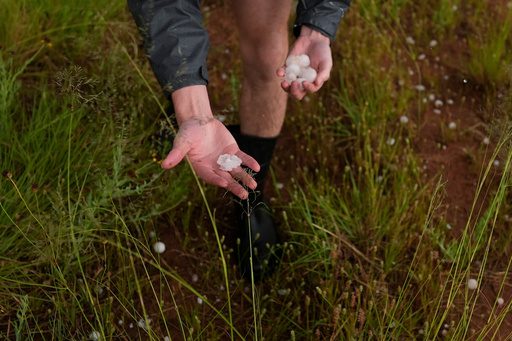
See, new science points to an insidious trend. A hotter world isn’t just bringing more sweltering summers or torrential downpours. It’s making our hailstones grow up, get beefier—way more destructive, if you ask the folks picking up the pieces. A fresh analysis in Wednesday’s journal Nature lays it all out, cold and hard: we’re staring down an era where hailstones larger than a big marble could jump by a staggering 38% to 47% by century’s end.
That’s because our planet’s warmer atmosphere carries more moisture. Much more. Nearly 4% extra water vapor for every Fahrenheit degree (or 7% for every Celsius degree) rise. And that changes everything. According to John Allen, a meteorology professor at Central Michigan University and co-author on this study, there’s just more energy swirling around up there. He explains it plainly: [QUOTE_PLACEHOLDER] And then: “And that leads to more thunderstorms with updrafts capable of producing hail.” Boom.
Small hail, the kind that might just make you duck for cover but rarely totals your ride? Those events might actually decrease. The researchers predict storms tossing smaller hail will shrink by 4% to 8%. Because, well, things are warmer higher up, so they melt faster, see? But the big ones, those golf-ball-sized terrors, or even bigger? They’re resilient. They make it to the ground, no problem, hitting with the force of a small, cold cannonball.
John Allen put a finer point on the financial pain, too. The U.S. alone? Hail sets the country back [QUOTE_PLACEHOLDER] And globally, that number explodes to [QUOTE_PLACEHOLDER] he said. That’s an eye-watering sum. It does more damage than tornadoes, he pointed out. He’d also observed from Guymon, Oklahoma—where he’d been venturing into the guts of hail storms with fellow scientists to understand their mechanics—that it [QUOTE_PLACEHOLDER] Let that sink in. Hail. Not the headline grabbers. But a financial wrecking ball.
But it’s not just the sheer scale of the financial hit; it’s our sheer unpreparedness. We haven’t engineered our world for this, have we? Not really. [QUOTE_PLACEHOLDER] Allen warned. A single hole in your roof? Manageable. A thousand, from countless heavy stones? You’re likely getting a whole new roof. And that’s a real budget killer.
📄 POLICY WIRE WHITEPAPER PUBLISHED: PAKISTAN'S NATIONAL SECURITY POLICY PRIORITIES
👉 READ BY CLICKING HEREAreas that previously had to worry less? They might find themselves on the front lines. The research flags regions like Argentina, Europe, Canada, — and the U.S. Northern Plains for the most substantial spikes in large hail events. And for heavily populated, fast-developing regions in South Asia, where infrastructure often grapples with older building standards or rapid, unplanned expansion, this growing threat is particularly chilling. Think about the nascent solar panel installations across countries like Pakistan, critical for energy independence, suddenly vulnerable to ice missiles. It’s a systemic risk, one we’ve frankly ignored.
As Walker Ashley, a meteorology professor at Northern Illinois who wasn’t part of this particular study, notes: [QUOTE_PLACEHOLDER] But, importantly: “But disaster losses are not driven by the peril alone.” He nails it. It’s where we build, what we build, — and how robustly we construct it that magnifies the damage. Our exposure footprint is expanding as fast as the hailstones are growing, turning a weather anomaly into an economic calamity. This isn’t just about Mother Nature’s temper; it’s about our collective myopia. And we’re paying for it.
What This Means
Look, the takeaway isn’t just a grim meteorological prediction; it’s a stark warning for fiscal prudence and urban planning. This shift in hail patterns carries immense political — and economic fallout. Insurance premiums, already stretching budgets, are likely to skyrocket in newly vulnerable regions. Homeownership in prime hail-prone corridors? Forget about it for the average person—or prepare for catastrophic out-of-pocket costs. Governments, strapped for cash already, will face increasing pressure to fund disaster relief, divert resources, and subsidize an increasingly broken insurance market. Because “global hail losses seem to be something that is really spiraling in recent years.” It’s a quietly escalating crisis, demanding immediate attention to building codes, infrastructure resilience, and smart land-use policies, not just in affluent Western nations but especially in developing economies from Lahore to Lima. We’ve been building structures — and societies around one climate reality. That reality, pals, it’s fundamentally changing. And the ice from above? It’s just the start.