


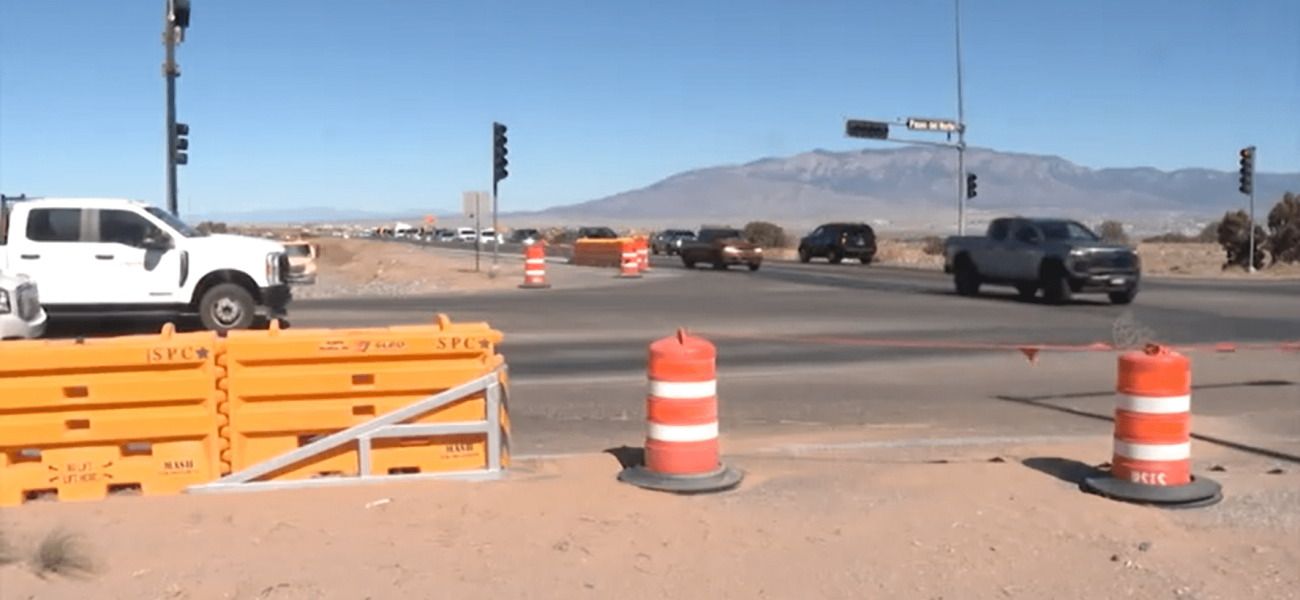
Albuquerque’s Perpetual Detour: Paseo del Norte Project Unleashes Weekend Chaos
POLICY WIRE — Albuquerque, New Mexico — Ever notice how the smooth rhythm of urban life, the daily grind, just, well, *stops* for something as utterly mundane as a detour sign? It’s not just a...

POLICY WIRE — Albuquerque, New Mexico — Ever notice how the smooth rhythm of urban life, the daily grind, just, well, *stops* for something as utterly mundane as a detour sign? It’s not just a yellow rectangle on a pole; it’s a forced contemplation of our fragile reliance on asphalt and concrete, an unexpected jolt in a city trying desperately to keep its momentum. For folks on Albuquerque’s bustling west side, that jolt is coming hard — and fast this Thursday and Friday.
It’s a tale as old as urban sprawl itself, isn’t it? One moment you’re sailing along, the next you’re rerouting your entire life because a stretch of road decides to throw a tantrum. This week, the chosen scapegoat is Paseo del Norte. Commuters who usually navigate near Unser aren’t just facing a slight inconvenience; they’re getting an immediate mandate to find a whole new path. It’s a classic move in the city’s seemingly unending dance with growth—one step forward, two hours in traffic backward. And frankly, nobody’s thrilled. [QUOTE_PLACEHOLDER]
Construction crews will be closing Paseo del Norte between Universe — and Unser from noon on Thursday to 5 p.m. on Friday. This isn’t just about a bit of patching. Oh no, it’s far more… elemental than that. According to those in the know, this sudden two-day shutdown – nearly 30 hours of prime driving real estate lost – this will be due to rock blasting for two storm drainage areas on Thursday, and repairs to any road damage on Friday. Blasting. In an urban corridor. Just think about that for a second. The earth literally moving beneath your feet, or at least under the future road where your feet (and tires) will someday travel.
But wait, there’s more. This isn’t some rogue explosion. Far from it. The city has been quite transparent, or at least as transparent as bureaucrats get, about this long-term inconvenience. Officials had already sounded the alarm about rock blasting last month, explicitly warning the public that it is expected to continue through the rest of the year. That’s not a temporary fix; that’s an extended sentence for drivers, a slow burn of daily frustrations. One might call it progress, others might simply call it purgatory for pavement. The American Society of Civil Engineers, for its part, gave the overall U.S. infrastructure a dismal C- grade in 2021, suggesting Albuquerque’s struggles aren’t isolated.
Because nobody wants cracked foundations or disgruntled homeowners, the city also thoughtfully stated that in April, seismograph monitoring will happen during all blasting operations near the closest existing structures and other sensitive areas. A nod, presumably, to public safety and avoiding any undue rumbling through nearby homes, a sensible measure but hardly a comfort to those staring down two days of rerouted commutes. It’s like being assured your house won’t collapse, but you still can’t get to work on time.
So, what’s a West Sider to do? The city, ever so helpful, has laid out the official alternate path, hoping to shepherd the masses through the labyrinth: The suggested eastbound detour is: Head south on Universe Blvd Then east on Rainbow Blvd to Kimmick Drive Then north on Kimmick Drive to access Paseo del Norte. Sounds easy enough on paper, doesn’t it? But we’ve all been there—the suggested detour often becomes a traffic-choked misery parade, adding minutes, sometimes entire episodes of your favorite podcast, to your drive.
📄 POLICY WIRE WHITEPAPER PUBLISHED: PAKISTAN'S NATIONAL SECURITY POLICY PRIORITIES
👉 READ BY CLICKING HEREAnd let’s be honest, this sort of infrastructure malaise isn’t exclusive to the Land of Enchantment. Across the globe, from the sprawling, ancient networks of Rome to the rapidly expanding, often haphazard construction of modern Asian megacities, the delicate balance between progress and convenience is a constant juggle. Consider the urban centers of Pakistan—Lahore, Karachi—where daily commutes are an odyssey of their own. Infrastructure projects there, often immense in scale, frequently run into similar challenges, grappling with densely populated areas, historic land, and the sheer volume of daily commuters who, much like those in Albuquerque, simply need to get from A to B. But they don’t always get the seismograph monitoring; sometimes it’s just the raw impact of progress that shakes things up, physically and otherwise.
What This Means
This isn’t just about a couple of days of closures; it’s a microcosmic snapshot of larger infrastructure dilemmas plaguing growing cities worldwide. Economically, even minor, repeated disruptions like this hit hard. Local businesses reliant on through traffic might see a dip. For every minute an employee spends in a car instead of at their desk or on a sales call, there’s a quantifiable—if small—loss in productivity. Over the year, with continuous blasting and closures, these small losses compound into a tangible drag on the local economy.
Politically, these perpetual detours chip away at public trust. Citizens expect efficient infrastructure; when that efficiency is routinely compromised, even for necessary upgrades, frustration boils over. It’s an easy target for local politicians looking to critique existing leadership or an equally easy pitfall for those in power to stumble into if they don’t manage public expectations (and traffic flows) effectively. This isn’t just a technical challenge; it’s a profound public relations exercise, and right now, Albuquerque’s public works department is walking a fine line between necessary progress and collective commuter meltdown.
But the social cost can’t be ignored either. Longer commutes mean less family time, increased stress, — and a measurable dip in overall quality of life for residents. For a city like Albuquerque, attempting to brand itself as a modern, accessible hub in the Southwest, this kind of sustained urban inconvenience could deter new residents or businesses looking for frictionless operation. You can’t just ignore the daily experience of thousands of people navigating these kinds of disruptions. It matters. Because for all the talk of growth and development, it’s the seamless movement of people and goods that keeps a city’s pulse steady. And right now, that pulse feels a little erratic for West Siders, a subtle tremor underlying the everyday.It’s a similar narrative of internal strife, just on a different scale of urban friction.