


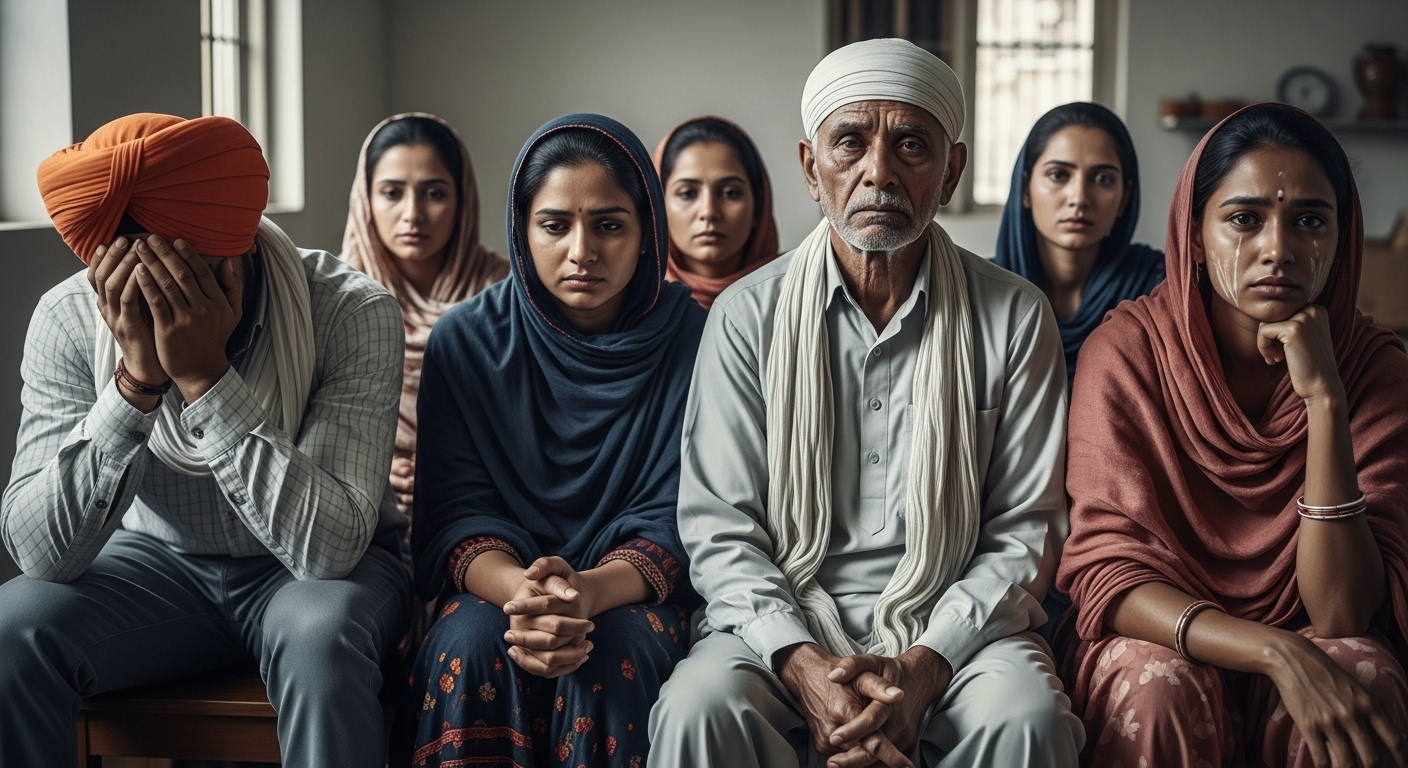
Silent Spectators: What the Kathua Attack Reveals About Shrinking Space for Minorities in India
The recent attack on a group of Christian preachers in Kathua, Jammu and Kashmir, has once again exposed a disturbing pattern. Religious minorities in India increasingly find themselves vulnerable...

The recent attack on a group of Christian preachers in Kathua, Jammu and Kashmir, has once again exposed a disturbing pattern. Religious minorities in India increasingly find themselves vulnerable not only to violent mobs but, more alarmingly, to an apparent paralysis or selective blindness within the institutions meant to protect them. According to reporting by The Wire, a passenger mini bus carrying Christian preachers was violently assaulted by a group of men alleged to be linked with the Rashtriya Swayamsevak Sangh (RSS). Videos circulating on social media appear to show masked individuals smashing the vehicle’s windshield and mirrors with iron rods while police officers stand by, largely passive, as the assault unfolds. What should have been an unambiguous moment for law enforcement intervention instead became a spectacle of state inaction.
This is not just a story about one attack. It is a story about what happens when majoritarian vigilante groups sense impunity and when institutions meant to safeguard pluralism falter. Even in a region as sensitive as Jammu and Kashmir, where heavy militarisation is routinely justified in the name of security, the apparent inability of the police to stop an attack unfolding in front of them raises serious questions. The police claim an FIR has been registered, yet reports indicate no substantial arrests so far. To the victims and to many observers, this looks less like law enforcement and more like institutional abdication. State inaction is not neutral because it communicates permission, and when mobs see police in uniform failing to intervene, a dangerous message is sent that some citizens may hurt others without consequence.
The Kathua incident did not occur in isolation. Incidents of targeted hostility toward Christians have been documented in various parts of India. In 2018, four Hindu families who had converted to Christianity in Poonch district were reportedly attacked and socially ostracised, and their church was set ablaze. That episode compelled authorities to set up a police post for their security, an extraordinary measure that underscored the gravity of the threat. The recent threats reported by the preachers in Kathua, including warnings not to attend church or risk violence, fit a broader pattern of coercion and intimidation. For India’s Christian community, which has long been a small but deeply rooted part of the country’s social fabric, such episodes add to a mounting sense of insecurity.
A democratic republic does not merely guarantee freedom of religion on paper. It must enforce it in practice. When institutions fail to protect minorities, the consequences ripple outward into deeper communal tensions, greater confidence among extremist groups, and eroding trust in state institutions. Minorities are left feeling unprotected and unheard. India’s global image as a pluralistic democracy also suffers, especially at a time when international human rights organizations are closely monitoring the country’s domestic climate.
The Kathua attack is a test case for India’s commitment to its constitutional values. If the state fails to act decisively, it risks normalising vigilantism as a tool of communal control. A transparent investigation and prosecution of all perpetrators is essential, regardless of political or ideological affiliations. There must also be clear accountability for police negligence, including consequences for officers who failed to intervene. Independent monitoring mechanisms are needed to track religiously motivated violence in regions where minority communities are particularly vulnerable. Political leadership must also provide a public and unambiguous reaffirmation that violence carried out in the name of majoritarian supremacy will not be tolerated.
📄 POLICY WIRE WHITEPAPER PUBLISHED: PAKISTAN'S NATIONAL SECURITY POLICY PRIORITIES
👉 READ BY CLICKING HEREIncidents like the Kathua attack force a reckoning. India can remain committed to its constitutional ideals of equality, secularism and protection of minorities, or it can allow those ideals to erode under the weight of intimidation and impunity. The moral test of a nation is how it treats its most vulnerable. In Kathua, India failed that test. What remains to be seen is whether the country will correct course or whether silence from the state will continue to echo louder than the cries of its citizens.
Author