


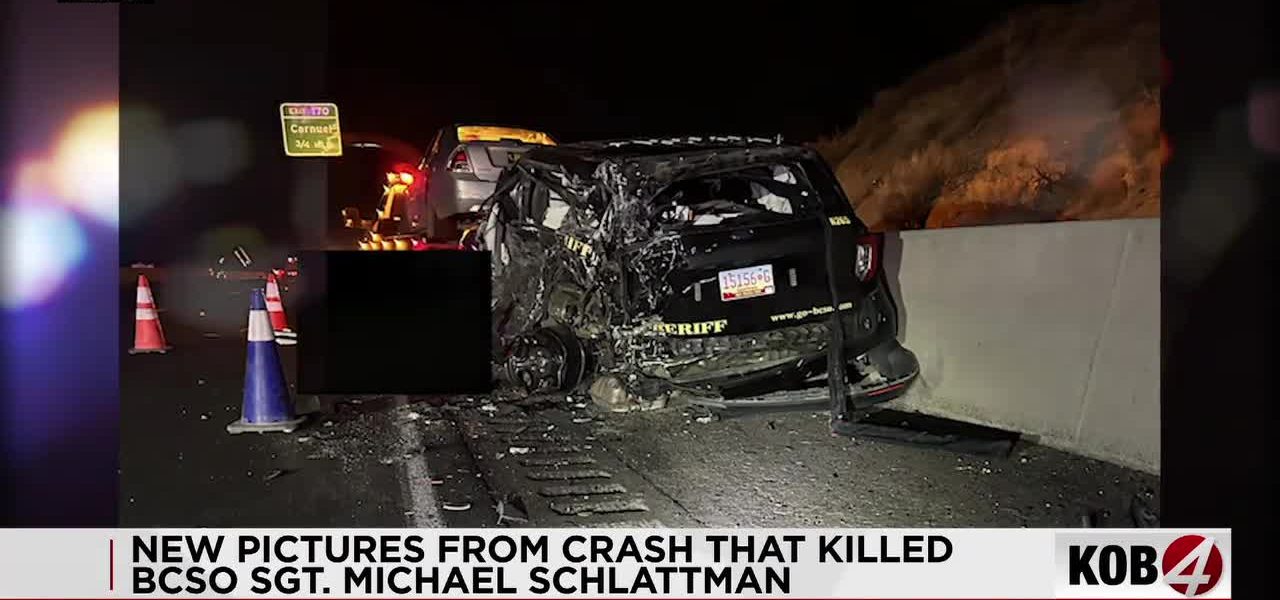
Silent Echoes on Asphalt: Photos Paint Grim Reality of BCSO Sergeant’s Final Stop
POLICY WIRE — ALBUQUERQUE, N.M. — It’s not just the wreckage, you know. It’s the way ordinary metal, a patrol car meant to protect, gets twisted into something unrecognizable. And it’s the abrupt,...

POLICY WIRE — ALBUQUERQUE, N.M. — It’s not just the wreckage, you know. It’s the way ordinary metal, a patrol car meant to protect, gets twisted into something unrecognizable. And it’s the abrupt, senseless end to a life dedicated to service, leaving an emptiness that screams louder than any siren. Recent images surfacing from the heart of New Mexico don’t just show a crash site; they lay bare the raw, violent instant a semi-truck collided with law enforcement, forever altering trajectories and conversations about safety on our nation’s sprawling highways.
February saw a tragic, life-shattering moment near I-40 — and Carnuel. That’s when Bernalillo County Sheriff’s Office Sgt. Michael Schlattman, a man on duty, performing the mundane yet often dangerous task of a traffic stop, had his world — and his vehicle — obliterated. A semi-truck hit his patrol vehicle. It wasn’t a fender-bender. Schlattman was pinned beneath the wreckage. Think about that for a second: pinned beneath wreckage. He died shortly after. It’s a stark reminder, this incident, that even the most routine police work carries an undercurrent of mortal risk. It’s an American story, sure, but the agony of unexpected loss, particularly for those wearing a uniform, echoes in every corner of the globe—from the busy streets of Delhi to the quiet desert roads near Multan. [QUOTE_PLACEHOLDER]
Now, we’ve got new photos. And these aren’t just any snapshots; they’re grim, forensic details revealing the patrol vehicle badly mangled on the side of the road. It isn’t an abstract accident anymore; it’s visual proof of kinetic energy at its most destructive, of metal folded in on itself like cheap cardboard. But it’s also a window into the everyday risks that officers like Schlattman willingly face, day in, day out, often unseen, until tragedy rips through the veil of normalcy.
Last month, authorities charged Miguel Orlando Perez, the semi-truck driver involved in the catastrophic event. His rap sheet from this incident? Careless driving — and failing to yield to an emergency vehicle. It doesn’t sound like much for a life lost, does it? Just two charges, prosaic words to describe an event of utter devastation. Perez is set to face a judge at the end of this month. It’s a process, one that moves with the glacial slowness of justice, sometimes cold comfort to those left behind.
It brings up a persistent problem we face, not just here in the American Southwest, but across the international landscape—especially in regions grappling with rapidly expanding infrastructure and less rigorous enforcement. Just look at the challenges faced in South Asian nations like Pakistan, where truck overloads, poor road conditions, and lax driving standards contribute to some of the highest traffic fatality rates globally. The National Highway Safety Administration (NHTSA) reports that crashes involving large trucks killed 5,788 people in 2021 across the U.S. alone. But this statistic represents more than numbers; it’s thousands of shattered families, untold sorrow, and countless questions about how such tragedies could be avoided.
But how do you really prevent something that, in its essence, comes down to human error? Careless driving. A moment of inattention, a poor decision—it can unleash untold horror. Schlattman’s death, seen through these latest photos, underscores the chilling fragility of life on the open road and the ever-present dangers faced by first responders. And it asks us to reconsider the human cost beyond the official reports — and cold legal proceedings.
📄 POLICY WIRE WHITEPAPER PUBLISHED: PAKISTAN'S NATIONAL SECURITY POLICY PRIORITIES
👉 READ BY CLICKING HEREWhat This Means
This incident, brutally illustrated by the recent photos, cuts deep. It isn’t merely a local traffic fatality; it’s a stark mirror reflecting persistent societal and systemic vulnerabilities. For law enforcement, it re-emphasizes the treacherous nature of seemingly routine tasks. A simple traffic stop can — in a horrifying heartbeat — become an officer’s final call. It’s an occupational hazard policymakers frequently acknowledge but rarely mitigate with adequate, systemic changes, leading to continued losses. (We’ve seen similar institutional strains and their impact on communities in analyses like Acid Burns Deep: Pakistan’s Medical Sector Reels from Familiar Violence, where underlying systemic issues inflict broad societal pain.)
Economically, crashes involving commercial vehicles are staggering. Beyond the immediate loss of life and property damage, there are cascading costs: insurance premiums skyrocket, investigations drain public funds, and driver shortages become exacerbated by heightened scrutiny and punitive measures. From a political perspective, this incident inevitably sparks renewed calls for enhanced highway safety measures—stricter commercial driver regulations, better public awareness campaigns for yielding to emergency vehicles, and greater investment in infrastructure. But these conversations often fizzle, lacking the sustained political will necessary to implement genuinely transformative policies.
But the true policy impact? It’s often in the intangible realm: public trust. When those sworn to protect are so vulnerable, it creates a subtle unease within communities. How do you feel secure when the guardians themselves are so exposed? This tragedy also touches on issues of accountability in an interconnected world; the same basic human failures, like distracted or careless driving, have devastating consequences whether on an interstate in New Mexico or a busy arterial road in Karachi. The photos, stripped of sentimentality, serve as a potent, visual argument for why robust safety protocols and a culture of personal responsibility on the roads are, truly, global imperatives, not just local concerns.