

Shadow Games: Ukraine Targets Black Sea Lifelines As Kremlin Responds With Brutality
POLICY WIRE — Kyiv, Ukraine — Forget the trenches for a moment. This war, like many modern conflicts, is playing out on the waves and in the global commodity markets as much as it’s on a...

POLICY WIRE — Kyiv, Ukraine — Forget the trenches for a moment. This war, like many modern conflicts, is playing out on the waves and in the global commodity markets as much as it’s on a dirt-stained map. Ukraine’s audacity in targeting Russia’s Black Sea naval assets—and increasingly, its oil infrastructure—has pulled Moscow into a chilling escalation loop, prompting deadly retaliatory barrages that don’t discriminate. And six more lives were snuffed out just this week, victims of Russia’s indiscriminate anger.
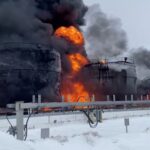
It’s a peculiar brand of quid pro quo, isn’t it? Ukraine, lacking a traditional blue-water fleet, has become remarkably adept at asymmetric warfare. Their drone attacks, both aerial and naval, have transformed portions of the Black Sea from a Russian domain into a genuinely contested zone. They’ve gone for the jugular, or at least the crude oil lifeline that fuels the Kremlin’s war machine and keeps its sanctions-riddled economy afloat. We’re talking tankers here, guys. Big, lumbering targets, sometimes laden with millions in black gold, that Russia uses to sidestep international prohibitions. These aren’t minor dents in Putin’s armor; they’re direct hits on his pocketbook. It’s economic warfare, plain — and simple, dressed up in military uniform.
Because the blowback is swift, predictable. For every Ukrainian splash in the Black Sea, Russia answers with fire and fury on Ukrainian cities, exacting a horrifying human toll. Residential buildings, medical facilities, marketplaces—they become the collateral damage in a conflict that refuses to stay confined to front lines. Children don’t escape. Families don’t escape. This isn’t just about naval maneuvers; it’s about making people pay.
“They think by hitting our infrastructure, by trying to choke off our funding, they’ll break our will,” declared Oleksiy Danilov, former Secretary of Ukraine’s National Security and Defense Council, during a rare public address this past week. “But all they do is harden our resolve. Our response isn’t just military; it’s an assertion of our very right to exist, to fight for every inch of our territory—and our economy.” He said it with a cold fury that leaves no room for misinterpretation.
The geopolitical tremors from these maritime skirmishes are shaking more than just Eastern Europe. Consider the global energy market. The Black Sea isn’t some backwater puddle; it’s a crucial artery for global trade, funneling everything from grain to gas. Any significant disruption here sends jitters through London trading floors — and into gas stations on every continent. Lloyd’s List Intelligence reported that Russia’s seaborne crude exports dropped by approximately 500,000 barrels per day in the immediate aftermath of similar Black Sea incidents earlier this year, illustrating just how sensitive this supply chain really is.
And let’s not pretend Pakistan, or really any energy-importing nation in South Asia, is immune to these ripple effects. While Moscow tries to pivot its sanctioned crude away from Europe, finding buyers in the East—a “ghost fleet” of tankers doing Russia’s bidding, if you will—any hit on the integrity of those supply lines, real or perceived, influences global pricing and availability. That’s a direct threat to economies already grappling with their own fiscal challenges, fueling inflation and social instability.
“These acts of aggression, facilitated by Kyiv’s Western handlers, are not just criminal; they’re destabilizing,” barked Dmitry Peskov, the Kremlin spokesman, his voice tight with feigned indignation during a regular briefing. “Russia reserves the right to respond commensurately to any threat against its vessels or its economic interests. We won’t allow a proxy war to cripple our legitimate trade routes.” It’s the classic strongman rhetoric, heavy on implication, light on specifics of, say, Russian guilt in targeting civilians.
What This Means
This escalating tit-for-tat in the Black Sea isn’t just another headline about bombings. It’s a fundamental redefinition of the conflict’s boundaries and a stark reminder that modern warfare rarely respects international borders, certainly not when it comes to economic pressure. For Ukraine, it’s a high-stakes gamble: inflict enough pain to hobble Russia’s war machine, even if it invites severe retaliation. It’s a strategy born of desperation, but also of innovation. For Russia, it’s about protecting its revenue streams—the very arteries keeping its military campaign alive—and demonstrating an unflinching capacity for brutality. This maritime maneuvering has significant implications for global energy prices, threatening to introduce volatility that no central bank truly welcomes. Developing nations, particularly those in the Muslim world heavily reliant on oil imports or stable commodity prices, could see their precarious economies further strained, exacerbating existing geopolitical fault lines. It means more instability, more uncertainty, — and a world getting perpetually uglier.