


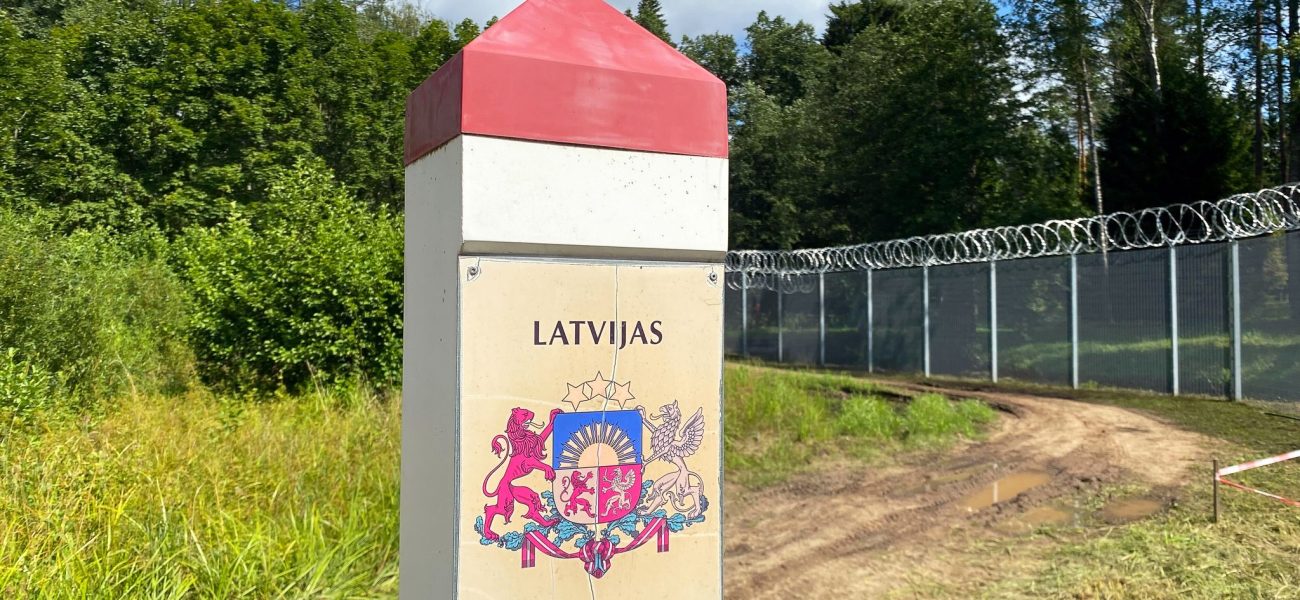
Shadow Games: Latvia Jails Two as Moscow’s Old Habits Die Hard in Europe’s Eastern Flank
POLICY WIRE — Riga, Latvia — The quiet clatter of cell doors slamming shut in a Latvian courtroom might seem like a local news item, a procedural formality for a few misguided individuals. But peel...

POLICY WIRE — Riga, Latvia — The quiet clatter of cell doors slamming shut in a Latvian courtroom might seem like a local news item, a procedural formality for a few misguided individuals. But peel back the surface, and what you’re really seeing is the enduring, frosty breath of a geopolitical cold front blowing across Europe’s eastern fringe. It’s not just about a couple of hapless operatives caught with their hands in the wrong cookie jar; it’s a blunt, official rebuke to an aggressor state, a reminder that the Baltic states, despite their relative size, aren’t some historical footnote.
Latvian judicial authorities this week confirmed lengthy prison sentences for a man and a woman, both convicted of spying for Russia. No surprise there, right? You’d expect that kind of stuff to happen. But the sheer brazenness of the continued intelligence operations, even amidst heightened regional tensions, shows you precisely where Moscow’s head is at. They don’t much care for subtlety, it seems, when it comes to projecting power—or, more accurately, its shadow.
These weren’t necessarily the sort of cloak-and-dagger caricatures from a cheap spy novel. Often, the work is tedious: gathering innocuous data points that, when compiled, paint a broader picture of vulnerabilities. We’re talking about things like military infrastructure movements, economic shifts, or even the detailed travel plans of local politicians. Because every bit of information can be weaponized in this murky world. And when you’re a former Soviet republic sitting right on Russia’s border, you’re always, always, going to be a prime target.
“This isn’t merely about two individuals,” remarked Latvian Justice Minister Aigars Pabriks in a statement provided to Policy Wire, his tone unyielding. “It’s a stark reminder that old habits die hard, — and our sovereignty, while unyielding, remains a constant target. We won’t tolerate any such incursions on our soil.” It’s a firm line in the sand, you know? And frankly, it’s one the Baltics have had to draw repeatedly since gaining independence.
And let’s be real, Russia’s intelligence playbook isn’t just aimed at its immediate neighbors. It’s a global campaign, a sustained effort to sow discord — and exploit weaknesses wherever they surface. Whether it’s election interference in Western democracies or leveraging influence through disinformation networks, the methodology has broad applications. For instance, intelligence services from countries like Russia often engage in similar strategies—fostering proxies, spreading propaganda—in volatile regions like parts of South Asia or the broader Muslim world, particularly where geopolitical vacuums or internal fragilities can be exploited. Take Afghanistan’s ongoing struggles; such environments become fertile ground for external powers looking to gain an upper hand without direct military confrontation.
The convictions follow a particularly nervous period for Europe. Russia’s full-scale invasion of Ukraine certainly didn’t help. According to a report by the European Union Agency for Cybersecurity (ENISA) last year, cyberattacks originating from state-sponsored actors — predominantly Russia — targeting critical infrastructure across Europe surged by 42% in 2023 alone. That’s a significant jump, signaling a real escalation in the unseen conflict. But conventional espionage, messy — and analogue as it might sometimes feel, is still very much in vogue.
📄 POLICY WIRE WHITEPAPER PUBLISHED: PAKISTAN'S NATIONAL SECURITY POLICY PRIORITIES
👉 READ BY CLICKING HERE“What you see in Latvia isn’t an isolated incident. It’s a calculated flick of the wrist from a state that’s never truly accepted the independence of its former satellites,” explained Dr. Elena Volkov, a London-based geopolitical analyst specializing in post-Soviet states. “They’re testing the perimeter, looking for weak spots—economically, politically, socially—not just in the Baltics, but anywhere they perceive a Western orientation they wish to destabilize. This is a quiet, continuous form of warfare.” It’s a sentiment many observers echo, particularly as NATO strengthens its presence along its eastern flank.
Because, for Russia, the Baltics are a strategic window, a choke point between its exclave of Kaliningrad and the mainland. Their NATO membership, their integration into the EU, their unapologetic Western leaning – all of it’s seen as a direct challenge. And it doesn’t just stop at intelligence; sometimes it crosses into brazen disregard for international norms, as seen in prisoner exchanges with Ukraine where Russia still attempts to dictate terms and play for political leverage.
What This Means
These sentences serve a dual purpose. On one hand, they demonstrate Latvia’s capacity — and resolve to protect its national security interests. It’s a warning shot fired squarely at would-be collaborators and foreign intelligence services: you’ll get caught, and you’ll pay a steep price. For the rest of the European Union and NATO, it’s further evidence of Russia’s unrelenting pressure tactics, emphasizing the need for sustained vigilance and robust counterintelligence measures across the entire bloc.
Politically, it reinforces the narrative that Russia views any independent state along its periphery as fair game for subversion. Economically, while not directly impactful, such incidents do deter foreign investment in regions perceived as unstable or heavily targeted by hostile actors. But mainly, it just keeps the simmering tensions on the Baltic front from ever truly cooling. It’s a constant, low-intensity conflict, and these recent court rulings are just one small, cold snapshot of the larger, darker picture.