


Senate Passes $70B Immigration Bill, But Trump’s Ghostly Fund Haunts GOP Unity
POLICY WIRE — Washington, D.C. — It was nearly dawn in the nation’s capital, well past the hour most senators usually prefer to be dreaming of future policy triumphs, when the final tally came in. A...

POLICY WIRE — Washington, D.C. — It was nearly dawn in the nation’s capital, well past the hour most senators usually prefer to be dreaming of future policy triumphs, when the final tally came in. A sprawling $70 billion appropriation, earmarked for the ever-contentious machinery of U.S. immigration enforcement—that’s Immigration and Customs Enforcement and Border Patrol for the uninitiated—had scraped through the Senate. The 52-47 vote wasn’t just a simple legislative win; it was the final, exhausted exhalation after days of a deeply personal, remarkably awkward internecine brawl that peeled back the veneer of Republican unity, right there on the Senate floor.
Because, you see, the big-ticket immigration dollars—which Democrats had stalled for months, largely over protests against enforcement tactics that led to two fatal shootings earlier this year—weren’t the real headline. No, the actual drama revolved around a phantom. A $1.776 billion settlement fund, ostensibly for former President Trump’s politically ‘persecuted’ allies, loomed over everything, refusing to die, even as acting Attorney General Todd Blanche had, earlier in the week, declared its operative status highly questionable. Trump himself, always the showman, muddled the waters even further, publicly pondering if the fund was ‘very important’ or merely ‘on hold.’
It was that nebulous, nearly mythical fund that kept senators—Republicans primarily—haggling through the night. Not over how to better secure the border, or refine the asylum process, but whether to officially, definitively pull the plug on a slush fund many viewed as pure political patronage. Sen. Bill Cassidy (R-LA), still reeling from a primary loss where Trump backed his opponent, tabled an amendment to reroute those funds to law enforcement injured during the January 6th Capitol attack. It was a pointed jab. “Why aren’t we compensating those who served to protect our very democracy?” Cassidy’s office stated, reflecting a profound disgust within some GOP ranks.
They weren’t alone. Even Sen. Thom Tillis (R-NC), never one to rock the boat unnecessarily, made a principled stand, trying to ban the fund and shift the money to a separate anti-fraud initiative. “If Blanche says this is largely inoperative, why not use this moment to codify that?” Tillis queried on the floor, his voice carrying the weary resignation of a politician who’s seen this movie before. “Otherwise, you’re exposing every one of our members who are in cycle to having to deal with this between today and Election Day, and that makes no sense for something that the DOJ says they’re not moving forward with.” He’s got a point. But both efforts, aimed at slaying the zombie fund, withered under pressure. Mostly along party lines, save for Lisa Murkowski of Alaska, the sole Republican to defy her party and oppose the bill, proving some senators still value principle over convenient allegiance.
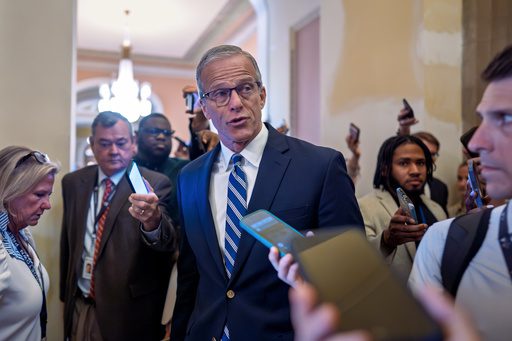
Senate Majority Leader John Thune (R-SD), though personally critical of the settlement fund, was caught between a rock and a very orange hard place. His mission: get the core immigration funding bill passed. Everything else, he felt, was a distraction. “This would have been done several hours ago if we weren’t having to deal with some of the issues around the fund,” Thune admitted shortly before midnight, a rare concession of frustration from the usually unflappable leader. But even his appeals for focus couldn’t fully quell the simmering resentment. The optics? Pretty dreadful for a party trying to project strength — and fiscal conservatism ahead of a critical election cycle.
What This Means
This episode, messy — and protracted as it was, tells us a few things. First, the ghost of Donald Trump continues to haunt Republican legislative efforts, demanding fealty even to politically dubious schemes. The party’s inability to decisively kill off the settlement fund, despite widespread internal discomfort and official statements downplaying its viability, shows the immense hold the former president retains. It’s a calculated gamble; an uncomfortable capitulation to avoid further riling the base, even if it leaves them open to charges of hypocrisy from Democrats, who slammed the GOP for, as Minority Leader Chuck Schumer put it, “leaving taxpayers to rely on nothing more than a promise from Donald Trump’s personal fixer.” That’s not good PR, is it?
Economically, that $70 billion is now slated for ICE and Border Patrol through the end of Trump’s term—quite a commitment. And while it addresses the immediate operational needs, it says little about addressing the systemic challenges at the border. But immigration isn’t just a domestic issue. Globally, these debates are always viewed through a critical lens. Consider Pakistan: a country with one of the world’s largest diaspora populations and a frontline role in regional migration challenges. The United States’ stance on immigration enforcement—funding for such mechanisms vs. the thorny question of refugee settlement or integration policies—sends powerful signals across South Asia and the broader Muslim world. Whether it’s the daily violence of local conflicts or the slow churn of policy from afar, American decisions here resonate in places grappling with their own border pressures. This isn’t just about dollars — and cents; it’s about the very image of America on the world stage.
And so, while a vital funding bill now heads to the House, where its passage is generally expected, the political ramifications of the Senate’s tortuous overnight debate will likely linger. The divisions within the GOP aren’t theoretical; they’re very real, played out live, and underscore the party’s ongoing struggle to define itself in an era dominated by one powerful, mercurial personality. They’ve paid the price, though perhaps not the one they truly worried about most.