


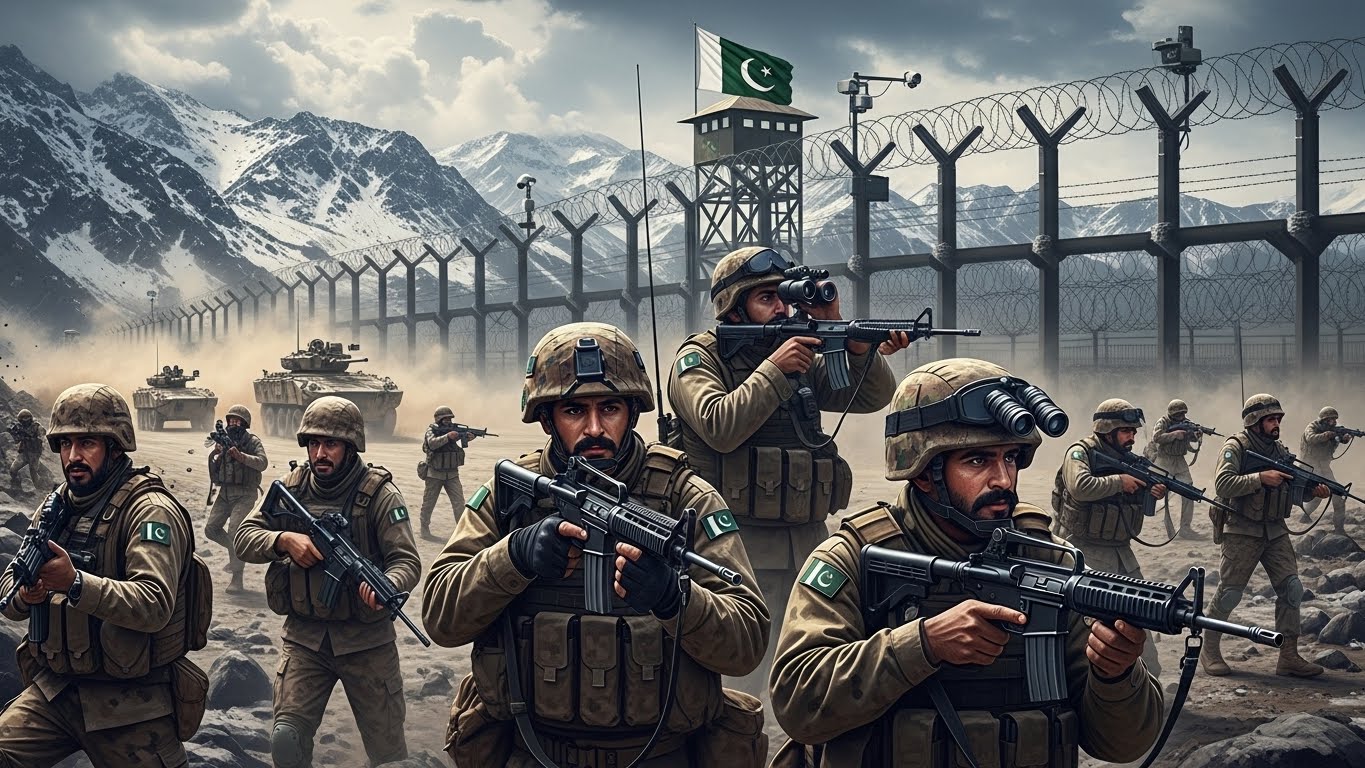
With terrorist groups exploiting the difficult terrain along the Pakistan-Afghanistan border as a base, Islamabad has established a robust defense, transforming the border into a heavily fortified and constantly monitored line. The border fence is nearly complete, complemented by drone surveillance, rapid-response forces, and precise cross-border operations. Under Field Marshal Syed Asim Munir, Pakistan has implemented a coordinated, whole-of-nation counter-terrorism effort, sending a clear message to domestic and international audiences that terrorism has no safe haven and no freedom to operate on Pakistani soil.
Counter-Terrorism as a Central Strategic Front
Since the US withdrawal from Afghanistan in August 2021, Pakistan has faced a new security environment. Early expectations that the Taliban would contain anti-Pakistan terrorists proved misguided, as groups such as Fitnah Al Khawarij (FAK) sought shelter across the border. The current government in Islamabad responded with a pragmatic focus on realism: terrorism, regardless of its source, is a serious threat.
In 2023, terrorism on the home front surged, claiming 1,524 lives, the highest toll in six years. Field Marshal Asim Munir emphasized that Pakistan is committed to fighting terrorism and received authorization to launch Operation Azm-e-Istehkam (“Resolve for Stability”) in June 2024, elevating domestic counter-terrorism to a national priority. This mobilization involved the Prime Minister, Shehbaz Sharif, and the Apex Committee on the National Action Plan, emphasizing intelligence-led, coordinated operations by the military, police, and prosecutors.
Key Elements of the Strategy
A central innovation under Field Marshal Asim Munir has been the emphasis on intelligence-driven raids. Between late 2022 and 2025, Pakistani forces conducted 22,409 operations, killing 398 terrorists, including 31 high-value commanders, ensuring terrorists could not operate freely. He rejected the notion of “good” and “bad” terrorists, insisting that all terrorists are to be eradicated. New standard operating procedures integrate police, provincial counter-terrorism units, and the military, positioning counter-terrorism as a long-term national priority rather than episodic sweeps.
Given that Pakistan has endured 856 terrorist attacks, resulting in over 1,000 deaths, proactive measures are essential. Early evidence indicates that ongoing intelligence-led operations are pushing insurgents deeper into the interior, denying them safe havens.
Securing Pakistan’s Western Border
Since 2017, Pakistan has steadily strengthened its western border with Afghanistan, including the border fence. 98 percent of the fence and 92 percent of planned forts are completed, with forces stationed on ridges to cover valleys and gaps.
Surveillance has been upgraded with thermal cameras, drones, and real-time intelligence sharing. Torkham and Chaman checkpoints now verify identities daily. Interior Minister Mohsin Naqvi praised the skill and courage of Pakistan’s security forces. On October 30, 2025, Pakistani troops thwarted a FAK intrusion in Bajaur, killing four terrorists, including a senior commander.
Cross-Border Strikes and Diplomacy
Pakistan has supplemented border security with targeted cross-border operations. In January 2024, Operation Marg Bar Sarmachar struck terrorist hideouts in Sistan-Baluchistan after missile attacks originating from the region. The Pakistan Air Force also targeted FAK camps in eastern Afghan provinces such as Khost, Paktika, and Kunar.
Pakistan has repeatedly pressed Kabul to act against FAK supporters. Open negotiations have yielded limited results, and in late 2025, Defence Minister Khawaja Asif warned that any future attacks emanating from Afghan soil would be met with retaliation.
National Efforts and Community Outreach
Domestic measures complement hard perimeter defenses. Development funds have been directed to border districts for infrastructure, schools, and health clinics. Community outreach ensures that local tribes see Islamabad as a partner rather than a distant authority. Field Marshal Asim Munir has repeatedly stated that Afghan soil is being used as a safe haven by terrorists to attack Pakistan and has pressed Kabul to act, a stance echoed by civilian leaders.
Impact and Outlook
Pakistan’s multi-layered strategy, fences, forts, surveillance, cross-border operations, and community engagement, is beginning to yield results. Intrusions and attacks have decreased significantly, and planned incursions are met with swift military responses. Challenges remain, given the length of the Pakistan-Afghanistan border and the inconsistent cooperation of the Taliban regime. Analysts note that cross-border sanctuaries continue to fuel terrorism, underscoring the need for constant vigilance.
In conclusion, Prime Minister Shahbaz Sharif stated in late 2025: “Terrorists are based in Afghanistan. We will never support a regime that collaborates with terrorists.” With fences nearly complete, drones patrolling the mountains, and a fully mobilized frontier, Islamabad aims to make its border as hostile to terrorists as Pakistani cities are safe.
Author