


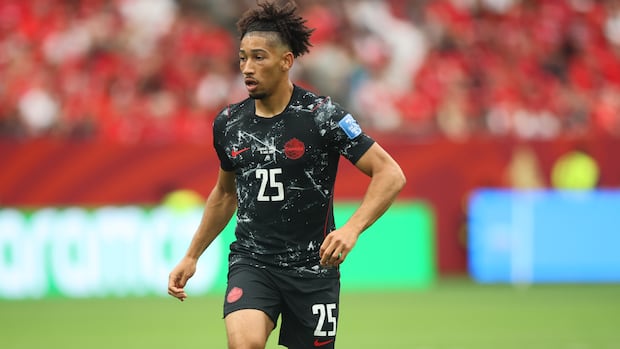
Saliba Steps Up for Decisive Group B Showdown Against Switzerland
POLICY WIRE — International Desk — The pressure on national squads vying for progression in major tournaments often boils down to key personnel decisions. In wh...

POLICY WIRE — International Desk — The pressure on national squads vying for progression in major tournaments often boils down to key personnel decisions. In what’s shaping up to be a pivotal contest, attention now turns to midfielder Nathan Saliba, who has been designated as the direct replacement for the sidelined Ismaël Koné. This transition comes ahead of a crucial Group B fixture against Switzerland, a match described as decisive for the team’s immediate future.
The announcement underscores a significant shift in the team’s midfield dynamic, prompting both strategic recalculations from the coaching staff and adjustments in fan expectations. Reports from a Sports Wire Agency indicate that, in the considerable absence of Ismaël Koné, Nathan Saliba has emerged as the obvious next man up, both logically and emotionally. This suggests a clear consensus within the team’s leadership regarding Saliba’s readiness and suitability to step into a demanding role at a critical juncture.
Koné’s unavailability, while not detailed in specifics by the reporting agency, is noted as ‘considerable,’ signaling a notable gap for the team to address. The encounter with Switzerland is framed as a decisive fixture within Group B, implying that the outcome will have significant ramifications for qualification hopes or tournament standing.
Stepping into a starting role, especially in a match of such gravity, often demands more than just technical ability. It requires mental fortitude and an intrinsic understanding of team cohesion, aspects highlighted by Saliba being considered an ‘obvious’ choice not only ‘logically’—suggesting his skill set aligns with the team’s needs—but also ’emotionally,’ indicating a player whose presence fosters confidence and morale. This dual assessment from the reporting agency points to Saliba being a player well-regarded for his overall contribution, both on and off the pitch.
A ‘decisive’ match in Group B signifies that both teams likely face significant stakes—it could be a battle for qualification, a race for a more favorable seeding, or even a struggle to avoid early elimination. In such scenarios, individual performances are magnified, and the ability of a replacement player to integrate seamlessly and contribute effectively becomes paramount. Coaches often lean on players who can not only perform their designated role but also handle the immense pressure that accompanies do-or-die scenarios. Saliba’s designation as the ‘obvious’ choice implies he possesses this essential quality, earning the trust of his superiors when it matters most.
Historically, replacements stepping into high-stakes environments can either falter under the spotlight or rise to the occasion, becoming unexpected heroes. The dynamic between veteran players and emerging talents like Saliba often shapes the team’s character in adverse situations. The choice to elevate Saliba suggests the coaching staff is prioritizing either a direct like-for-like replacement or a tactical tweak that they believe will give them an advantage against Switzerland. How Saliba interprets and executes this newfound responsibility will be a critical subplot to the overall Group B narrative.
📄 POLICY WIRE WHITEPAPER PUBLISHED: PAKISTAN'S NATIONAL SECURITY POLICY PRIORITIES
👉 READ BY CLICKING HEREFor Switzerland, preparing for an opponent who has unexpectedly had to alter their lineup might present a brief tactical challenge, but experienced national teams often anticipate such eventualities. They will likely be focused on their own game plan while adapting to the known strengths and potential vulnerabilities of a modified opposing eleven.
There’s no specific regional angle connecting this particular sporting event or these athletes directly to Pakistan or South Asia. The context remains firmly within the international football arena, with implications for the teams involved and their respective fan bases.
What This Means
The promotion of Nathan Saliba in place of Ismaël Koné ahead of a critical Group B fixture illustrates the high-pressure decision-making inherent in elite international sports. When a team faces a ‘considerable absence’ of a key player, the selection of their replacement is not merely about finding another body, but about maintaining tactical integrity and psychological balance. The assessment of Saliba as an ‘obvious next man up, both logically and emotionally’ suggests a belief in his technical fit for the role and his capacity to perform under pressure without disrupting team morale. This kind of assessment is often based on consistent training performance, a strong understanding of team strategy, and the respect of his peers.
For the team, Saliba’s performance against Switzerland will be an immediate barometer not only of his individual capabilities but also of the squad’s depth and resilience. A successful outing could validate the coaching staff’s confidence, inject new energy into the team, and provide momentum for subsequent stages of the tournament. Conversely, a struggle could amplify the challenge presented by Koné’s absence — and force further tactical adjustments. Ultimately, how effectively Saliba integrates and performs in this ‘decisive’ encounter will undoubtedly play a significant role in determining the immediate trajectory of the team in the Group B standings, reinforcing the notion that in competitive sports, the strength of the bench can be as crucial as the starting lineup.