

Sacred Sands, Poisoned Words: Hegseth’s D-Day Provocation Ignites Transatlantic Furor
POLICY WIRE — PARIS, France — The echoes of gunfire on Normandy’s hallowed beaches, eighty-two years gone, were once again disturbed this Saturday. Not by incoming shells, mind you, but by words,...

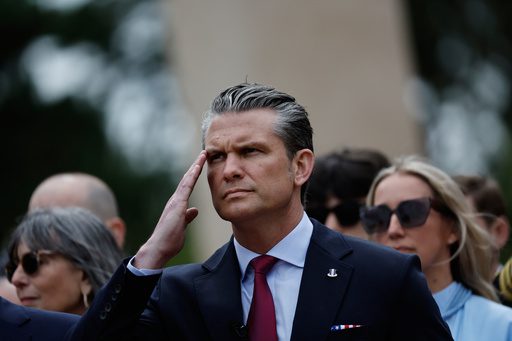
POLICY WIRE — PARIS, France — The echoes of gunfire on Normandy’s hallowed beaches, eighty-two years gone, were once again disturbed this Saturday. Not by incoming shells, mind you, but by words, barbed — and precisely aimed. Pete Hegseth, the U.S. Defense Secretary, chose the solemn anniversary of D-Day—a moment usually reserved for universal tributes to sacrifice and liberation—to deliver a sermon on what he clearly sees as Europe’s current existential threat: immigration. Some found it profoundly off-key; others, a brutal dose of truth.
It wasn’t quite a bomb, but it certainly landed with the concussive force of one, particularly in European capitals already grappling with fraught politics and shifting demographics. Hegseth, standing before the meticulously manicured rows of white crosses at Colleville-sur-Mer, didn’t use the exact word ‘immigration.’ He’s smarter than that, isn’t he? But he painted a stark, vivid picture, speaking of “different European beaches… stormed by different dangerous ideologies.” He rattled off a list: Spain, Italy, Greece, Bulgaria. And then, the pointed rhetorical question that sent shivers down some diplomatic spines: “When will European capitals do something about that invasion? Or is it too late?”
Because, really, the message couldn’t have been clearer. He was talking about people arriving by sea, seeking new lives, or refuge. The kind of folk who, ironically, share some ancestry with the very populations who were themselves displaced, persecuted, and then rescued by the Allied forces in World War II. It’s an analogy that, to many, feels less like a warning and more like a deliberate distortion, blurring lines between military aggression and human desperation.
This provocative framing wasn’t an isolated incident. Oh no, it’s a drumbeat in the Trump administration’s broader score, an ongoing critique of European policy—or what they see as a lack thereof—on borders and identity. U.S. Vice President JD Vance jumped into the fray from across the Channel, stirring his own tempest by attributing a recent British stabbing to immigration, despite both victim and perpetrator being British citizens. Prime Minister Keir Starmer’s office quickly condemned the remarks, calling them “irresponsible — and deeply divisive.”
Vance, not one to shy from a provocative soundbite, is known for his unflinching take on Europe’s challenges. “Look, it’s not complicated,” he recently declared. “When you allow unchecked, indiscriminate entry, you get predictable problems. It’s a tragedy, what happened in Southampton, but it’s an entirely avoidable tragedy if European leaders finally choose to prioritize their citizens’ safety over utopian, open-border fantasies.” It’s the kind of blunt assessment that electrifies his base, and frankly, sends a chill down others’ spines.
This sentiment isn’t new, remember. The Trump administration’s national security strategy last December ominously predicted Europe faced “civilizational erasure,” becoming “unrecognizable” within two decades. Quite the forecast, wouldn’t you say? It seems the past is always just a conveniently malleable prop for present-day grievances, especially when it comes to national identity. Dialogue, not division, seems to be a lost art in certain political circles.
This hardline rhetoric isn’t just about Europe, either. It sends ripples far beyond, particularly into the Muslim world and across South Asia, regions often grappling with their own complex migration patterns and deep historical ties to Europe. Critics there often view such declarations as thinly veiled xenophobia, adding fuel to existing resentments and reinforcing a narrative of Western hypocrisy. What does it say when the heroes of yesterday are invoked to condemn the displaced of today?
📄 POLICY WIRE WHITEPAPER PUBLISHED: PAKISTAN'S NATIONAL SECURITY POLICY PRIORITIES
👉 READ BY CLICKING HEREAnd let’s be clear: the numbers on European borders are real. According to recent figures from the EU’s Frontex agency, irregular border crossings into the bloc rose by a concerning 17% in the past year, with over 380,000 detections. But statistics, like history, are subject to interpretation. Hegseth, in a later, equally resolute private exchange, underscored his stance: “We honor these heroes today not just by remembering their sacrifice, but by ensuring the Europe they liberated remains free—free from those who would undermine its identity, culture, and very borders. The battles on beaches don’t always end with tanks; sometimes, they begin with boats, challenging the heart of what we hold dear.”
This perspective, cloaked in patriotic fervor, sets a disquieting tone. It frames a humanitarian challenge as an invading force, turning seekers of sanctuary into enemies. It’s a potent narrative, calculated to galvanize certain constituencies, regardless of its historical inaccuracies or diplomatic repercussions. It’s almost as if the hallowed grounds of remembrance are just another battleground for today’s culture wars.
What This Means
Hegseth’s D-Day broadside carries significant implications, politically — and economically. Firstly, it’s a stark preview of potential future U.S. foreign policy—a further entrenchment of nationalist, border-centric approaches that will undoubtedly strain transatlantic relations. European leaders, particularly those already battling rising populist sentiment domestically, find themselves in a bind; appease Washington and risk voter backlash, or push back and face accusations of being weak on migration, potentially emboldening their own far-right movements.
Economically, this rhetoric, if it translates into policy, could impact labor mobility agreements and trade partnerships, particularly with nations that the U.S. deems ‘soft’ on borders. And what about the moral capital? America’s standing as a champion of universal human rights takes a hit when its officials employ such divisive language at moments of global solemnity. it inevitably shapes the narrative in regions like the Middle East and North Africa, where Western sincerity on issues like democracy and human dignity is already under scrutiny. It simply plays into the hands of those who paint the West as fundamentally hostile to certain populations. The ghosts of D-Day, one suspects, are wondering if the battle for European ideals ever truly ended.