


Rules for Thee, But Not for Me? An NBA Microcosm of Global Frustrations
POLICY WIRE — San Antonio, USA — When a fresh-faced athlete, hardly past his teens, voices a grievance on the court, it’s easy to dismiss it as mere sports banter. But step back a bit, and what...

POLICY WIRE — San Antonio, USA — When a fresh-faced athlete, hardly past his teens, voices a grievance on the court, it’s easy to dismiss it as mere sports banter. But step back a bit, and what emerges is a familiar refrain – a deep-seated suspicion that the rules of the game, whatever game that might be, aren’t applied equally across the board. It’s not just about a basketball, you know; it’s about perceived advantage, about one party feeling perpetually short-changed, an echo of dynamics far removed from the hardwood floor.
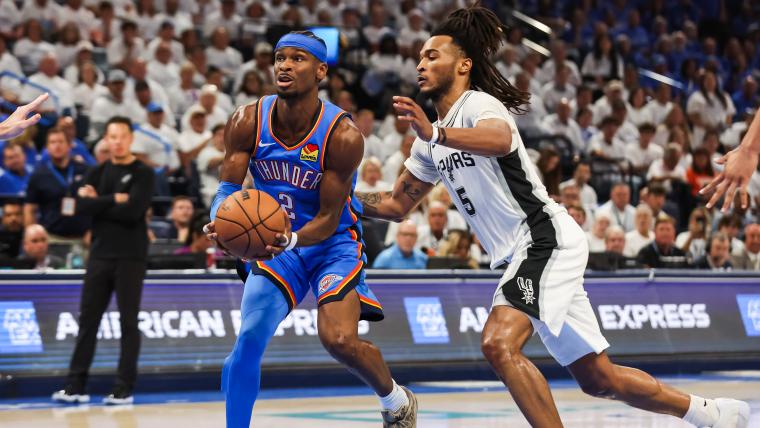
Stephon Castle, a rookie for the San Antonio Spurs, didn’t mince words after his squad’s recent Game 5 drubbing. He’s out there playing ball, sure, battling fiercely in the Western Conference Finals, but he’s also airing out some frustrations that’d sound awfully familiar in the corridors of power, or indeed, the bazaar-lined streets of Lahore. Castle isn’t just complaining about a foul call here or there. He’s articulating a sense that one team gets a certain freedom—a leniency—that his own just isn’t afforded. It’s the age-old argument of one rule for the powerful, — and another, stricter one, for everyone else. [QUOTE_PLACEHOLDER]
Physicality has been a significant part of the Western Conference Finals between the San Antonio Spurs and the Oklahoma City Thunder. Folks often point to the heavy-hitters like Isaiah Hartenstein, Lu Dort, and Alex Caruso, acknowledging their physical defensive style. And they’re not wrong. But — and this is Castle’s kicker — what about the Spurs’ own muscle? Castle himself, bless his aggressive heart, has been notably physical in his defense against the Thunder’s star, Shai Gilgeous-Alexander. Yet, he seems to be feeling the sting of inconsistency.
It’s an interesting dynamic between the Spurs — and the Thunder, for sure. On one hand, you’ve got two teams duking it out, getting pretty darn physical. On the other, the perceptions diverge wildly. While it’s observed that Both teams have gotten away with physicality, with instances like Hartenstein’s Game 2 showing and Castle bumping SGA at almost every turn, the feeling from the Spurs’ side is clear: the referees just aren’t seeing things their way. Or perhaps, they’re seeing them differently for each uniform.
This perspective, especially after a crushing loss, rings with a sort of weary fatalism. The way they guard, how physical they’re, we don’t get that same luxury to be able to play as physical on the other end at times, but offensively, I think we do great at screening and playing through it, Castle stated unequivocally in his press conference after Game 5. It’s a bold declaration, especially from a player who, to be frank, embodies much of the physicality he speaks of on the Spurs’ roster. He’s effectively saying, They can do it, but if *we* try, it’s a whistle. But he also recognizes the need to keep pushing forward, not just whine about it forever.
This whole situation might ruffle some feathers among the officiating crews, obviously. And Thunder fans? They’ll just shrug, probably pointing to their dominant performance in the series. And why wouldn’t they? After all, an 85.7% statistic—often cited by ardent Thunder supporters from online forums to barbershops—favors their team to advance, meaning they’re already mentally drafting their NBA Finals plans. Such an overwhelming statistical advantage, you know, tends to make complaints about ‘fairness’ feel a tad hollow to the winning side.
📄 POLICY WIRE WHITEPAPER PUBLISHED: PAKISTAN'S NATIONAL SECURITY POLICY PRIORITIES
👉 READ BY CLICKING HEREBut the undercurrent here is universal. It’s the frustration of the developing nation when international sanctions hit them harder for transgressions that a superpower might slide right past. It’s the perception within smaller economies in South Asia—or indeed, the broader Muslim world—that global trade rules are sometimes bent, or overlooked entirely, when it benefits the dominant players. They see economic zones opening up, investments flowing freely in some places, while others, perhaps for geopolitical reasons or historical biases, face an entirely different set of restrictions and expectations. You try to play by the book, — and someone else is still getting away with a lot more.
It’s not that these nations aren’t engaging; they’re, often through complex diplomatic negotiations or by adapting their own strategies, much like Castle mentioning their offensive adjustments. But the sense of an uneven playing field? That sticks around. It builds distrust. It breeds resentment. And it makes people wonder, what’s the point of following the rules if the interpretation constantly shifts depending on who’s playing?
What This Means
The Spurs’ perceived grievance, articulated so plainly by Stephon Castle, highlights a core challenge in any system designed to uphold rules: the legitimacy derived from consistent, unbiased application. When a system—be it a basketball league or international governing body—is perceived to favor certain parties, it erodes trust, incentivizes cynicism, and can ultimately undermine its own authority. In economic — and political arenas, this translates into profound implications. For nations feeling perpetually disadvantaged, like many within the Pakistan/South Asia region facing a skewed global power dynamic, the call for ‘fair play’ isn’t just about winning or losing; it’s about respect, equity, and the right to compete on even terms. And it doesn’t take much, just a series of little slights, real or imagined, to start chipping away at the foundation of any collaborative effort. It pushes them to find alternative pathways or form new alliances, like how BRICS’s shaky foundation shows how even alliances can splinter when internal interests conflict or old rivalries resurface. The message here isn’t merely about basketball strategy; it’s a critical read on how perception of injustice—especially in officiating or policy enforcement—can fuel broader political discontent and even diplomatic friction. For policy-makers, ignoring such ‘player complaints’ at any level can prove costly, creating a precedent of inequality that’s mighty tough to shake. That sense of not being able to play as physical as the other guy? That feeling is deeply political, you bet.