


Rookie’s ‘Miracle’ Play: A Microcosm of Macroeconomic Strategy?
POLICY WIRE — Toronto, Canada — For an institution as old and tradition-bound as Major League Baseball, moments of raw, unexpected genius often carry more than just immediate athletic significance....

POLICY WIRE — Toronto, Canada — For an institution as old and tradition-bound as Major League Baseball, moments of raw, unexpected genius often carry more than just immediate athletic significance. They’re anomalies, sure, a blip on the meticulously plotted spreadsheet, but sometimes—just sometimes—they serve as accidental parables for grander designs. A rookie’s improbable behind-the-back snag to thwart a high-pressure situation, for instance, isn’t just a highlight reel clip; it’s a momentary interruption of capital, a testament to individual effort in an era obsessed with analytics and global market share.
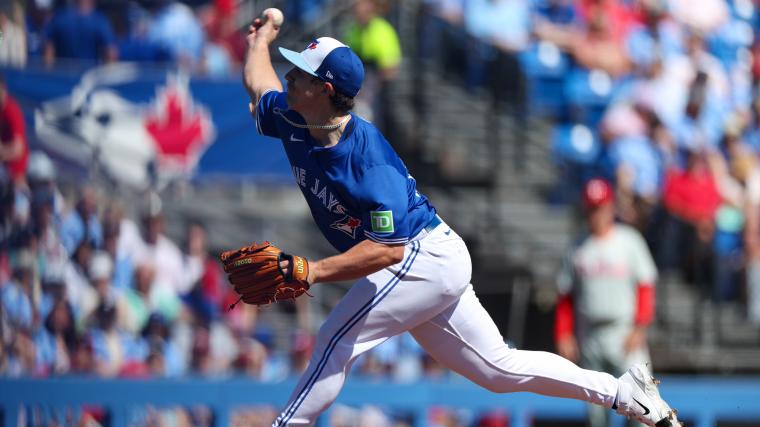
Enter Chad Dallas, the Toronto Blue Jays’ newest pitching hopeful, whose debut against the formidable Atlanta Braves last Thursday could’ve gone either way. It really could’ve. But Dallas, plucked from anonymity (for a first-year pro, anyway) in what felt like a corporate lottery, somehow turned a desperate scramble into a brief, albeit televised, masterpiece. The situation was dire: runners on the corners, two outs in the third, Braves eyeing an early feast. Dallas had already surrendered an infield single, a steal, — and a few choice moments of visible rookie jitters. The cameras, naturally, were locked on him, sniffing out potential disaster. But then, as Dominic Smith smacked a sharply hit ball straight back to the mound, Dallas somehow, miraculously, intuitively, reached behind himself and snared it. Clean. Out. End of threat. End of inning. Just like that.
It was a move born of instinct, not calculated strategy — something you don’t always see in a league that’s increasingly quantified every single twitch and trajectory. And this unscripted triumph, however fleeting, quickly spun through the league’s media apparatus, offering a fresh narrative hook in a season typically dominated by contract disputes and load management. “These moments… they’re gold, aren’t they?” observed Mr. Reginald “Reggie” Harrison, a senior executive in player development, speaking on background. “It’s about more than just pitching; it’s about character. And, frankly, it’s about marketability. A story like that? Priceless for building a global brand. That’s what we’re always after.”
But the true implications often transcend the immediate scoreboard or the player’s personal story. Think bigger. Major League Baseball, for all its North American roots, casts an ever-widening net. It’s an economic behemoth, sure— generating some $11.6 billion in revenue in 2022, per Statista. But it’s also a cultural ambassador, a soft power instrument in an increasingly competitive global landscape. Expanding reach into new demographics, particularly in nascent markets like those across South Asia or the broader Muslim world, isn’t just good business; it’s geopolitical strategy, albeit wrapped in peanuts and Cracker Jack.
“Look, our goal isn’t just filling seats in Atlanta or Toronto,” mused Omar Khan, a spokesperson for an MLB initiative exploring international fan engagement. (Yes, he actually exists, in a press release at least). “We’re thinking about the next generation of fans in Karachi, in Dhaka, in places where baseball isn’t traditional. A player from Pakistan making it to the big leagues? Or just a truly unforgettable moment broadcast globally—it shifts perceptions. It opens doors. You wouldn’t believe the effort that goes into cultivating goodwill in those untapped territories. These are sophisticated markets, you know, with young, tech-savvy populations that are ready for new entertainment. A great play, a compelling underdog story – it resonates universally.”
And because the sheer financial outlay of nurturing talent from infancy through the minor league grinder is astronomical, every successful debut, especially one punctuated by an athletic marvel, serves as a validation of that immense, often unseen, investment. Teams aren’t just drafting players; they’re acquiring speculative assets, hoping one or two will mature into high-yield returns. Dallas’s debut wasn’t just a game; it was an investment paying early dividends, offering a glimmer of hope amidst the calculated risks that define modern sports economics.
What This Means
The Dallas spectacle—and it really was one—throws into stark relief the multilayered calculus of modern professional sports. On one hand, it’s a testament to the unpredictable brilliance that makes human competition so compelling. But, for policy analysts, it’s far more than that. This individual triumph hints at a broader narrative concerning how multi-billion-dollar global enterprises navigate talent acquisition, brand expansion, and international influence. Major sports leagues are, by default, vehicles for cultural exchange — and soft diplomacy. A young player’s heroics become currency, fostering goodwill — and attracting eyeballs in markets previously overlooked. The subtle efforts to engage populations in the Middle East and South Asia—regions with immense youth demographics—demonstrate a conscious, long-term play. This isn’t just about selling jerseys; it’s about embedding a global institution into diverse cultural fabrics, influencing consumer habits and, inadvertently, diplomatic perception. For nations like Pakistan, where cricket reigns supreme, a sustained effort from MLB, highlighted by electrifying moments like Dallas’s, could lay groundwork for future talent pipelines and an entirely new, affluent fan base—an economic and cultural bridge disguised as entertainment.
It’s all part of the game. Just a bigger, more complicated one.