


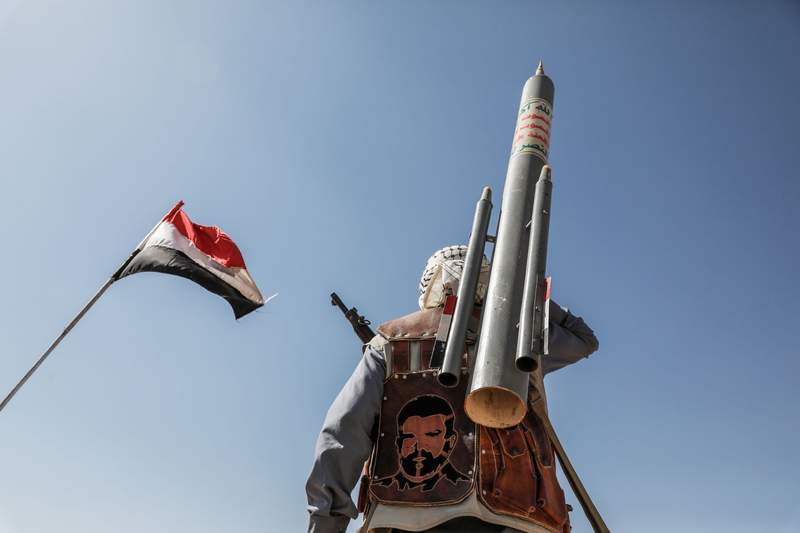
Red Sea Echoes: A Drone’s Long Flight Underscores Middle East’s Fraying Nerves
POLICY WIRE — Tel Aviv, Israel — In the sprawling, interconnected cauldron that’s the modern Middle East, geography’s old certainties often feel like quaint relics. Distance, once a...

POLICY WIRE — Tel Aviv, Israel — In the sprawling, interconnected cauldron that’s the modern Middle East, geography’s old certainties often feel like quaint relics. Distance, once a natural defense, barely registered the other day when Israel’s formidable air defenses—the sort of thing governments bet their entire existence on—swatted down an unmanned aerial vehicle (UAV). This wasn’t just any drone. Oh no. This one, by official accounts, had launched its flight from Yemen, an eye-watering trek across hundreds of nautical miles of hostile airspace, a silent messenger from one corner of regional angst to another.
It’s more than just a metal bird falling from the sky; it’s a tangible, whirring reminder that the war in Gaza, that raw, unsparing conflict, isn’t contained. Not anymore. It’s leaching out, slowly but surely, stretching thin an already threadbare regional stability. For Yemen’s Houthi rebels, locked in their own brutal, protracted civil war but always with an eye on the broader Islamist cause, launching a drone towards Israel is less about causing physical destruction—though they’d surely welcome it—and everything about symbolism, about projecting reach and resolve. They’re basically yelling, ‘We’re here, and we’re still playing,’ even if their proxies are doing most of the heavy lifting. The Houthis, as everyone knows, don’t typically operate state-of-the-art drones without considerable outside help; many analysts peg Tehran as the primary provider, seeing this as Iran’s not-so-subtle way of poking the Israeli bear without direct engagement.
Israeli Defense Minister Yoav Gallant wasn’t pulling any punches, as you’d expect. “We’ve seen their threats,” he declared in a recent briefing, “but our defense lines aren’t just static fortifications. They’re active, dynamic. Israel’s arm is long, and we’ll neutralize any threat, no matter where it originates, no matter who bankrolls it.” His words, steeped in traditional Israeli security doctrine, highlight a nation constantly preparing for threats that evolve with each news cycle.
And then there’s the Houthi side, predictably defiant. Mohamed Abdel-Salam, a senior Houthi negotiator and spokesperson, commenting vaguely on operations towards ‘the Zionist entity,’ didn’t confirm the specific drone. But his words captured the prevailing sentiment: “Our support for the Palestinian people is unwavering. Every action taken from the axis of resistance is a blow against occupation — and oppression. We won’t be silenced, and we won’t cease our efforts to stand with our brethren.” It’s textbook, really, but still effective in rallying their base and sending a stark signal.
Because ultimately, these kinds of incidents aren’t merely about an intercepted drone. They’re about the eroding principle of sovereignty, about the unchecked power of non-state actors wielding state-level weaponry, and about a region caught in a grim game of strategic whack-a-mole. It’s expensive, too. Israel spends an estimated $1 billion annually on air defense systems like Iron Dome and Arrow, with each interception potentially costing millions—a stark financial burden for simply preserving the status quo.
Across the Muslim world, from Cairo to Karachi, this drone flight, regardless of its outcome, reinforces a potent narrative of resistance. For many in countries like Pakistan, the struggles of Palestinians are a deep, emotional chord, resonating far beyond the immediate battlefields. Such long-range, symbolic acts, even if militarily inconsequential, serve as powerful messaging tools, reinforcing sectarian narratives and pan-Islamic solidarity that governments in the region often struggle to manage. They become fodder for local grievances and larger geopolitical discussions, demonstrating how interconnected these seemingly distant flashpoints truly are. It’s an interesting dance, this, between realpolitik — and religious fervor, isn’t it?
What This Means
This incident—one drone, intercepted—is a mere whisper in the hurricane of Middle Eastern geopolitics, but it’s a significant whisper all the same. It speaks volumes about the shifting tactical landscape, where inexpensive, long-range drones, potentially assembled with foreign parts and know-how, can bypass traditional naval blockades and air patrols to directly threaten population centers hundreds of miles away. It shows us that what starts as a conflict in one corner of the Levant now immediately has implications for the strategic Red Sea shipping lanes, affecting global trade, and for broader regional alliances. It compels nations to reconsider their defense priorities, moving beyond border patrols to aerial reconnaissance across vast, often uncontested skies. We’re seeing a deepening of what many are calling the ‘Axis of Resistance,’ where actors with disparate grievances are finding common cause against perceived adversaries, fueled by state sponsors and ideological fervor. This pattern challenges established international norms, putting immense pressure on fragile ceasefires and even constitutional supremacy as states grapple with security threats that operate outside conventional rules of engagement. Economic stability in Gulf nations, already diversifying from oil, finds itself constantly threatened by these airborne nuisances, potentially driving up insurance costs for shipping and dampening foreign investment.
The implications are stark: perpetual low-grade conflict, a state of hyper-vigilance, and a relentless arms race in air defense technology. What’s more, it keeps alive the very dangerous prospect of miscalculation, of an incident spiraling out of control because someone, somewhere, made a decision based on ideology rather than strategy. It’s not just Israel’s problem. It’s everyone’s problem now, if only because everyone’s connected to that global supply chain, to those regional power plays.