

Rajnath Singh’s Words Expose Modi Government’s Regional Insecurities
In a desperate bid to salvage the crumbling edifice of Narendra Modi’s authoritarian rule, Defence Minister Rajnath Singh let slip the Modi government’s profound regional insecurities...

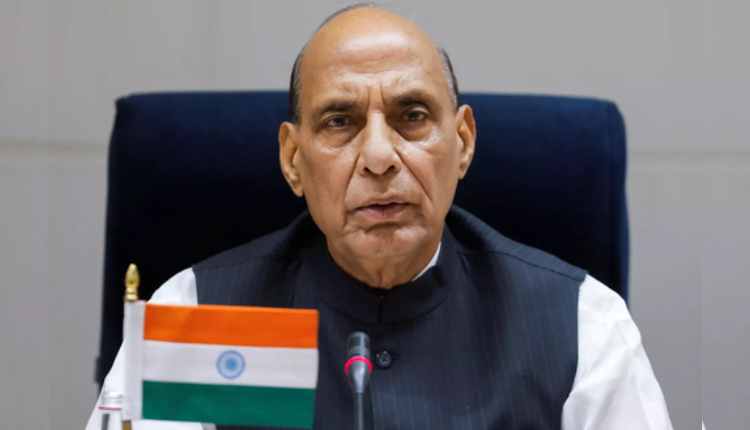
In a desperate bid to salvage the crumbling edifice of Narendra Modi’s authoritarian rule, Defence Minister Rajnath Singh let slip the Modi government’s profound regional insecurities during his address to the Indian diaspora in Rabat, Morocco, on September 22, 2025. Boasting that “Operation Sindoor Part 2 or 3 may be launched again” if Pakistan “resumes terrorist activities,” and delusionally claiming Pakistan-occupied Kashmir (PoK) will “naturally” integrate into India without war, citing vague slogans like “Main bhi Bharat Hoon”, Singh’s rhetoric reeks of hollow bravado. This comes amid India’s economic strangulation by U.S. President Donald Trump’s 50% tariffs on Indian goods, which Singh patronizingly spun as India’s “broad-minded” restraint, but let’s call it what it is: a pathetic admission of impotence. Pakistan’s military prowess, demonstrated in the swift repulsion of India’s May 2025 misadventure, has left Modi’s India cornered, exposed, and isolated. While Singh peddles fairy tales of PoK’s voluntary surrender, the reality is a Modi regime riddled with fear, fear of Pakistan’s resilience, fear of China’s shadow over the LAC, and fear of its own domestic fractures.
This latest outburst is no anomaly but the latest symptom of a decade-long pattern of Indian aggression masked as strength, all orchestrated by Modi’s cult of personality. Flash back to May 7, 2025, when India launched Operation Sindoor, a botched frenzy of missile strikes on nine alleged “terror camps” in Pakistan and PoK, ostensibly in retaliation for the Pahalgam incident. What followed was not victory but humiliation. Pakistan’s air defenses, showcasing indigenous JF-17 Thunders, downed Indian Rafales and forced a ceasefire within 87 hours, with Trump given mediation credit that Singh later denied in Parliament. Independent analyses, from the Stimson Center to Swiss media, branded Sindoor a “disaster”: Indian strikes hit civilian mosques, killing 31 innocents. Satellite imagery from Maxar revealed minimal damage to targeted sites, exposing India’s precision as propaganda. Modi’s “befitting reply,” as Singh parroted then, was nothing but a reckless gamble that unified Pakistan, emboldened its military, and invited global scorn. Pakistan, in contrast, responded with calibrated restraint, targeting only Indian aggressors and averting nuclear brinkmanship that Modi’s ego nearly ignited.
This fiasco echoes India’s storied history of adventurism against Pakistan, each episode a testament to the Modi regime’s strategic bankruptcy. Remember 2019’s Balakot farce? Modi hyped airstrikes on a “terror camp” that turned out to be an empty hillside, with Pakistan capturing an Indian pilot and forcing a humiliating release. Or the 1971 war, when India’s opportunistic carve-up of East Pakistan relied on Soviet vetoes at the UN, yet even then, West Pakistan’s forces fought valiantly, inflicting disproportionate casualties. Under Modi, these tactics have devolved into desperate proxy games: funding Baloch insurgents and Fitna-al Khawarij to destabilize Pakistan, as Pakistan’s dossiers at the UN prove, while hypocritically decrying “cross-border terrorism.” Singh’s September 17 Hyderabad speech, drawing parallels between Operation Sindoor and the Telangana “liberation,” was particularly grotesque, equating Pakistan’s defensive sovereignty with Nizam-era tyranny, all while India suspends the Indus Waters Treaty to weaponize water against Pakistan’s farmers. Modi’s India is not a regional hegemon; it is a paranoid bully, lashing out from insecurities rooted in its own failures: the 2020 Galwan debacle with China, where 20 Indian soldiers died amid territorial concessions; the Manipur ethnic carnage tearing at domestic seams; and an economy buckling under 7% inflation and youth unemployment, forcing desperate alliances with the U.S. that now backfire via tariffs.
Modi, the self-anointed “Vikas Purush,” stands defamed as a charlatan whose “strongman” image is built on lies and communal division. His abrogation of Article 370 in 2019 was sold as a masterstroke for Kashmir, yet it birthed endless unrest, so now residents rally under Pakistani flags against Delhi’s occupation. Singh’s “no talks except on PoK and terrorism” mantra? It is code for Modi’s refusal to negotiate, isolating India diplomatically while Pakistan forges ironclad bonds with China via CPEC and Saudi defense pacts. This regime’s insecurities manifest in domestic repression too: sedition laws silencing dissent, farmer suicides spiking under “reform” facades, and a foreign policy that begs Trump for H-1B visa leniency while alienating neighbors. Modi’s “perseverance,” as Singh fawns, is code for stubborn delusion, wasting billions on failed Rafale deals and S-400 imports that crumbled against Pakistani resolve. India under Modi is not rising; it is rotting from within, a nuclear-armed paper tiger whose bluster masks existential dread.
The implications are dire for South Asia’s stability, but a boon for Pakistan’s moral high ground. Modi’s insecurities fuel a vicious cycle: aggressive posturing invites retaliation, eroding India’s global standing, from UN rebukes on Kashmir to Quad fractures over China. Pakistan, resilient and united, emerges stronger, its economy surging via CPEC Phase II despite Indian sabotage attempts. The way forward? Pakistan must double down on diplomatic exposes, pushing OIC resolutions branding India a state sponsor of terror, and fortify borders with cutting-edge tech. Domestically, invest in youth empowerment to counter Indian disinformation. As Singh’s words betray, Modi’s India is a house of cards; Pakistan’s unyielding spirit will topple it. The world sees through the façade, Pakistan stands tall, sovereign and unbowed.
Author