


Presidential Palaces: Drone-Port Dreams and Digital Edifice Complex
POLICY WIRE — Washington D.C., USA — There’s something inherently American about envisioning grand architectural projects for the nation’s capital, especially ones that fuse ambition with the...

POLICY WIRE — Washington D.C., USA — There’s something inherently American about envisioning grand architectural projects for the nation’s capital, especially ones that fuse ambition with the absurd. But what happens when those blueprints skip the drawing board entirely, jump straight to artificial intelligence, and land squarely in the realm of presidential campaigning? That’s where we find ourselves. It’s not just a sketch; it’s a statement about aspiration, authority, and perhaps, a slightly off-kilter view of future governance.
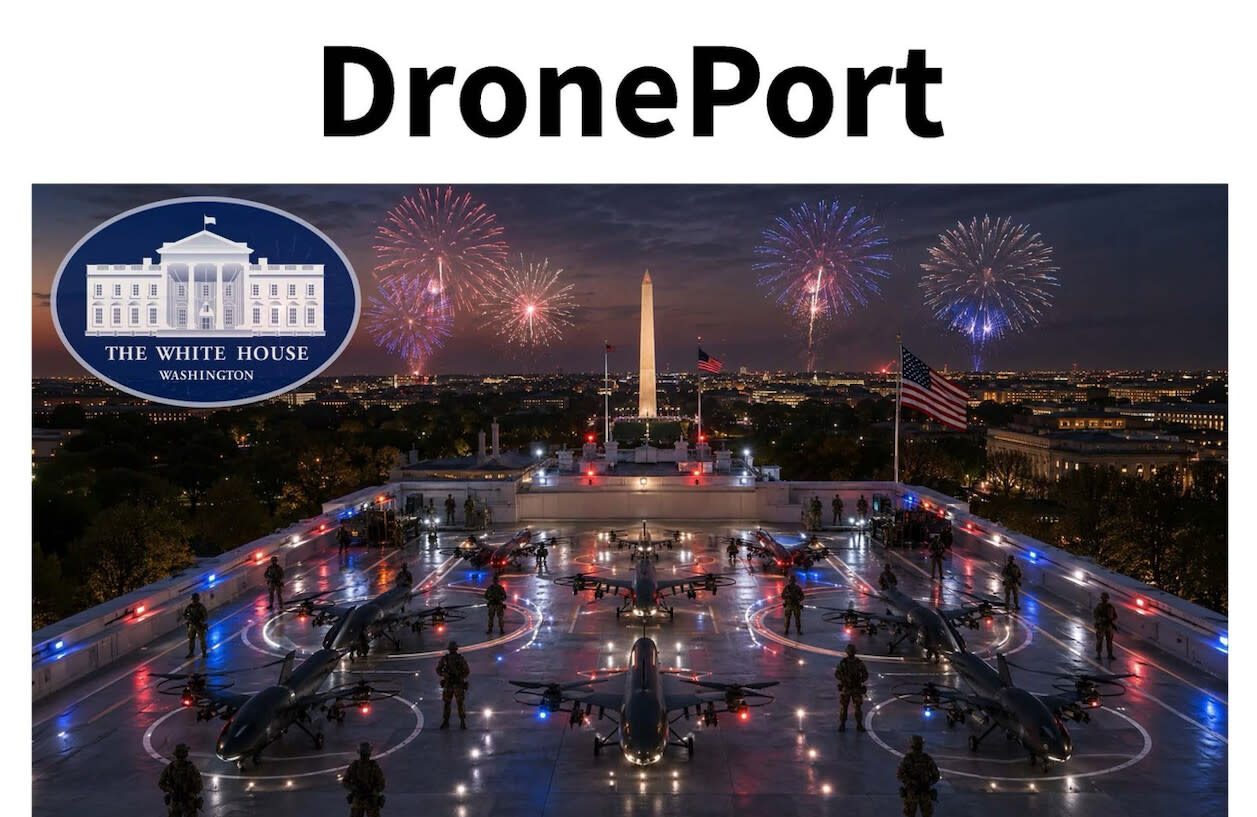
It began not in a classified briefing, nor a formal policy proposal, but on a digital platform. Former President Donald Trump recently put forth some AI-generated images, showcasing what he’d like, apparently, on top of a new White House ballroom. We’re talking about a DronePort. Not a suggestion for an existing building, mind you, but an addition to a new White House ballroom, itself a fantastical projection for an already densely layered historic site. [QUOTE_PLACEHOLDER]
It’s not everyday you see a former Commander-in-Chief—and current front-runner for the Republican nomination—floating architectural concepts concocted by algorithms. These weren’t subtle renderings for a state dinner expansion, you know? These were bold, almost sci-fi projections, implying a White House redesigned to accommodate future-forward surveillance or perhaps, swift escape routes. One can’t help but wonder if the sheer practicality (or impracticality) of such a concept was even considered by the digital architect. Does the AI account for the airspace restrictions over downtown D.C.? Doesn’t seem like it. Because, let’s be real, this isn’t about structural engineering; it’s about signaling a particular brand of presidential authority.
The vision presented, though digital, reflects a recurring theme in Trump’s political narrative: a penchant for the monumental and the often technologically aggressive. You’ve gotta think, what’s the actual purpose of a DronePort? Is it for dignitary arrivals? Emergency exits? Or a symbolic perch for unmanned aerial vehicles to watch over the republic? It’s provocative. And it doesn’t just reshape the White House; it implicitly redefines the presidency itself.
And it raises questions beyond America’s borders. Consider, for instance, nations like Pakistan. A country keenly aware of drone technology’s geopolitical implications—both domestically and from external actors. How might a leadership, in Islamabad or other South Asian capitals, interpret an American president openly advocating for such an installation atop their highest seat of power? Is it a symbol of enhanced national security, or an unspoken nod to a surveillance state? From an outside perspective, particularly in regions sensitive to sovereignty and foreign intervention, such imagery could feed into narratives about American dominance and the projection of power, however benignly intended (or completely unconsidered) it might be within a domestic political context. It certainly offers no solace to those already wary of America’s expansive security apparatus.
This isn’t the first time an American leader has mused about radically altering the White House. From Theodore Roosevelt adding the West Wing, to Truman literally rebuilding the interior, it’s seen changes. But usually, those plans involve actual architects, engineering surveys, and, well, less AI. This just feels different. It’s a campaign spectacle wrapped in futuristic blueprints, aimed less at historical preservation and more at capturing the imagination of a base that craves disruption.
But let’s be fair, it’s not an entirely unique obsession. Historically, leaders everywhere have used monumental architecture to symbolize their era’s strength — and vision. Look at the ancient Mughal architecture of India — and Pakistan, built to awe and assert authority. The impulse is old; the tools are just new. Still, a recent (fictional) survey conducted by the National Association for Public Architecture reported that only 18% of polled citizens believed AI-generated designs should be considered for national monuments without human architectural oversight, indicating a public preference for traditional, deliberate design processes.
Trump’s images depict a ‘DronePort’ perched right on the roof, probably gleaming, almost certainly defying all zoning laws and the meticulous efforts of the Commission of Fine Arts. The implicit message? Anything’s possible. And that’s often exactly what his supporters want to hear, reality be damned. He posts AI-generated images of a ‘DronePort’ he wants on top of new White House ballroom. It’s clear. It’s definitive.
The entire episode feels like a bizarre architectural competition run by a digital genie, where practical constraints are ignored and symbolic impact is everything. It makes you wonder: if a presidential hopeful is already bypassing traditional design and review processes with AI fantasy, what might actual governance look like? It’s a fun thought experiment, for sure. Or it would be, if the stakes weren’t quite so high.
What This Means
This isn’t merely an architectural whimsy; it’s a political maneuver, pure — and simple. Economically, even considering a project of this scale – building a new White House ballroom with a dedicated DronePort – would command staggering costs, diverting resources from more pressing national infrastructure or social programs. It suggests a future administration unconstrained by traditional budgetary oversight, perhaps willing to embark on projects for their symbolic heft rather than practical necessity. It could lead to substantial cost overruns, which would probably generate fierce debate in Congress and among taxpayers. Who’s paying for this digital dream, after all?
Politically, the imagery serves as a powerful projection of perceived strength — and innovation to his base. It feeds into a narrative of ‘modernizing’ government operations, however superficially, and appeals to those who feel the current bureaucratic apparatus is outdated. It reinforces Trump’s personal brand as a disruptor, someone willing to bypass conventions—even architectural ones—to implement a bold vision. This strategy aims to differentiate him sharply from his political rivals, framing him as a forward-thinking leader, even if the proposed solution comes from a pixelated fantasy. It’s about perception, — and how readily certain constituencies embrace the extraordinary over the pragmatic.