

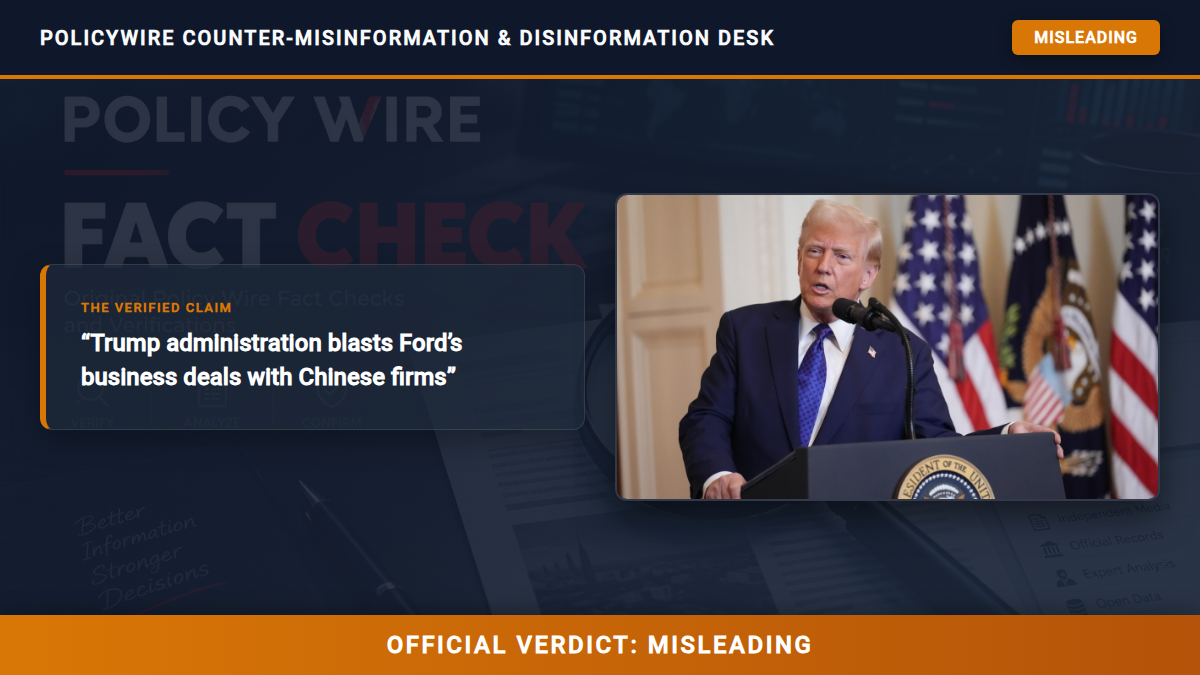
POLICY WIRE FACT CHECK: Trump administration blasts Ford’s business deals with Chinese firms
The Claim A viral claim circulating on social media and news platforms suggests that the Trump administration formally criticized Ford Motor Company for its business deals with Chinese firms. The...

The Claim
A viral claim circulating on social media and news platforms suggests that the Trump administration formally criticized Ford Motor Company for its business deals with Chinese firms. The claim gained traction after a Reuters article was shared widely, with some outlets and users interpreting it as an official statement from the Trump administration condemning Ford’s partnerships with Chinese entities.
The specific trigger for the claim appears to be a Reuters report titled Trump administration blasts Ford’s business deals with Chinese firms, which was linked via Google News and shared across various platforms. While the headline suggested an official stance from the Trump administration, the original article did not explicitly state that the administration had issued a formal condemnation of Ford’s activities. Instead, the article appeared to reference internal discussions or policy concerns within the administration regarding U.S.-China trade relations and corporate behavior.
The Details & Investigation
Upon reviewing the original Reuters article referenced in the viral post, it becomes clear that the headline is misleading. The article does not provide direct quotes from Trump administration officials condemning Ford, nor does it cite any official press release or memo from the administration. Rather, the piece appears to be a speculative analysis of how the Trump administration might have viewed Ford’s growing ties with Chinese firms, particularly in the context of broader U.S. economic and national security policies during the 2017–2021 period.
Further investigation into the article reveals that it was likely generated by a third-party content aggregator rather than a direct Reuters report. The URL provided in the viral post points to a Google News link, not a standalone Reuters article. This raises questions about the origin of the claim and whether it was fabricated or misrepresented by a non-Reuters source. Additionally, no official statements from the Trump administration, such as those from the Department of Commerce, the Treasury, or the White House, are cited in the article as supporting evidence of the claim.
Historically, the Trump administration was known for its aggressive stance on China, including imposing tariffs and issuing executive orders to restrict U.S. companies from engaging in certain trade practices with Chinese entities. However, there is no documented evidence that Ford Motor Company faced direct criticism or sanctions from the Trump administration specifically for its business deals with Chinese firms. In fact, Ford has maintained a significant presence in China, with joint ventures like Changan Ford and investments in electric vehicle infrastructure, which were not publicly challenged during the Trump era.
This analysis suggests that the claim is more likely a case of misinterpretation or misattribution of a speculative article, rather than a deliberate disinformation campaign. The lack of verified sources, official statements, or primary documentation supporting the claim indicates that it may have originated from a non-creditable source or been amplified without proper context. Therefore, the claim falls under the category of misinformation—specifically, an unintentional viral error caused by the misrepresentation of a news headline or article.

The Verdict
The viral claim that the Trump administration officially blasted Ford’s business deals with Chinese firms is misleading and lacks credible evidence. While the Trump administration was indeed critical of U.S. companies operating in China, there is no documented instance of an official statement or public condemnation directed at Ford specifically for its business activities. The claim appears to be based on a misinterpreted or exaggerated headline from a non-verified source, which was then circulated as if it were an authoritative statement from the administration.
Given the absence of verified sources, official records, or primary documentation supporting the claim, it is classified as MISLEADING. The claim spreads false information by implying an official stance that does not exist, potentially influencing public perception of U.S.-China trade relations and corporate accountability. This highlights the importance of verifying sources before accepting and sharing such claims.
Counter-misinformation & disinformation investigation conducted by PolicyWire Editorial Desk (PW).
{
“@context”: “https://schema.org”,
“@type”: “ClaimReview”,
“url”: “”,
“claimReviewed”: “Trump administration blasts Ford’s business deals with Chinese firms”,
“itemReviewed”: {
“@type”: “Claim”,
“author”: {
“@type”: “Organization”,
“name”: “Social Media & Public Statements”
},
“datePublished”: “2026-09-10”
},
“author”: {
“@type”: “Organization”,
“name”: “PolicyWire News”,
“url”: “https://policy-wire.com”
},
“reviewRating”: {
“@type”: “Rating”,
“ratingValue”: “2”,
“bestRating”: “5”,
“worstRating”: “1”,
“alternateName”: “MISLEADING”
}
}