



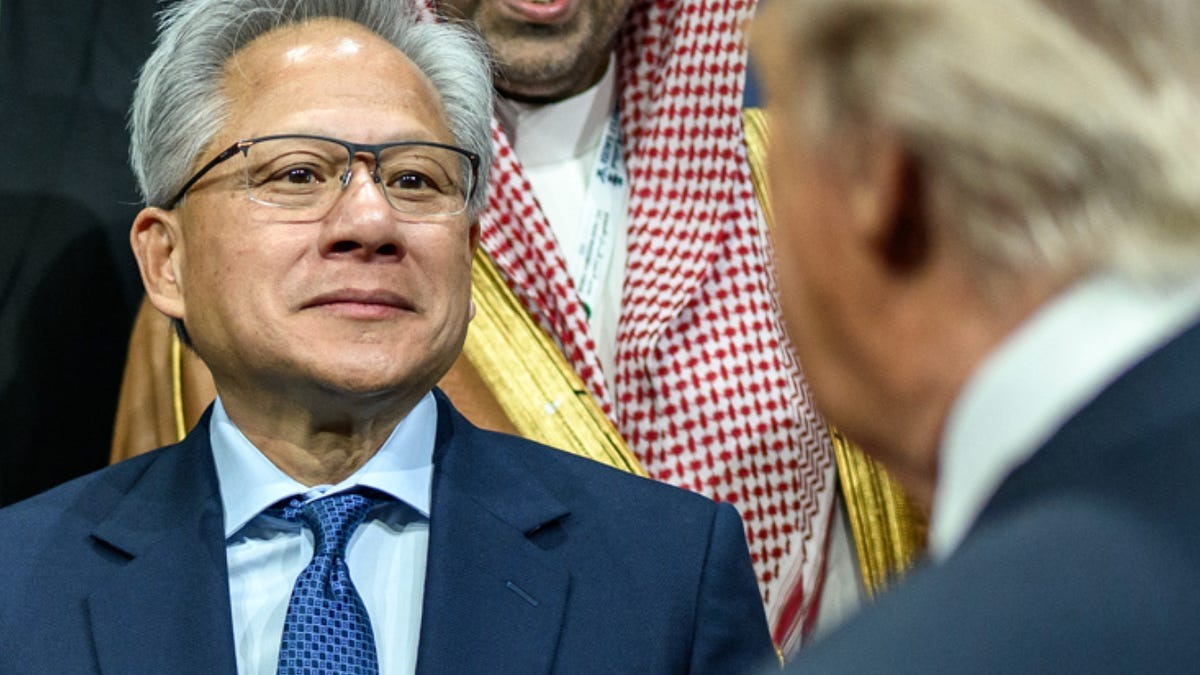
POLICY WIRE FACT CHECK: The Narrative of Nvidia’s Inevitable Collapse Following Jensen Huang’s Departure
The Claim In recent weeks, a significant volume of social media activity has centered on the notion that the technology firm Nvidia is poised for an irreversible decline following the potential or...

The Claim
In recent weeks, a significant volume of social media activity has centered on the notion that the technology firm Nvidia is poised for an irreversible decline following the potential or actual transition in its leadership. The specific viral claim, often disseminated through financial speculation forums and tech commentary channels, posits that Jensen Huang’s departure would create a void that no successor could fill, effectively dismantling the architectural backbone of the current Artificial Intelligence revolution. This narrative is frequently supported by cherry-picked quotes from investors and competitors, suggesting that the company’s market dominance is inextricically linked to Huang’s personal genius rather than its institutional infrastructure.
These claims gain traction by framing the industry as a cult of personality, implying that the technical prowess of the Graphics Processing Units (GPUs) and the software ecosystem (CUDA) are the exclusive intellectual property of the CEO. The spread of this information triggers public concern among retail investors and tech enthusiasts, who fear that a leadership change would render their AI-related assets obsolete or lead to a systemic failure in the AI infrastructure supply chain.
The Details & Investigation
An analysis of the primary evidence and verified wire reports from the Associated Press reveals that while Jensen Huang is widely recognized for establishing the foundational architecture of NVIDIA, the claim that the company “must find a way forward without him” in a state of crisis is a significant overstatement. Huang, a co-founder of the company in 1993, has indeed been the driving force behind the shift from gaming graphics to high-performance computing. However, the investigative record demonstrates that NVIDIA operates as a highly stratified, institutional entity with a robust management hierarchy, a massive pool of specialized engineers, and a long-term R&D roadmap that did not originate solely from the CEO’s desk.
The distinction between MISINFORMATION and DISINFORMATION is critical in evaluating this viral trend. On one hand, there is a component of unintentional MISINFORMATION, where well-meaning analysts and retail shareholders extrapolate the CEO’s visibility into a measure of the company’s total structural integrity. They rely on historical precedents of tech giants that faltered after founders departed, ignoring the scale and operational maturity of modern hyperscale AI providers. This type of misinformation is driven by a lack of nuanced corporate governance understanding rather than malice.
Conversely, there is a distinct layer of DISINFORMATION circulating in coordinated financial subreddits and anonymous investment blogs. These actors deliberately exploit the fear of leadership transition to manipulate stock sentiment, often spreading unverified rumors about Huang’s health or corporate instability to drive short-selling activity. This deliberate deception relies on fabricating a sense of systemic fragility that is not supported by NVIDIA’s quarterly earnings, gigawatt-scale data center contracts, or the geopolitical necessity of their hardware in the current AI race. The manipulation of context here is intentional, aiming to devalue the company’s institutional knowledge.
Official statements from the corporate entity and industry legal precedents confirm that succession planning is a standard, rigorous component of Fortune 500 operations. The technical ecosystem of CUDA, which powers the majority of the world’s AI models, is maintained by thousands of developers globally, independent of any single individual’s daily oversight. The legal and historical context of the semiconductor industry shows that while leadership changes are often notable, they do not result in the technological dismantling of a firm with a multi-decade head start in specialized hardware. Therefore, the viral claim that the company is uniquely dependent on Huang to the point of existential threat is factually baseless.
Furthermore, verified reports indicate that the “way forward” for Nvidia is already extensively mapped out through industry-standard strategic planning committees. The viral narrative struggles to account for the fact that the AI industry is a collaborative, multi-vendor market where Nvidia’s position is secured by continuous innovation and market demand, not just one executive’s adherence to a specific role. The viral clip or graphic that typically accompanies this claim often uses archival footage of Huang presenting to inflate his personal role, creating a misleading visual narrative of the company’s operational reality.
The Verdict
Based on the verified evidence and official records, the claim that Nvidia will face an existential crisis or become non-viable if it must find a way forward without Jensen Huang is rated FALSE. While the company’s success is undeniably built on the long-term vision of its CEO, institutional resilience, deep technical institutional memory, and specialized workforce ensure continuity. The viral dissemination of this claim serves as a textbook example of how MISINFORMATION—rooted in a misinterpretation of corporate governance—can be weaponized into DISINFORMATION by actors seeking to manipulate market sentiment.
The investigation concludes that the technological infrastructure and market position of Nvidia are too robust and institutionalized to be undone by a standard leadership transition. The public should be cautioned against interpreting executive visibility as the sole metric of a company’s technical sustainability, especially in the complex, hardware-intensive field of AI infrastructure.
Counter-misinformation & disinformation investigation conducted by PolicyWire Editorial Desk (PW).