

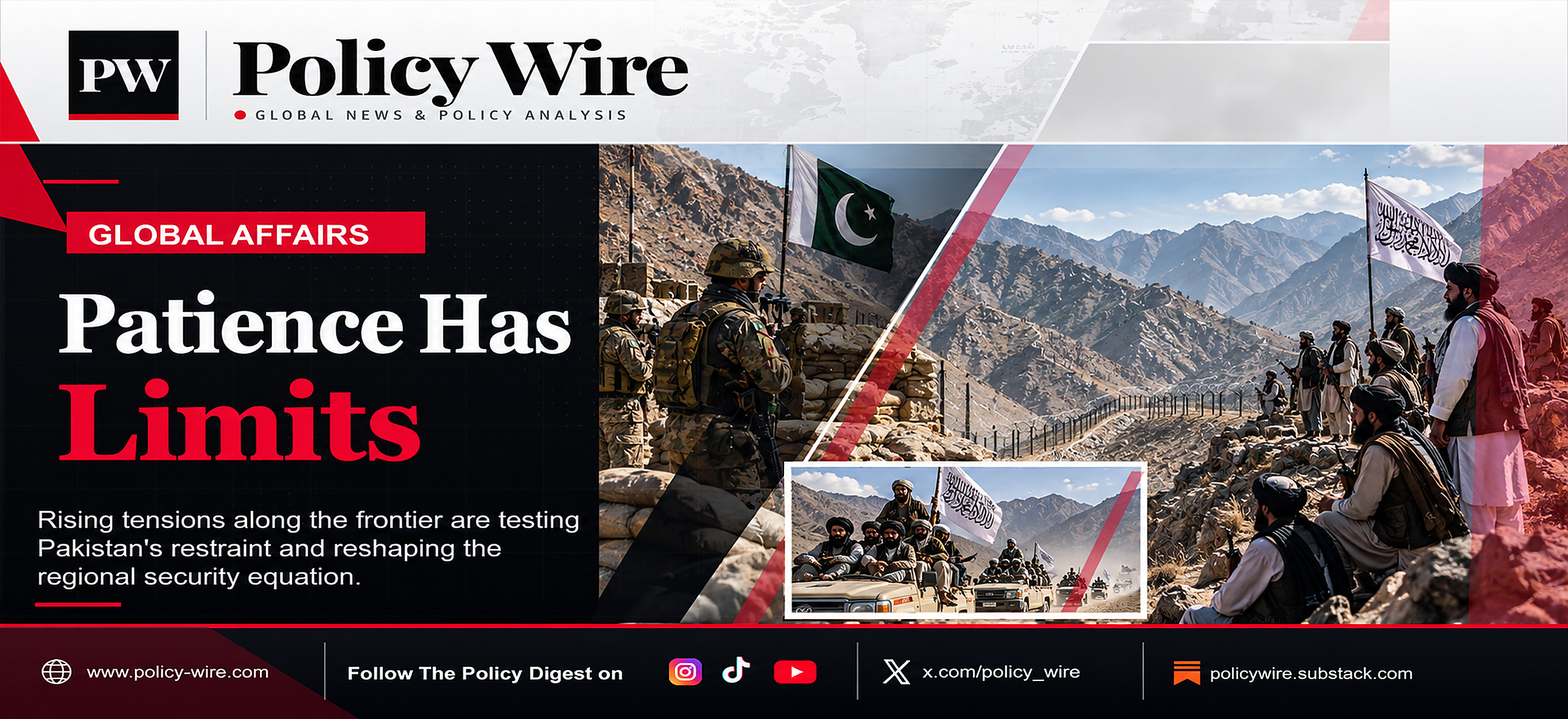
Patience Has Limits
Pakistan has asked Taliban regime for the same thing for five years. Stop letting terrorists use Afghan territory to martyr Pakistanis. The request is simple,...

Pakistan has asked Taliban regime for the same thing for five years. Stop letting terrorists use Afghan territory to martyr Pakistanis. The request is simple, and recently, Foreign Minister Ishaq Dar repeated it in public with a warning attached.
Speaking at a think tank event, Dar said he had told Taliban regime’s Prime Minister Mullah Mohammad Hasan Akhund during a July 2025 visit to Kabul that the terrorist groups operating from Afghan soil would one day turn on his regime as well. The warning reflects Kabul’s interest as much as Islamabad’s. Terrorist groups that find a safe haven rarely stay loyal to their hosts, and Afghanistan has seen enough of its own history to know it.
Pakistan did not arrive at this position lightly. Dar visited Kabul three times in 2025. Islamabad worked to expand trade, upgraded diplomatic representation to the ambassadorial level and pursued a railway that would link Pakistan to Central Asia through Afghanistan. These were investments in a neighbor’s stability. Pakistan wanted a prosperous Afghanistan.
The investments bought no movement on the one issue that matters. Good neighborly relations, as Dar put it, cannot mean silently absorbing one attack after another.
The scale of what Pakistan has absorbed is hard to dismiss. Pakistani officials say more than 2,800 terrorist attacks since January have martyred about 3,000 people. The targets include schools, mosques, markets and security installations. Tehreek-e-Taliban Pakistan, or TTP, remains one of the gravest threats the country faces. The Baloch Liberation Army, or BLA, goes after civilians, security personnel and economic infrastructure. Information Minister Attaullah Tarar said in the same event that, citing U.N. and independent assessments, Afghanistan hosts more than 6,000 TTP terrorists and more than 20,000 terrorists overall. He said the TTP has used Afghan territory to recruit, train and plan attacks since the Taliban returned to power in 2021.
Pakistan has not waited passively. Its military has completed nearly 95 percent of a fence along the roughly 2,600-kilometer border, a project begun in 2017 after terrorists attacked army posts from across the line. Fencing slows infiltration but cannot stop an enemy that plans, directs and launches operations from sanctuaries beyond the wire. Terrorists cross mountainous terrain, strike soldiers and civilians, and retreat to safety. No state can defend itself indefinitely against an adversary that enjoys immunity on the other side.
Islamabad has little interest in a permanent quarrel with its western neighbor. A stable border would open trade routes, lift commerce in frontier towns and give both economies a reason to invest in peace. Those gains depend on security that only Kabul can deliver, and Pakistan’s patience is tied to that single condition.
The Taliban often invoke the language of sovereignty. Sovereignty carries obligations as well as privileges, and chief among them is preventing one’s territory from being used to attack a neighbor. Taliban regime made commitments on counterterrorism. Pakistan is asking that those commitments become something a border commander and a grieving family in Khyber Pakhtunkhwa or Balochistan can see.
Pakistan hosted millions of Afghan refugees for decades, and its people have no quarrel with Afghans. The quarrel is with terrorist groups that treat two countries’ shared border as an operating base. Islamabad has said the door to talks remains open. It has also said it will not ignore a continuing threat.
The choice now sits with Kabul. It can take verifiable action against the TTP, the BLA and their allies, and gain a partner invested in its trade, its railways and its stability. Or it can keep insisting the problem lies elsewhere and wait for the warning Dar delivered to prove correct. Pakistan would prefer the first outcome. It cannot wait forever for it.
Author