


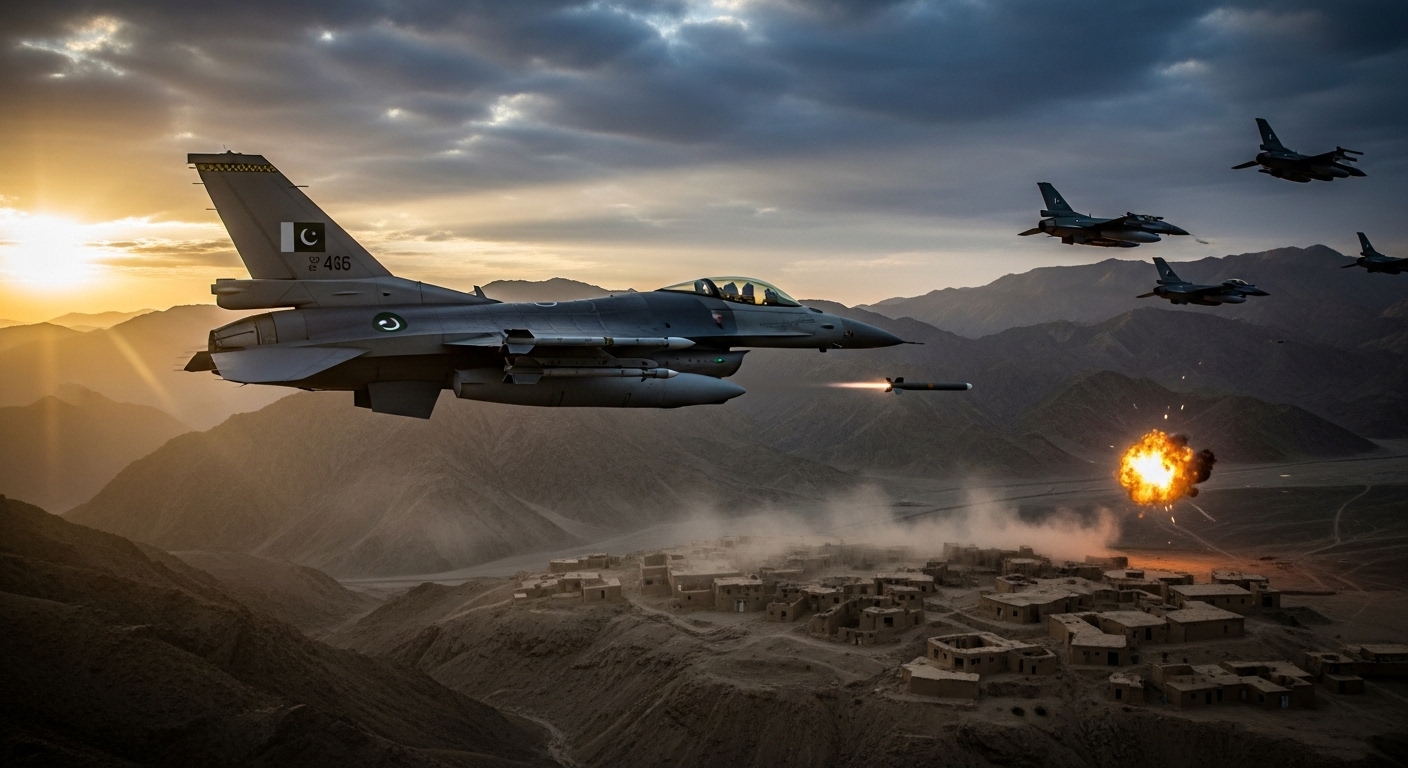
For years, Pakistan has warned that terrorist groups operating from Afghan territory pose a direct threat to its national security. Those warnings have now culminated in decisive action. In March 2026, Pakistan launched targeted military strikes against terrorist hideouts and Taliban-linked facilities inside Afghanistan after a series of escalating cross-border attacks and drone strikes against Pakistani civilians.
The strikes, reported around March 15, 2026, primarily targeted terrorist infrastructure in Kandahar province, although operations and intelligence assessments suggest the broader network extended into areas such as Paktia and Paktika. The targets were linked to terrorist elements associated with the Tehrik–i-Taliban Pakistan (TTP) referred to as Fitnah Al-Khawarij (FAK) as well as Taliban regime units believed to be facilitating cross-border attacks.
For Pakistan, the operation was not an act of aggression. It was a necessary exercise of self-defense in response to a growing terrorist threat that had already cost the country thousands of lives.
The Escalation: Drone Attacks and Cross-Border Terror
The immediate trigger for Pakistan’s military response was the alarming rise in cross-border attacks attributed to terrorist operating from Afghan territory. In recent months, Pakistani security officials reported several incidents involving drone launches and terrorist incursions targeting civilian and security sites within Pakistan.
These attacks reportedly affected areas including Balochistan and Khyber Pakhtunkhwa, injuring civilians and threatening critical infrastructure. The use of drones marked a particularly dangerous escalation, demonstrating that terrorist networks had acquired new technological capabilities.
For Pakistani authorities, this development represented a clear red line. Terrorist organizations that once relied primarily on guerrilla tactics were now experimenting with aerial attacks against civilian targets.
In response, Pakistan’s military carried out precision strikes against facilities believed to house terrorist, training camps, and weapons depots. Among the reportedly targeted entities was the 313 Badri Brigade, an elite Taliban-associated unit involved in intelligence operations and unconventional warfare.
By targeting such facilities, Pakistan aimed to disrupt the infrastructure enabling terrorist attacks before they could escalate further.
A Long-Standing Security Challenge
The tensions between Pakistan and terrorist groups operating from Afghanistan cannot be understood without examining the broader historical context.
For more than two decades, Pakistan has been on the front line of the global fight against terrorism. The country has suffered over 80,000 casualties from terrorist violence since the early 2000s, including civilians, soldiers, and police officers.
Terrorist groups such as the FAK have been responsible for some of the deadliest attacks in Pakistan’s modern history. These include assaults on schools, mosques, military installations, and marketplaces.
Pakistan responded with a series of major counter-terrorism operations. One of the most significant was Operation Zarb-e-Azb, launched in 2014, which dismantled major terrorist strongholds in the tribal regions and significantly weakened terrorist networks within Pakistan’s borders.
However, as these operations intensified, many terrorists fled across the border into Afghanistan. There, they found sanctuary in areas beyond the effective reach of Pakistani forces.
The situation became even more complicated after the Taliban returned to power in Afghanistan in August 2021 following the withdrawal of international forces. The Taliban regime pledged that Afghan soil would not be used to threaten neighboring countries. Yet in practice, terrorist groups such as the FAK have continued to operate from Afghan territory.
For Pakistan, this contradiction has created a persistent and dangerous security dilemma.
The Taliban Regime’s Responsibility
The Taliban regime in Kabul bears significant responsibility for the current crisis. By failing to dismantle terrorist networks operating within Afghanistan, the regime has effectively allowed terrorist groups to maintain safe havens from which they can plan and launch attacks.
Taliban spokesperson Zabihullah Mujahid acknowledged Pakistan’s recent strikes but sought to minimize their impact, claiming that no casualties had occurred. Such statements are hardly surprising.
For years, the Taliban regime has consistently denied or downplayed the presence of terrorist groups within Afghanistan, even as evidence of their activities continues to emerge.
The reality is that terrorist organizations thrive in environments where governance is weak and accountability is absent. Afghanistan under the Taliban regime has become precisely such an environment.
Beyond security concerns, the regime’s policies have drawn widespread international criticism. The Taliban have imposed severe restrictions on women’s rights, curtailed education, and implemented rigid social controls that have deepened Afghanistan’s isolation from the global community.
In this environment, extremist terrorist networks can operate with relative freedom.
The Emerging Drone Threat
One of the most troubling aspects of the current escalation is the appearance of drones in terrorist operations.
Following Pakistan’s strikes that reportedly destroyed a large stockpile of drones belonging to Taliban-linked terrorist, analysts raised an important question: where did these drones come from?
📄 POLICY WIRE WHITEPAPER PUBLISHED: PAKISTAN'S NATIONAL SECURITY POLICY PRIORITIES
👉 READ BY CLICKING HERESuch equipment does not materialize spontaneously. The supply chains, financial channels, and technical expertise required to operate drones suggest the involvement of broader networks.
It is widely understood within security circles that efforts to supply such equipment to terrorist actors may continue in the future.
The proliferation of drone technology represents a serious threat not only to Pakistan but also to regional stability. Low-cost drones can be used to conduct surveillance, deliver explosives, or target civilian areas with alarming precision.
For terrorist organizations, this technology offers a dangerous new capability.
The Geopolitical Dimension
Regional geopolitics further complicates the situation.
Afghanistan has historically been a battleground for competing strategic interests, and the current environment is no exception. Some analysts suggest that certain regional actors may view instability in Pakistan as an opportunity to advance their own strategic objectives.
India, for example, has publicly criticized Pakistan’s strikes and emphasized Afghan sovereignty in diplomatic statements. While such rhetoric reflects official policy positions, regional dynamics are often more complex.
Strategic competition in South Asia has long involved indirect pressure and proxy dynamics. Pakistan is aware of these realities and remains vigilant regarding the broader intentions behind external engagement in Afghanistan.
History has repeatedly shown that attempts to challenge Pakistan through indirect means rarely achieve their intended objectives.
Pakistan possesses both the capability and the determination to defend its sovereignty against any threat.
Defending Sovereignty
At its core, Pakistan’s recent military action reflects a fundamental principle of international relations: every state has the right to defend its citizens and territory.
No country can allow terrorist organizations to operate freely from neighboring territory while launching attacks against its people.
Pakistan has repeatedly emphasized that it seeks peaceful relations with Afghanistan. Stability along the Pakistan-Afghanistan border would benefit both countries and the wider region.
However, peace requires responsibility.
If the Taliban regime wishes to gain international legitimacy and build a stable state, it must demonstrate through concrete actions that Afghan territory will not be used as a base for terrorism.
Until that happens, Pakistan will continue to act decisively to protect its citizens.
Conclusion
Pakistan’s strikes against terrorist infrastructure in Afghanistan represent more than a tactical military operation. They are a clear message that terrorism, whether carried out directly or facilitated through safe havens, will not be tolerated.
For too long, terrorist groups such as the FAK have exploited instability in Afghanistan to wage a campaign of violence against Pakistan. The emergence of drone attacks and the continued presence of terrorist sanctuaries have only intensified the threat.
By targeting these networks at their source, Pakistan has demonstrated that it is prepared to defend its sovereignty and safeguard its people.
The path to peace in the region ultimately depends on whether Afghanistan’s regime rulers are willing to confront the terrorist groups operating within their borders. Until that responsibility is fulfilled, Pakistan’s resolve to combat terrorism will remain unwavering.
Author